
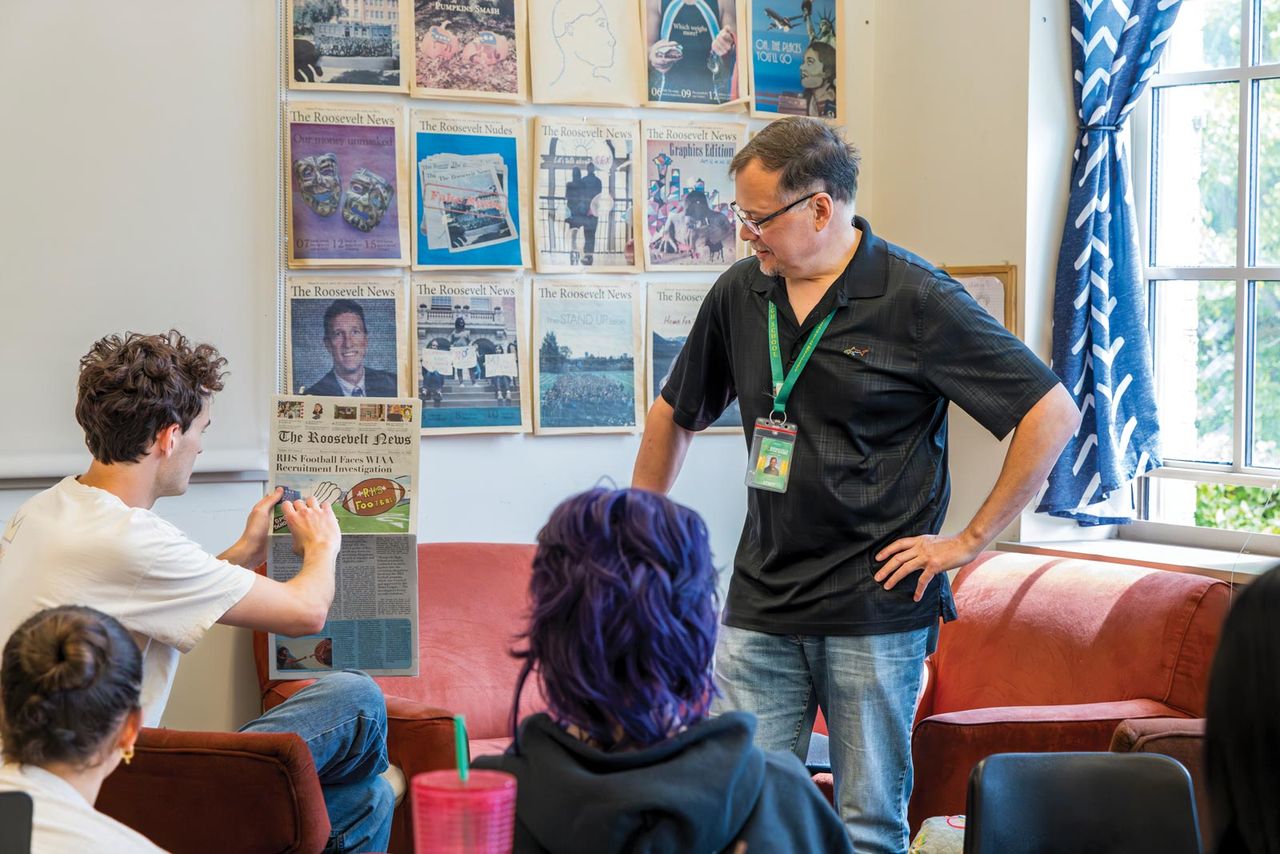
Remember your high school newspaper’s gossip-filled pages and the yearbook staff’s valiant effort to include at least one photo of every student in addition to their mugshot?
Yearbooks and student journalism have changed in the years since then.
While many of us bemoan the crumbling state of American journalism, student reporters and editors today aim for the highest journalistic standards. At Washington schools today, students are producing print and broadcast media that more closely mirror professional media than did the basic sports and activities coverage of yesteryear.
Consider the front page of the April 29, 2025 issue of “The Roosevelt News,” including stories about ICE deportations and chemicals in food. Turn the pages of this student paper (in print for more than 100 years) and you’ll read an article about school funding under threat from the Trump administration, a column about whether celebrities should speak up in politics, a debate over whether college is worth pursuing, and a discussion about trans athletes.
Engaged students, real journalism
Students across Washington are engaged in the political discourse of the day and actively participating in debates on controversial topics. While parents may wish they could protect kids from the news for a few more years, students stress that it’s too late: They lived through the pandemic, witnessed the past few elections, and live on social media. Their eyes are wide open.
On a recent visit to Roosevelt High School, I expected to be giving the newspaper and yearbook students a pep talk about being brave and covering issues their classmates were passionate about – from the war in Gaza to the actions of the Trump administration.
No pep talk was required.
“With all the news happening, it’s important to cover it all so then we can remember,” said sophomore Gus Self.
Classmate Charlotte Louvier, a senior who worked on the yearbook’s 2024 election spread, said student staff did their best to capture a variety of opinions, even though Roosevelt is a mostly liberal school in a decidedly blue neighborhood and city.
“A lot of people are scared to speak about their political views if they disagree with the majority,” Louvier said.
News by the numbers
Washington has at least 24 student newspapers at public and private high schools, plus four in the middle grades – College Place Middle School in Lynnwood, Washington Middle School in Olympia, Nisqually Middle School in Lacey and Snoqualmie Middle School. Students at other schools publish less formal or regular papers, including Talbot Hill Elementary in Renton. Some schools also have TV and radio stations.
Washington student journalists have had more freedom to express themselves since 2018 when the legislature passed the New Voices Act. After a 1988 U.S. Supreme Court decision curtailing student press freedom, the Washington Legislature handed back their First Amendment rights by making students and not the administration responsible for what is published in school media.
Taking their responsibility seriously
Charlotte Swapp, another Roosevelt senior, demonstrated how the law has given students both freedom and responsibility. She recalled a decision students had to make regarding publishing a controversial comment about what students planned to do after turning 18. One student replied that they planned to be in a three-person relationship.
Because yearbooks last forever and are often seen by readers outside of school – including parents – the students decided they didn’t want one controversial comment to draw attention away from the interesting and impactful stories in the rest of the yearbook. They did some soul searching, debated the pros and cons and even consulted the principal before deciding to pull it.
Swapp said they decided to take a more careful approach on this relatively innocuous part of the 2024-25 yearbook to make “space” for their election coverage and other potentially controversial sections, including pages on the war in Gaza and Luigi Mangione, the young man accused of killing UnitedHealthcare CEO Brian Thompson.
Kathy Schrier, executive director of the Washington Journalism Education Association (WJEA), noted that enlightened administrators understand that student journalism enhances the student learning experience. There are principals who believe students shouldn’t write or broadcast about certain issues, Schrier said. WJEA aims to move them out of that mindset while providing training for newspaper and yearbook advisers and their staff.
She stresses that student journalists gain skills in communications, writing, design and photography, while also building civic engagement skills. “There’s this one room in their building where democracy is actually happening,” Schrier said.
Complaints will happen
Anne Hayman, who is a journalism adviser at Arlington High School as well as an officer of the WJEA, advises parents to first talk to their kids when they have concerns about student publications, then to the program adviser before knocking on the principal’s door. (The principal will likely refer them back to the newspaper staff.)
Even when complaints end up in court, the New Voices law means students will likely be the ones testifying about how they reported and wrote their story. About a decade ago, when Roosevelt students defended a story in court, the judge decided they were just doing their journalism jobs.
Hayman believes the New Voices law brings journalism ethics rules to life: “When you treat them like professional journalists, they are more likely to behave as such.”
Legal aid on the rise
Washington is one of 18 states with New Voices laws protecting student journalism from administrative censorship. Mike Hiestand, senior legal counsel with the national Student Press Law Center and a resident of Ferndale, says the New Voices laws have helped revitalize student journalism programs.
Hiestand says calls for legal help have been on the rise in the past few years, perhaps because the issues students are tackling are increasingly controversial.
“Because the biggest issues of the day are pr [public relations] unfriendly, the principal is going to field some phone calls,” Hiestand said.
News deserts—communities with limited access to credible and comprehensive local news and information—are another reason students are tackling big stories they may have ignored in the past. “High school students are kind of picking up the slack, filling in the gaps,” Hiestand said.
He encourages parents to read student papers. He offers one caveat, however: Recognize you’re not reading The Seattle Times; this is student journalism. Students do amazing work, but they also make mistakes.
Mistakes are part of the learning.


