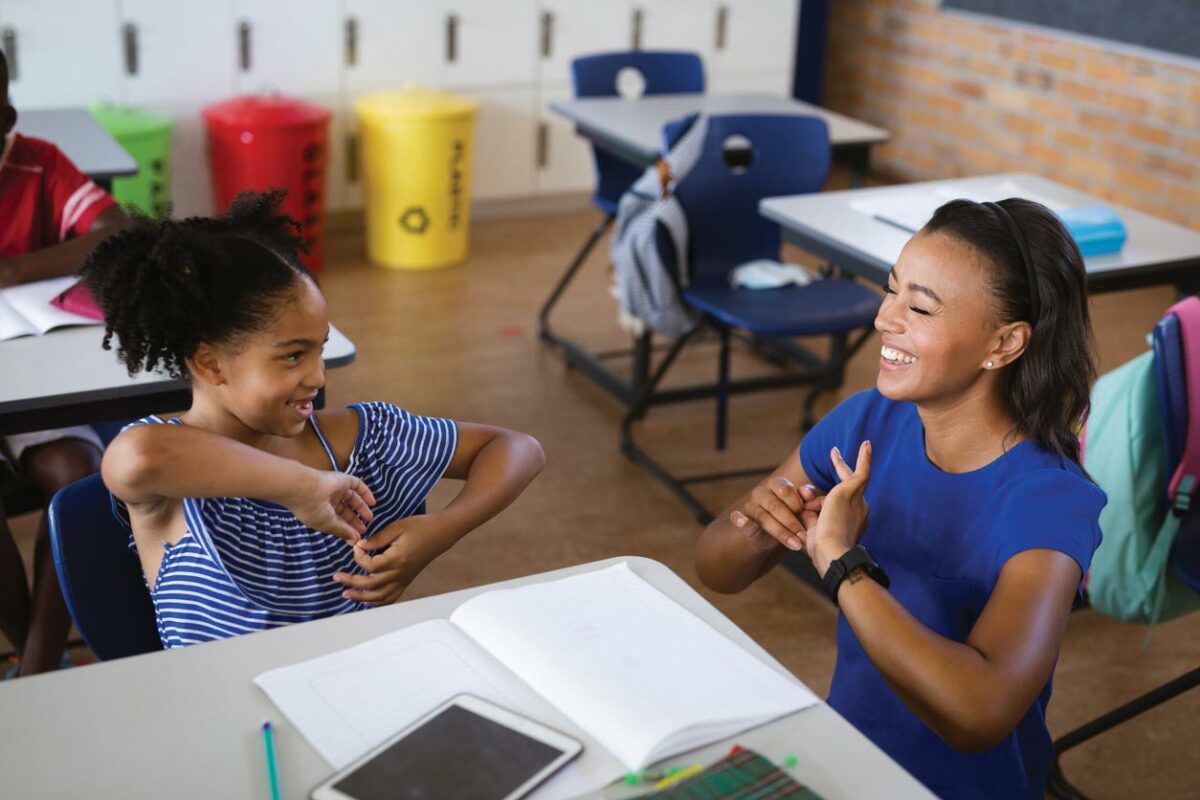
Laura Gramer, a Seattle-based mother of two deaf children in sixth and ninth grades, remembers when her oldest son, a fifth grader at the time, began the school year without a sign language interpreter. He was attending TOPS K-8, one of two schools — the other being Roosevelt High School — in Seattle Public Schools (SPS) with a self-contained program for students who are deaf or hard of hearing (DHH). A statewide shortage of American Sign Language interpreters meant Gramer’s son went without an interpreter for most of the year.
Gramer, who also is deaf, told the school they needed to find one. In subsequent years, Gramer says, “They had to find one from out of state and fly them in.”
The interpreter shortage is still impacting DHH students and family members who need American Sign Language (ASL) support. A child or parent who is deaf has the right to a district-provided interpreter at extracurricular activities, school events, and parent-teacher conferences.
The issue made news earlier this year when the Seattle School Board failed to secure an interpreter for an important public hearing, leaving some parents unable to participate. Deaf parents have had to rely on spouses for parent-teacher conferences and parents say requests for
interpreters at school events like concerts and plays often aren’t met. While it’s hard to pin down how many SPS parents rely on ASL, there are approximately 180,000 DHH adults living in the Greater Seattle area. After the May kerfuffle, SPS Board President Gina Topp apologized to the DHH community:
“We understand this is not just a single incident, but part of a longer history in Seattle Public Schools where decision making has been
inaccessible to the DHH community,” Topp wrote.
Statewide, 1,310 DHH students were enrolled in school during the 2022-23 school year. According to Ann Curry, Student Support Services Supervisor for SPS’ Special Education Program, SPS has more than 420 students with diagnosed hearing impairment, ranging from minimal loss to deafness. Approximately 10% of these students use sign language. According to the National Institute on Deafness and Other Communication Disorders, about 10% of DHH kids have at least one parent who is also deaf or hard of hearing. Some students have a hearing impairment combined with other disabilities.
“Our job as educators and evaluators is to determine what is the diagnosis of a disability that needs the fastest and most support so that we can remediate any loss of time of learning and access to language,” says Curry. Classroom support may include captioning, sign language interpretation, or assistive listening devices.
The district also prioritizes the family’s language modality, whether signed or spoken language. If an interpreter is needed, Curry will try to
match the student with someone for the entire school year. However, as with all school positions, interpreters may call in sick or need time
off, leaving schools scrambling to find replacements.
The challenge isn’t unique to SPS. Curry hears the same woes from DHH program leaders in Tacoma, Puyallup, Edmonds, and other districts.
“All of us are arm wrestling for the same interpreters,” Curry says. “I have to put in my request for students now, two months before [school] starts.”
Gramer says school interpreters really need an educational interpreting background.
“There were three deaf boys, including my son, and the interpreter was interpreting really fast because he’s trying to keep up with the teacher. School interpreters with an educational background know they need to look at the kid for cues, because sometimes kids don’t know how to self-advocate yet with a stranger.”
Diana Fitzgerald, a Tacoma mom of an eighth grader and a high school junior who rely on ASL interpreters, wants Tacoma School District to hire highly qualified, competitively paid, on-staff interpreters rather than contract workers.
That may be tough to do, given the current shortage. Right now, Spokane Falls Community College is the only interpreter training program in the state. Additional programs are needed, “plus more sign language programs in our schools to inspire kids to go into that field,” Curry said. “We’re trying to create the infrastructure to feed the pipeline, but it is a slow iceberg to move.”
Meanwhile, advocates continue to push initiatives to better serve DHH families. In July, a new state law kicked in, tightening the qualifications and standards for ASL interpreters in public schools. SPS has also implemented a policy giving enrollment priority at TOPS K-8 and Roosevelt High to families whose home language is ASL, and not just to DHH students.
“The ability to enroll as a convenience for parents who are deaf or hard of hearing [and have hearing kids] is very new,” said Curry. “The ink isn’t even dry yet. This is a big movement for Seattle to make this inclusive decision.