Being a parent is nonstop hard work, making it challenging to stay on top of news that impacts families in Washington state. Below are highlights and commentary on key policy updates and headlines from the week of Nov. 24-30.
Ask Seattle School Board members questions
There are significant changes afoot in Seattle Public Schools, and Dec. 8 is your day to hear Seattle School Board members’ responses to questions about them. In November, The Seattle Times’ Education Lab asked readers to submit questions. The Ed Lab Live webinar with the board’s new and returning members will be guided by those questions.
What kinds of questions are on the docket? Here’s one: “What efforts will you make in collaboration with our new superintendent to expand access to Dual Language Immersion programs within Seattle Public Schools?”
The event will take place Dec. 8, from 6:30 to 7:30 p.m. Be sure to register for the hour-long Zoom webinar. Read more about The Seattle Times event.
Sen. Murray slams admin for dismantling DOE
When U.S. Senator Patty Murray (D-Bothell) met with local education leaders last week in Seattle, she blasted the Trump administration and the continued dismantling of the county’s Department of Education (DOE).
“Donald Trump and Linda McMahon are lawlessly trying to fulfill Project 2025’s goal to abolish the Department of Education and pull the rug out from students in every part of the country,” Murray said in a statement. “Instead of seeking congressional approval of their reckless actions to weaken our education system, Trump and McMahon are now pretending that our laws and the constitutional separation of powers are a mere suggestion.”
Murray’s comments came in response to the administration’s announcement that all education grants — including the county’s Title I program — will now be overseen by the Labor Department rather than the DOE. Further, according to the announcement, the department’s Office of Elementary and Secondary Education and Office of Postsecondary Education will be outsourced. They are the DOE’s two most extensive programs.
Murray, who is vice chair of the Senate Appropriations Committee and a senior member and former chair of the Senate Committee on Health, Education, Labor, and Pensions (HELP), called the administration’s actions “an outright illegal effort to continue dismantling the Department of Education, and it is students and families who will suffer the consequences as key programs that help students learn to read or that strengthen ties between schools and families are spun off to agencies with little to no relevant expertise and are gravely weakened—or even completely broken—in the process.”
A former preschool teacher and school board member, Murray added: “This isn’t a plan to improve outcomes; it’s a plan to abandon students and families, rip away resources and support, and leave kids who are simply looking to get a good education to fend for themselves.” Read more about the gathering of educators in Seattle in The Seattle Times.
Take Action: Congress holds the sole authority to prevent the dismantling of the U.S. Department of Education because the agency was established by an Act of Congress and cannot be abolished by an executive order alone. Call your congressional representatives and tell them your position on the future of the DOE; find your representative at congress.gov
WA’s plan to transform mental health services
It’s been years in the making, including reaching the low point of ranking 48th in the country for youth mental health, but Washington state has finally released the Washington Thriving Strategic Plan. The plan is a roadmap for transforming the state’s behavioral health services for kids and youth, young adults, and pregnant people. The behavioral health arena includes services to support mental health, recover from substance use, and address other life stressors.
The plan aims to ensure that every Washingtonian, from birth to age 25, has access to a high-quality, coordinated system of care. And last week, Governor Bob Ferguson made clear he’s on board with the plan.
“In Washington, we have dedicated behavioral health providers, investment at the state level, and communities’ commitment to supporting our children, yet we rank 48th for youth well-being,” Governor Ferguson said. “That is unacceptable. Washington Thriving’s strategic plan lays out a new approach. I look forward to working with legislative partners to identify the first steps toward realizing Washington Thriving’s ambitious vision.”
According to state data, only 52% of Washington youth and young adults on Medicaid who need mental health treatment currently receive it. Each year, more than 2,500 young people experience their first episode of psychosis, yet 80% cannot access specialized care.
“Parents shouldn’t have to become experts in navigating multiple agencies just to get their child support,” said Representative Lisa Callan, co-chair of Washington Thriving. “Right now, families retell their most traumatic stories to agency after agency, wait months for appointments, and watch their children’s problems get worse while they’re stuck on waitlists. We have a moral obligation to do better, and this plan shows us how.”
The Washington Thriving Strategic Plan is a framework that would guide the state’s investment, policy development, and coordinated action. The directive to develop the plan came from the state legislature and will be returned to lawmakers for approval during the 2026 legislative session, which begins Jan. 12, 2026.
League of Education Voters webinar
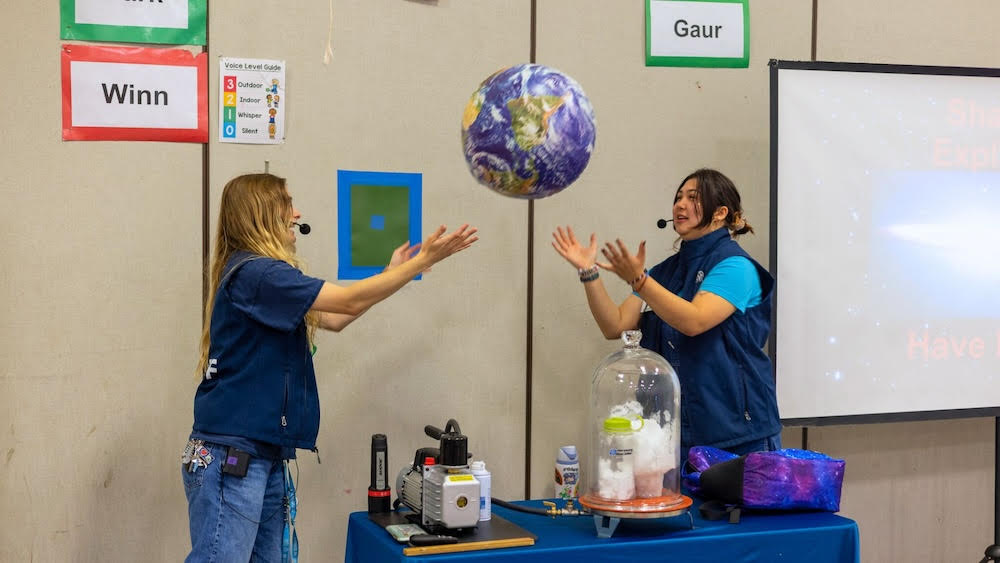
Pacific Science Center’s popular education outreach program, Science on Wheels, has become Washington’s largest provider of outreach science education, according to the Seattle-based nonprofit League of Education Voters (LEV). On the road since 1974, the program has delivered interactive, standards-based STEM programming to kids across Washington, including 116,000 learners across 48 legislative districts last year. The vast majority of programs cost little or nothing for low-income schools and community centers.
On December 11, LEV will host the free webinar “Bridging the STEM Gap: How Science on Wheels Drives Hands-on Science Learning Across Washington” to look at how investments in programs like Science on Wheels can help improve this painful statistic:
Only 55% of Washington students are currently meeting standards on the Washington Comprehensive Assessment of Science (WCAS).

(Image courtesy PacSci)
“It’s more important than ever to invest in science education,” Arik Korman, the League’s CEO, said in an email. “In this free webinar, we’ll explore how Science on Wheels is making hands-on science learning accessible, fun, and engaging. Hear from educators who will share how their classrooms benefited from the program, with students actively engaged in scientific practices like experimentation, critical thinking, and deductive reasoning.”
Science on Wheels has an ambitious goal to provide free STEM learning to every K–8 low-income school in Washington. Panelists will discuss how lawmakers’ support during the 2026 legislative session could deliver the programming to more than 52,000 students in 2027.
Take action: Join the online conversation on December 11 at 12:30 p.m. The event is free. Click here to register. If you can’t attend, register to receive an event recording.
Help those in need stand on Solid Ground
It’s been a rough year for many Seattle families who struggle with meeting their kids’ basic needs. As the colder months move in, the nonprofit Solid Ground is urging those with means to step up on behalf of families who have less.
Solid Ground’s new campaign, “Change Begins with Community,” highlights the power of communities to stand up for local families and neighbors faced with rising housing and food costs amid increased tariffs, cuts to social services, and other actions by the federal government. Contributions to the campaign help ensure that families have access to healthy food, secure housing, accessible transportation, and other basic needs.
Through Dec. 31, contributions to the campaign will be matched, doubling the impact (a $10 donation becomes $20 with a matching gift from another donor). “In times like these, sharing your time and resources with your neighbors is not an act of charity, but of resistance,” Shalimar Gonzales, Solid Ground CEO, said in a release. “It is up to every one of us to safeguard the future and well-being of our communities. Read the full story on Seattle’s Child website.
Take action: Donate at any level to the Change Begins with Community campaign. Or, during the holiday season, consider purchasing a gift on a Solid Ground wishlist.
Cost of autism therapy under Medicaid changes
As the parent of an adult child with autism, I understand the fear of losing services that help your child communicate and connect with the world around them. So it was with great interest and a whole lot of compassion that I read an article on Stateline regarding families’ fears that federal Medicaid cuts will cut access to one of the most successful approaches to working with autistic kids: applied behavior analysis, or ABA.
ABA is an evidence-based treatment that improves kids communication and social skills, sharpens memory and focus, and replaces challenging behaviors with positive ones. About 5% of children ages 3 to 17 on public insurance have autism spectrum disorder, compared with 2% of those who have private insurance, according to a CDC survey. Since ABA therapy ranges from 10 to 40 hours per week, it’s expensive.
In 2014, the federal government mandated that all state Medicaid programs must cover comprehensive autism services for children. By 2022, every state Medicaid program covered ABA. However, President Donald Trump’s One Big Beautiful Bill Act calls for more than $900 billion in federal spending cuts over the next ten years. According to the Stateline report, several states are already considering curbing ABA costs by capping therapy hours, tightening provider enrollment rules, reducing reimbursement rates, or changing patient eligibility rules.
While Washington has not announced plans to cap ABA hours covered by the state’s Apple Health (Medicaid) program, parents here remain concerned that the combination of the reimbursement‑rate cuts in Trump’s bill and potential provider withdrawals related to those could still lead to limitations on hours or access challenges for local families.
Autism experts are urging states to plan now for reduced federal Medicaid funding:
“For such a costly and intensive service, the states need to explore how to best reimburse this benefit so that it’s sustainable and promotes quality,” Mariel Fernandez, vice president of government affairs at the Council of Autism Service Providers, told Stateline. “Is [the rate] going to bankrupt Medicaid? Is it going to ensure that people are actually receiving the service?”
State lawmakers will start gathering in Olympia next week for pre-session working committees, where discussion of federal Medicaid cuts is likely to be on the table.
Take action: Call your congressional representatives and ask them to fully fund ABA services for eligible children; find your representative at congress.gov . Contact your state lawmakers and ask them to support legislation ensuring ABA services for kids in need:
- Contact members of the Washington State House of Representatives
- Contact members of the Washington State Senate
A highly educated city
If you’ve got high schoolers at home who are thinking about college, you may want to offer this advice: Get the degree, then take it outside of Seattle.
According to an article this week in The Seattle Times, Seattle now has one of the highest percentages of college graduates among large U.S. cities. That is at a time when college attendance is actually declining across the country. U.S. Census Bureau data from 2024 shows that 70% (about 416,000 of the city’s 595,000 residents ages 25 and up) have a bachelor’s degree or higher.
While living in one of the most educated cities in the country undoubtedly has its benefits, it could also lead to stiffer competition in many professions for young people entering the workforce.
As Seattle Times “FYI Guy” Gene Balk writes: “What that means for the city’s future — its workforce needs, its affordability, and its cultural identity — is a question Seattle might wrestle with in the years ahead.”
The Good Read and View: Meet Jelly
Wonder where your dollars go after you pay the entrance fee at Point Defiance Zoo & Aquarium (PDZA) in Tacoma? Well, some of them get thrown into the ocean.
This week, the zoo’s participation in the global ReShark program saw the first fruits of its efforts: the birth of Jelly, a zebra shark pup. Jelly was conceived by parent sharks Peanut and Butter, who live at PDZA, but hatched in Indonesia.
“We’re celebrating a major global conservation milestone,” said zoo spokesperson Tessa Miller in an email. “Jelly represents a significant step forward for conservation teams working to restore endangered zebra shark populations in their native waters.”
Learn more about PDZA’s work with the shark rewilding effort. Check out Jelly’s first feed video with your kids. WARNING: You may want to turn your volume down before clicking on the video. Jelly’s tank is LOUD: