Being a parent is nonstop hard work, making it challenging to stay on top of news that impacts families in Washington state. This Hits Home is your weekly hit of news, commentary and, occasionally, Op-Eds opinion. Here’s the update from the week of Dec. 28-Jan. 3.
Parental rights & blocking trans athletes initiatives advance
Let’s Go Washington, a conservative political committee, filed signatures for two controversial citizen initiatives this week in Olympia.
The group delivered 416,201 signatures for IL26-001, an initiative that would repeal changes made to the state’s “parents’ bill of rights” last year. The legislation outlines the rights of parents of public school children as well as the rights of children.
They also brought 445,187 signatures for IL26-638, an initiative that would block transgender girls from competing in girls’ sports.
If enough signatures are verified, lawmakers have three options, two of which would send the measures to voters. Read the whole story on the initiatives and their potential impact.
Take action: Feel strongly about parents’ rights or trans girls in public school girls’ sports? Make your voice heard: Contact members of the Washington State House of Representatives and Washington State Senate. Contact Gov. Bob Ferguson’s office.
Somali child care providers receive threats
While Seattle and the state of Washington attempt to move the ball forward on universally affordable child care, President Donald Trump and his administration have made a series of decisions over the past year to roll it back, the latest of which arrived last week. That’s when the administration announced it would freeze the funds it sends to help low-income families pay for child care in every state, following allegations of fraud schemes by Somali providers in Minnesota.
The federal funds — including approximately $200 million in Washington — will be withheld until states provide additional verification and administrative data about their federally funded programs through a review process.
In the meantime, Washington Attorney General Nick Brown’s office has received calls from Somali daycare providers who are being harassed and accused of fraud in this state,” with little to no fact-checking” following the allegations in Minnesota
Brown said in a statement on Friday that his office is working with the state Department of Children, Youth, and Families regarding claims being pushed online and the harassment reported by daycare providers.
“Showing up on someone’s porch, threatening, or harassing them isn’t an investigation. Neither is filming minors who may be in the home,” Brown said. “This is unsafe and potentially dangerous behavior. If you think fraud is happening, there are appropriate measures to report and investigate. Go to DCYF’s website to learn more. And where fraud is substantiated and verified by law enforcement and regulatory agencies, people should be held accountable.”
Take action: If you or a child care provider you know is experiencing threats or harassment, contact local law enforcement or the state’s Hate Crimes & Bias Incident Hotline at 1-855-225-1010 or atg.wa.gov/report-hate.
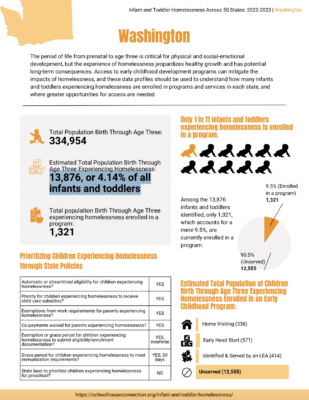
Infant and toddler homelessness data in Washington. CLICK to see report. (Image: Schoolhouseconnection.org)
Impacts of homelessness on children | Op-Ed
The numbers are shocking, or should be. According to a new report released by School House Connection, 13,876 infants and toddlers — 4.14% of all infants and toddlers — in Washington are homeless. Of those, only 1,321 are currently enrolled in early childhood programs like Washington’s Early Childhood Education and Assistance Program (ECEAP).
A strong body of research links quality early learning programs like ECEAP to healthy, longer-term childhood mental, emotional, physical, and academic development while also allowing their parents to pursue financial stability. A wealth of research also shows that not having access to such programs can lead to poor educational outcomes, homelessness, and health issues down the road.
And yet funding for ECEAP was slashed as lawmakers sought to reduce a multi-billion-dollar state budget deficit in 2025. As we head into the start of the 2026 legislative session—and adjust the 2025-27 biennial budget—The Seattle Times editorial board asks a critical question: Does it make sense to cut a program that gives low-income children, including many homeless children and their families, a chance for a healthier, more stable life? The board’s thoughts are well worth a read and consideration.
Read The Seattle Times editorial board’s opinion.
Take action: Do you have thoughts on the continuance of Washington’s Early Childhood Education and Assistance Program? Make your voice heard: Contact members of the Washington State House of Representatives and Washington State Senate. Contact Gov. Bob Ferguson’s office.
From now on, get your ballots in EARLY
The Trump administration has been mounting an attack on mail-in voting since he stepped back into office a year ago, despite research on mail-in voting showing low fraud and high benefit. The benefits (and low fraud) continue to make mail-in voting the law of the land in Washington State.
Every year in my West Seattle community, I get a kick out of watching neighbors rush to mailboxes on Election Day. And on Election Day, numerous democracy enthusiasts hit the streets with signs reminding folks to drop ballots by the 8 p.m. deadline. I admit to many 11th-hour drop-offs, especially when my kids were young. Call it procrastination, simple forgetfulness, or regular parent overwhelm. But an article last week from Washington State Standard sure put a fire under me to get my ballots into the drop boxes or mailboxes a good week or two before any Election Day from now on.
Why? Because the U.S. Postal Service (USPS) announced a new rule last month, which means some ballots stuck in boxes on or near Election Day may not be postmarked by that day (which is required for your vote to count) or on the day it’s dropped off. The new USPS rule took effect on Dec. 24. The postal service says the rule change merely clarifies a policy, despite the long-held understanding by voters and candidates that ballots are postmarked the same day they are received. Washington is one of 14 states and Washington, D.C., where mail sent by voters before the deadline wouldn’t be counted if the post office places a postmark after Election Day.
Why is this a parenting issue? Because your vote counting is your right and the best way to make your voice heard on issues important to your family.
Take action: Get your ballot in any election into the post office early, preferably a week or more before Election Day, to ensure it is counted.

Olympic National Forest and other national forest lands in Washington are protected under the “roadless rule.” (Image: Michael Gäbler)
The “roadless rule”
Some of my happiest moments as a child were driving through national parks with my family, usually on our way to a new military post (dad was in the Air Force). Even though my dad stopped the car and got out whenever a bee got in, leaving the rest of us to fend for ourselves, these trips awed us with the country’s incredible protected lands. I paid these memories forward to my kids as we too explored national forests and canyons.
These lands were protected by the federal government for a reason: so that our kids and their kids and further generations of kids could enjoy them in the midst of an increasingly denatured and industrialized planet.
If President Donald Trump has his way, those protections would be history. He wants to revoke the federal Roadless Area Conservation Rule, which protects national forests — including 2 million acres of old growth in Washington state—from industrial encroachment. The rule generally prohibits new road construction and limits logging, mining, and other industrial development in designated roadless areas.
If your hope for kids includes access to truly wild, protected forests, you may want to better understand the impacts of rescinding this crucial forest protection.
Don’t miss “Target on Tongass,” writer Lynda V. Mapes’ deep dive published in The Seattle Times.
Take action: Do you have thoughts about rescinding the “roadless rule?” Call your congressional representatives. Following what’s happening in Congress, and want to make your voice heard? Find your lawmaker at congress.gov.
New science on autism
If yours is one of the up to 48,000 children in Washington who have been placed somewhere on the autism spectrum, you may have the same big question as my son grew up with: why are his behaviors different from those of other kids on the spectrum?
A new paper from Princeton and the Flatiron Institute, published in Nature Genetics, may have answers. The report outlines four distinct autism types, each one with its own set of genetic traits and behaviors.
The Washington Post summarized the types:
- Broadly affected (about 10%): Kids with marked early developmental delays and significant problems with social interaction, communication, and repetition throughout life.
- Mixed autism with developmental delay (19%): Have early developmental delays but few other behaviors. Later, kids display social or repetitive behaviors, but levels vary dramatically.
- Moderately challenged (about 30%): Developmentally on-track but show social and communication differences and have repetitive habits.
- Social and/or behavioral (about 37%): On-track developmentally, but as they age, are challenged by conditions like depression, ADHD, anxiety, and obsessive-compulsive disorder.
Read the full story at The Washington Post.
Neighbors organize door-to-door outreach after ICE action
Each Sunday, all around Seattle for the past several weeks, immigration activists have been passing out whistles. They are not for play or to lead marching bands. They are to alert neighbors and other citizens that United States Immigration and Customs Enforcement agents are in the area or that agents are taking someone. Three blasts of the whistle are a call to gather, create a loud and large crowd, and pull out your phones to record the agents. One long, moaning whistle serves as a signal that an arrest is underway and is a call to warn others in the vicinity.
The whistles mark the fact that Seattle residents are being taken. A recent video captured on Martin Luther King Jr. Way South shows ICE agents taking someone out of a car right in the middle of the road.
So I wasn’t surprised to read in the South Seattle Emerald that New Holly neighborhood community members went door-to-door last month to share information, “Know Your Rights” flyers, whistles, and otherwise educate residents on how they can legally respond to immigration enforcement if and when they run into ICE agents.
Read the full story in South Seattle Emerald.
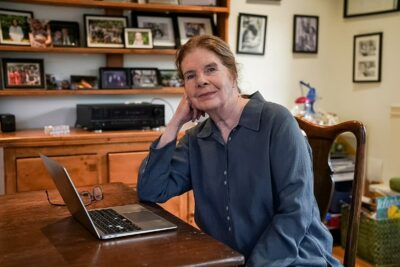
Seattle’s Child Publisher Ann Berman is a Rainmaker (Image: (Photo: Jovelle Tamayo / South Seattle Emerald)
Meet Seattle’s Child’s ‘Rainmaker’
I am not above tooting Seattle’s Child’s horn. The magazine has been published for nearly 47 years now. And that is due in tremendous part to publisher Ann Bergman, who saw the need for a source of reliable information on local parenting issues and kid-friendly activities when her own kids were small and turned it into a reality for all Seattle parents.
Four years ago, Bergman became a “rainmaker” as a monthly contributor to the powerful community-centered non-profit journalism produced by the South Seattle Emerald. Last week, the news organization celebrated her in its Community section Meet-a-Rainmaker series, highlighting that Bergman is not only a rainmaker for fact-based journalism, but also for local kids and parents.
“I wanted to give parents the sense of not being alone and also share all the different ways to raise children,” Bergman told the Emerald. “That there are as many ways to raise kids as there are parents.” Read “Meet Rainmaker Ann Bergman.”
The Good (and Difficult) Read: When terminal illness comes too early
Tatiana Schlossberg’s recent New Yorker essay, highlighted in a year-end reflection by editor David Remnick last week following her death, is a spare and unsparing account of what it means to become seriously ill at the very moment life feels most full. Schlossberg, a journalist and mother of two young children, writes about confronting acute myeloid leukemia shortly after giving birth, describing the collision of new parenthood with fear, uncertainty, and the brutal logistics of cancer treatment.
What makes the essay especially resonant for parents is not just the diagnosis, but the questions it forces into the open: Who cares for your children when you can’t? How do you explain absence, pain, or risk to kids too young to grasp it? Schlossberg also situates her personal story in a larger context, noting how public policy decisions regarding medical research and healthcare funding can shape outcomes for families in ways that seem abstract — until they are not.
In clear, unadorned prose, the essay returns again and again to the same quiet ache: the terror of being forgotten by your children, and the fierce love that persists even in the face of that possibility. For parents, Schlossberg’s story is both unsettling and grounding — a reminder of how fragile the structures we rely on can be, and how profoundly family, care, and community matter when those structures are tested.
It’s a must-read for any parent. Read Schlossberg’s essay “A Battle With My Blood” for free on Slideshare.net.
Take action: Take time now to think through how you would like to handle the questions raised in Schlossberg’s essay and write your thoughts down. If you don’t have a will and a plan for the care of your children in place in case of need, do it now. Check out “Why every parent needs a will.”