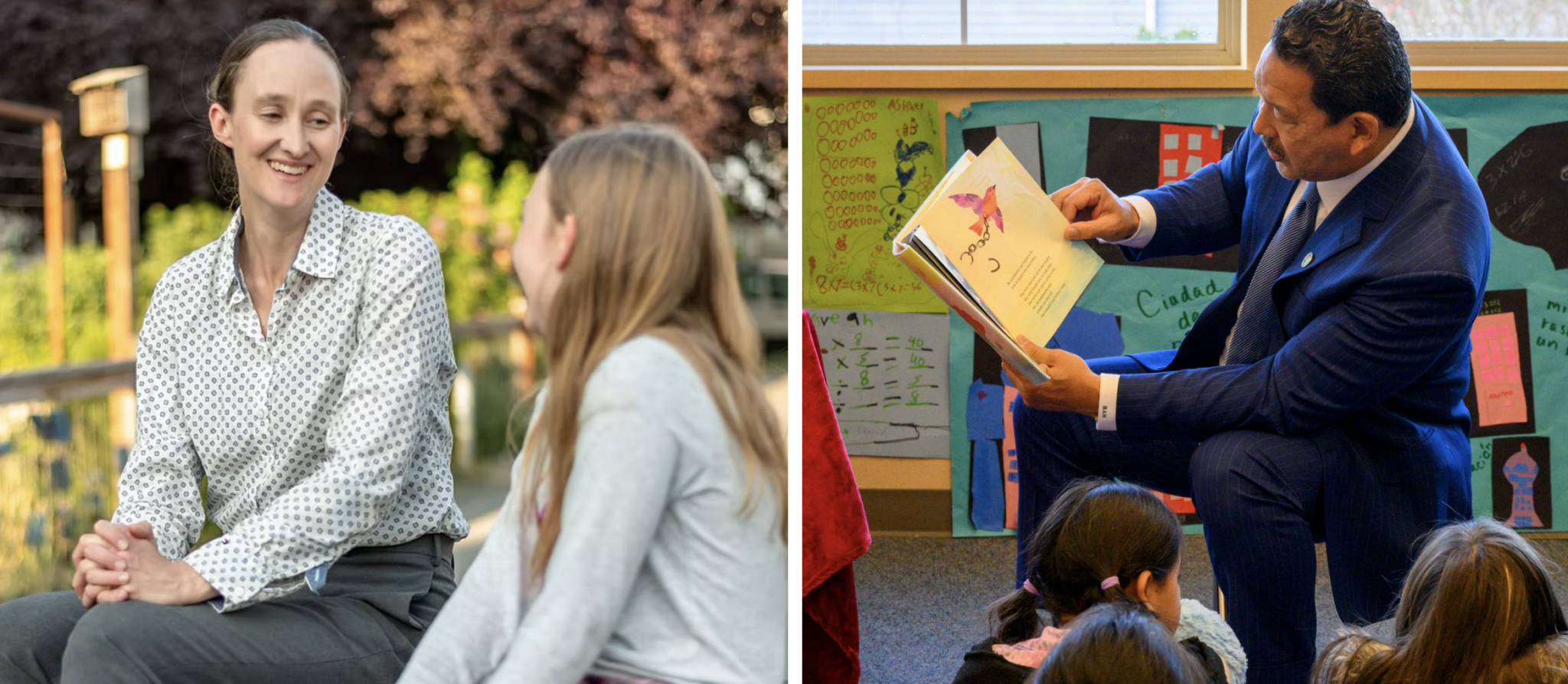
This month, former City of Seattle Mayor Bruce Harrell stepped down from office, and Seattle Mayor Katie Wilson stepped into the City’s top executive role.
During their campaigns for the office, both Harrell and Wilson addressed the City’s child care crisis, calling it a high priority. We asked both leaders to reflect on what’s working and what’s needed to make universally affordable and accessible child care a reality for Seattle working parents.
The following are edited comments from conversations with Seattle’s former mayor and current mayor.
Where are we on the road to universally affordable child care in Seattle?
Former Mayor Bruce Harrell
Harrell firmly believes he has laid the foundation for universal child care in Seattle over the last four years.
Toward that end, Seattle has sent out $16 million in direct payments to child care staff as part of its worker retention program since 2021, including direct payments to 5,000 child care workers in 2025. And in 2024, the City of Seattle made a $5 million one-time local investment in the development of the Rainier Valley Early Learning Campus (RVELC), which will combine high-quality, affordable care for young children with training, support, and professional development for early learning educators when it opens in 2027.
“We have invested in building the next generation of instructors who will be critical to expanding the child care and early learning workforce, he said.
“It’s not going to be solved overnight. There’s no magic pill, so every single week of every year, the question is: what can [we] do to establish one more place, or five more workers? How can we work with the employer community, the philanthropic community, and our existing tax options to keep pushing, pushing the issue? I think we’ve done a pretty good job of that.
Mayor Katie Wilson
Seattle’s new mayor said the City needs to treat child care “as a public good” and make it free or affordable to families. Further, a universally affordable child care system in Seattle needs to “consider the whole arc of childhood, not just the first few years, but also preschool, after-school and summer care, and positive opportunities for older kids to socialize, volunteer, or work outside school hours.”
“Right now there are so many gaps, and when children and families don’t have the support they need, our whole society pays the price,” Wilson said. “Parents are stressed, kids struggle and get into trouble, working families move out of the city because they can’t afford to build a life here.”
Wilson said she understands the child care crisis from experience. “Child care shouldn’t be a luxury, but it’s just so expensive right now – daycare for my daughter costs over $2,000 a month, and that’s totally normal in Seattle. Before I ran for office, my husband and I were juggling our kid back and forth, trying to make it work. Lots of people are in similar situations.”
Wilson said having family members step up to provide child care helps some local families, “but I understand not everyone has that option,” she said. “What that all means is that we’re stuck in a situation where even people making six figures can barely afford to have kids in this city. We need to fix that.”
What are your thoughts on the importance of quality of child care in Seattle?
Harrell: The outgoing Mayor said he believes that quality, not just quantity, in child care and early learning opportunities is critical for healthy child development and the prevention of poor outcomes down the road.
“If we follow the science, we realize that the kind of cognitive development nurturing, nutrition—all of the ingredients —that go into growing a well-developed child are critical and must be extremely intentional,” Harrell said. “Our focus has been on expanding those opportunities to as many families as possible, particularly families with the most need.”
Wilson: Seattle’s new leader said that quality care is an “inextricably linked” experience crucial for the well-being of kids and providers.
“For kids, it means safe and nurturing environments, and developmentally appropriate learning,” Wilson said. “But even though childcare is so expensive for families, the people providing that care are some of the lowest-paid workers in our community—they couldn’t possibly afford to pay the going rates for the child care they provide. Often, they have long commutes into Seattle because they can’t afford to live here, and that contributes to high employee turnover in the child care sector.
“We have to pay people fairly if we’re serious about quality care,” Wilson added. “And that goes back to treating child care as a public good, with appropriate public funding and support.
How do we close the gap between the 27,000 child care slots and the 60,000+ kids who might benefit?
Wilson: The new mayor stresses the City must set the goal of Seattle being a place “where there’s no gap.
“Child care should be universal, just like public schools or clean drinking water,” Wilson said. “Everyone who needs child care should be able to get it, period. We absolutely need to get on a path to provide child care to everyone in our city. New Mexico recently implemented a policy like this, and New York is on the way as well. I can’t promise it’s going to happen immediately here in Seattle, but we need to be thinking bigger than closing this gap – we need to be aiming for universal, affordable child care. That’s the real path to equity and affordability.”
Harrell: The former mayor recognizes the huge gap between the number of Seattle children who need or would benefit from quality child care and the number of affordable licensed care slots available. He believes investing in child care providers and provider training is the most critical part of closing the gap.
Where should the city look to site child care facilities?
Harrell: The two mayors are on the same page when it comes to creating more child care space—including establishing facilities in schools or workplaces where space is available. Harrell hopes the City’s Department of Early Education and Child Care will be given the license to get creative about where to build out old or build new infrastructure to support accessible, affordable child care for all families.
“Where in the entire city can we build childcare and pre-K establishments? Let’s think outside of the box,” Harrell said.
Wilson: The mayor also believes “we should be building child care facilities everywhere that people live and work – essentially, everywhere.
“Ideally, it’s easy to drop your kid off and pick them up every day because there’s high-quality child care available near your home or workplace,” she said. “That means we need to pay attention to the geographic distribution of child care facilities and focus on filling child care ‘deserts’.”
Both the current and former mayor pointed to city buildings, community centers, libraries, work sites, and Seattle Public Schools. Wilson wants the City to encourage or “incentivize” developers to include space for child care in any new buildings.
How should the City fund universally affordable child care?
The current and former mayors agree that City funding is not enough to develop the universally affordable, accessible child care system Seattle parents need.
Wilson: “The City can’t do this alone – and we have to recognize the child care crisis is statewide and nationwide – but we also can’t wait,” Wilson said. “We have to use the resources we have in our city budget to make the greatest impact we can for families, and seek new resources. And beyond subsidies, we need to consider a range of strategies to make it easier to site, start, and operate child care facilities in Seattle.
“The problem isn’t just cost, it’s availability,” she added.
Harrell
The former mayor agreed, adding that the City should push state and federal lawmakers to make child care funding a priority and to find stable long-term funding sources, as was the case in New Mexico.
Do employers and philanthropists have a role in achieving universally affordable child care?
Harrell: “I talk to employers in this region, and they’re trying to attract talent here, and I ask them, ‘If you’re paying a portion of child care, and you have child care built into your facility, might that make the difference between you and another employer?’’
“I think this is a great strategic advantage, competitive advantage, for companies to use,” Harrell said. “And, I think the City’s role can be to help employers come up with creative possibilities.”
Wilson: “Employers should absolutely be part of the solution, because they benefit enormously when their employees have access to reliable child care,” Wilson said. “Some big employers have stepped up in this area, but there’s a lot more that can be done.
Wilson added: “Philanthropy has a role to play, too. Given the cuts to state child care funding last year and the bleak budget forecast looming over this year’s legislative session, I’m glad that the Ballmer Group is stepping up to support Washington’s Early Childhood Education and Assistance Program. But we can’t rely on the generosity of employers and foundations as a replacement for public investment.”
SC: What about the state’s role in achieving universal child care?
Harrell: The former mayor believes Washington’s wealthiest residents need to step up and pay their fair share to make child care affordable to all.
“Without a state income tax, we’re always doing smaller things around the edges,” Harrell said. “From a progressive tax standpoint, we as a city have very limited options. This can’t be solved alone by the City of Seattle.” Currently, Democratic lawmakers in Olympia and Washington Gov. Bob Ferguson are pushing a “millionaire” tax. While it won’t fully fund child care in Seattle, it could move the ball closer to the goal.
Wilson: The mayor stresses that universal access to affordable child care is a local, state, and national problem that needs local, state, and national funding.
“It’s a huge affordability issue for so many people, and I’d love to see action at every level of government to get at solutions,” Wilson said. “But I also don’t think families can afford to wait. The recent moves in New Mexico and New York really show that it’s possible – we can, in fact, make progress on this issue. There’s a lot of work to do, but I’d love to see Seattle become a model, too.”