|
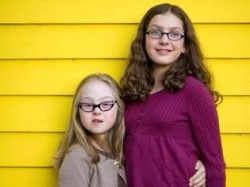
Courtesy of Ron Wurzer Katie Wade, 11, (right), a Sibshops participant, tosses a ball with her 8-year-old sister, Virginia, who has Down syndrome |
Katie Wade says she never quite knows what her little sister Virginia is going to do. During school lunch period, for example, Virginia might finish her lunch and then circle the lunchroom hugging people. "She never tells you – she just does it," Katie says of her sister, who has Down syndrome. "I always go after her and tell her, ‘Virginia, you have to stop that.'"
Katie tries to keep her sense of humor while getting her sister to keep her hugs to herself – even as other kids in the lunchroom urge 8-year-old Virginia to continue spreading the love.
"They don't understand that it's not OK for her to do things like that because she might do it someplace else. They're not helping her," says Katie, 11.
That may be because most kids at Katie's school are unaware of the special joys and challenges of living, loving and sometimes wrangling a sibling with special medical or developmental needs.
Luckily for Katie, there are kids who do know what it's like. Other siblings.
Connecting Sibs Through Fun, Talk and Food
Which is why she wouldn't miss her every-other-month trek to Seattle Children's Hospital and Sibshops, a support program specifically designed to connect, empower, support and educate siblings of children with special needs – whether it's Down syndrome or diabetes, cancer or cystic fibrosis, muscular dystrophy or any number of other conditions.
Seattle-based father support experts Don Meyer and Greg Schell and their colleagues launched Sibshops in the 1980s. Today there are more than 225 Sibshops programs all over the world, including in Japan, Guatemala and Iceland. On its Web site, Seattle Children's sums up Sibshops sessions as "lively, pedal-to-the-metal, award-winning celebrations of the many contributions made by brothers and sisters of kids with special needs.
"They acknowledge that being the brother or sister of a person with special needs is for some a good thing, others a not-so-good thing, and for many, somewhere in between."
Meyer and Schell, pioneers in the father support and extended family support movements, developed Sibshops to fill what they saw as a gaping hole in the special-needs family support network.
"The truth is, anything you can say about what a parent of a special-needs kid experiences, you can pretty much put ditto marks under ‘for his or her sibling,'" says Meyer. "But when you look at the support services parents have access to compared to what's directed specifically at siblings, it's easy to see who's getting the short end of the stick."
Children's offers two Sibshops groups, one for kids ages 6 to 9 and another for those ages 10 to 13. Meyer's organization, the Sibling Support Project, offers families several other options for participating, including programs in Bellevue, Kent, Puyallup, Bothell, Everett and other cities across Washington.
Katie's been going to the Children's sessions for five years now.
"When I go to Sibshops, I feel like I can talk freely about Virginia," Katie says. "I love her, but sometimes I feel she is just embarrassing! I can say that to my friends there because they understand."
The kids who attend Sibshops actually know a lot about each other even before they meet.
Most could tell you about the feeling of triumph that comes from creating a game that brings their sisters or brothers out of the isolation of autism, or makes a sibling confined to a hospital bed smile. Many are aware of the frustration of having siblings throw a fit for no apparent reason or get their way merely because of their disabilities.
"The truth is, Audrey gets her way a lot in the house, and there are different rules for the two girls," says Joy Daniel, whose 8-year-old daughter, Margaux, attends Sibshops. Audrey, 11, is autistic and partially deaf.
"Yeah," says Margaux. "One thing is Audrey get sweets for breakfast sometimes! I never do."
Like Katie, Margaux has felt the stress of embarrassing sibling moments.
"A lot of times when friends come over, my sister takes off all her clothes and lies on the bed," Margaux says. "They think it's funny, but I don't. I cover her up with a blanket."
Siblings of children with chronic medical conditions can experience some pretty heavy anxiety – they might dwell on things like a brother or sister's possible death or long-term physical discomfort. They also commonly feel isolation, stress, jealousy, as well as humor, patience, compassion and immense sibling love – just as their siblings do.
The other common link? Generally speaking, all kids like to have fun – which is why volunteers and facilitators spend a lot of time planning to make the three-hour Sibshops sessions a blast. Their work pays off, according to Katie, Margaux and other participants.
"Sibshops is really, really fun," says Kailana Wang, age 8, whose brother Kaipo, 12, has autism. "And, it helps me to be more open and relaxed. It's good to be with people in similar situations."
There's very little sitting around on folding chairs and talking about your problems in Sibshops. Instead, most sharing and connecting happen during fun, energetic activities and games or around favorite kid food. Human pinball, hug tag, dangling donut eating contests, body surfing, art projects – these workshops are energetic events where the time flies and most kids find it hard to go home. And, yes, there is also ample time for discussion as well.
Throughout it all, trained facilitators expertly create opportunities for kids to talk about their experiences being "sibs" and to offer each other advice for coping with the more challenging aspects of having a brother or sister with a disability. Facilitators will ask helpful leading questions, but when it comes to exploring new ways of coping, it's really the kids themselves who are the experts.
Support for One of Life's Longest Relationships
"We have to remember that the sibling is going to be involved with that child and in his or her life quite possibly longer than anybody, even their mom and dad," Meyer says of the importance of connecting siblings and helping them help each other. "It's important for them to know they aren't alone."
"If you can teach sibs they are not alone, you create the possibility of a much more healthy adult sibling relationship," adds Cathy Harrison, who coordinates Sibshops for Seattle Children's.
The program also helps parents better understand the common experiences and concerns of siblings.
A red flag went up for Melinda Wang when she first heard her daughter, Kailana, wonder aloud what it would be like to have a typical brother. Kailana has a close and loving relationship with her autistic brother, Kaipo. In fact, she says, "enjoying time with him and not paying attention to anything else" is one her favorite activities. But Wang worried that her daughter's curiosity about life without autism might be a sign that she needed more support.
"Kailana is a spectacular sister," Wang says. "But as they get older, I worry some of his social behaviors could get really hard for her. In this program, you don't have to define autism to your friends. I think it's important to her to be able to have a peer group that is her very own, that is unassuming and supportive."
Harrison points out that often siblings feel pulled between extremes – wanting to be the best sibling and wishing their sibling were "normal." They will tell you they feel angry when a sibling breaks a favorite toy and then feel guilty for having felt angry. They are apt to stress they love their brother or sister but hate some of their behaviors – like tantrums.
"When he has melt downs, which don't happen as often, it is challenging in knowing what to do to help him," Kailana says. "It seems like everyone has a different idea."
Smaller children often blame themselves for a sister or brother's disability or fear it will happen them. Older children may start to worry they will have to care for their siblings their whole lives and begin to feel resentful. Sibshops facilitators are quick to affirm feelings and correct misperceptions.
Because You Bring A Lot to the Party
Amy Martin, Katie Wade's mom, is glad that Sibshops is helping Katie to understand that she has her own life to live.
"Older siblings, especially girls, feel very responsible and feel they have to care for their siblings," she says. "We feel that Virginia's long-term care is our responsibility, and we need to be deliberate about passing that message on to Katie. Her job is to grow. We don't ever want her to feel that she needs to plan her life around figuring out how to care for her sister."
If there is one message that the leaders of Sibshops hope participants walk away with, it is just that: Your life is special too.
"You have a right to have things just for you, a right to have a life of your own," Meyer says. "Sibshops isn't for your brother or sister. It's just for you, because we think you bring a lot to the party."
About Seattle Children's Sibshops
Open to siblings of kids with special needs, including diabetes, cancer, cystic fibrosis, muscular dystrophy and heart, kidney, liver, gastrointestinal or lung disease, autism, cerebral palsy, Down syndrome, ADHD, spina bifida and other conditions.
Ages: Two groups are offered, one for children ages 6 to 9, another for kids 10 to 13
Fee: $20 (includes snack)
Location: Sound Café, Seattle Children's Hospital (4800 Sand Point Way N.E., Seattle)
Contact: 206-987-3285; www.seattlechildrens.org/child_health_safety/classes_events/sibshops.asp.
About the Sibling Support Project
Don Meyer, who launched the Sibshops program at Seattle Children's, now helps individuals and organizations develop Sibshops across the globe. His organization, the Sibling Support Project, provides information on programs in Bellevue, Kent, Puyallup, Bothell, Everett and other cities across the state.
To learn more about the Sibling Support Project, "a national effort dedicated to the life-long concerns of brothers and sisters of people who have special health, developmental, or mental health concerns," go to www.siblingsupport.org.
Cheryl Murfin is a Seattle-area freelance writer, communications director for the progressive advocacy group Fuse, and mother of two.