"Hola!" "Kon-nichiwa!" "Ni hao!"
If your child is a student in one of Seattle's international elementary schools, he probably begins the day with one of these "hellos."
In the years since John Stanford International School opened its doors in 2000, demand for international education in Seattle has grown, spurred along by evidence that language learning at an early age has a positive effect on brain development and correlates with higher achievement in other academic areas.
Despite tight budgets, the Seattle School District is trying to respond. This year, the district designated K-12 "feeder pathways" in North, South and West Seattle – linked elementary, middle and high schools – intended to guarantee that students who begin language immersion studies in elementary school get spots in international middle and high schools.
"Today's high school students will graduate into a world vastly different from that of the 20th century," says Vivien Stewart, vice president of the Education Asia Society. "To succeed in this new global age, our students will need a new skill set that goes beyond reading, math and science to include international knowledge and skills." The Seattle School District features Stewart's quote on its website to make the case for its commitment to international schools.
Despite the expansion, demand still far outstrips what's available in Seattle's public schools. Many parents are concerned that their children will not graduate with that "new [international] skill set."
Neighborhood Vs. Option Schools

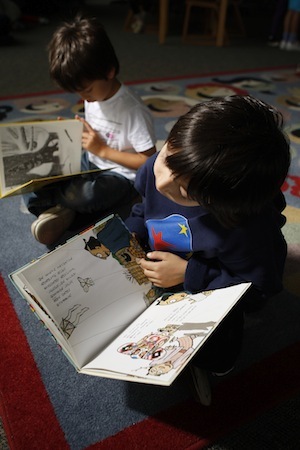
Kevin P. Casey Leo Rosales, left, and Tigran Avakyan, right, are second-graders in the Japanese immersion program at the John Stanford International School. |
Given that language immersion is such a desirable curricular approach, why are the city's international schools neighborhood schools, rather than option schools, to which a larger pool of students could apply? The district's oldest international school, John Stanford in Wallingford, has consistently had one of the longest kindergarten waiting lists in the city (on Sept. 1 it was 37 despite having four kindergarten classes this year). Beacon Hill International School, which became an international school in 2008, had 43 waitlisted kindergartners on Sept. 1.
"The question of neighborhood vs. option schools keeps coming up," says Karen Kodama, the district's much-admired international education administrator and John Stanford's founding former principal. As neighborhood schools, access to a broader diversity of students is really limited, she notes, especially at the North end's John Stanford and McDonald Elementary schools.
At Beacon Hill and Concord International School in South Park, however, many of the students speak English as a second language, and the language immersion programs there allow students to become proficient in both their native language and in English. Both schools serve extremely diverse student populations: children whose families are new immigrants to the U.S., children living in poverty, children with a wide range of racial and ethnic backgrounds. Making Beacon Hill and Concord option schools would exclude some neighborhood kids, who have the most to gain from the global curriculum.
As the district was developing its New Student Assignment Plan (NSAP), a group of international school principals proposed several options: making some international schools option schools and others neighborhood schools (but the district said they should all be the same), and drawing smaller neighborhood boundaries around the international elementary schools, so that a percentage of the seats would be left for students outside the boundary. This option could have been especially effective at Beacon Hill and Concord, says Kodama, as both schools wanted to increase the number of English speakers to ensure they had a 50/50 model (50 percent native/heritage speakers and 50 percent English speakers), especially in their Spanish immersion programs.
Kodama says misunderstandings between the district and the international school principals kept this idea from happening; where the principals thought such an option could take effect with the unveiling of the New Student Assignment Plan in 2010, the district was looking at 2015. "We can't make the current NSAP retroactive," says Kodama, "but as we expand and add more international schools into the future, we'll continue to look at this question."
For now, Kodama and the district are addressing the need for more language and global education opportunities for students by committing to K-12 pathways, as they've done this year. Though some schools have yet to be designated, eventually North, South, and West Seattle will each have two international elementary schools, one international middle school, and one international high school.
Different Schools, Different Approaches
There are a wide variety of approaches among the city's international schools. To receive an international school designation, schools must offer advanced language programs as well as a comprehensive global curriculum to all students, whether they are participating in language immersion or not. Cross-cultural offerings in music, social studies, science, technology and art, among other subject areas, are central to the curriculum. So is ongoing professional development for principals and staff. Denny International Middle School and Chief Sealth International High School, both serving extremely diverse student populations in West Seattle, have seen marked school-wide improvements since instituting their rigorous international programs.
Language immersion has its drawbacks. It can be extremely exhausting for young kids, and language skills come more easily to some students than others. Many parents find it takes their children much longer to reach grade-level proficiency in English language reading and writing skills. Also, students with learning challenges or other special needs don't tend to fare well. Nevertheless, there's no question that teaching for global citizenry benefits all children.
"I'm really excited by the district's focus on the various components of international education, not just on language," says Sarah Heller McFarlane, whose daughters went through the Japanese program at John Stanford and are now respectively a sixth grader at Hamilton International and a ninth grader at Ingraham. "It's such a natural way to build in rigor and to welcome everyone."
Beyond Seattle
Other school districts are similarly trying to fill the demand for international education, though each district approaches it differently.
In Bellevue, Puesta del Sol Elementary has been offering Spanish immersion since 1986. Kindergarten admission is by lottery and open to anyone living in Bellevue (on average, the waiting list runs about 60 students long). Students at Puesta del Sol study in Spanish full-time until third grade, when English is introduced for an hour a day. Students from Puesta del Sol go on to Tillicum Middle School and Newport High School, where they can graduate with an advanced international diploma.
Another public school option in Bellevue is the International School (grades six-12), where students are immersed in a globally-focused curriculum and study French or German for seven years.
In the Lake Washington School District, the International Community School in Kirkland (grades seven-12) offers a rigorous integrated curriculum that includes six years of Spanish and a year of study focused on Asia. Enrollment is by lottery.
As for Seattle, while the eventual expansion of international programs remains a priority, recent and anticipated budget cuts mean that some of the districtls plans are on hold.
Laura Hirschfield is a freelance writer and a mother living in Seattle. She has written articles on education for Parenting Magazine, elementary school curricula for McGraw-Hill, and fairy tales for astorybeforebed.com.