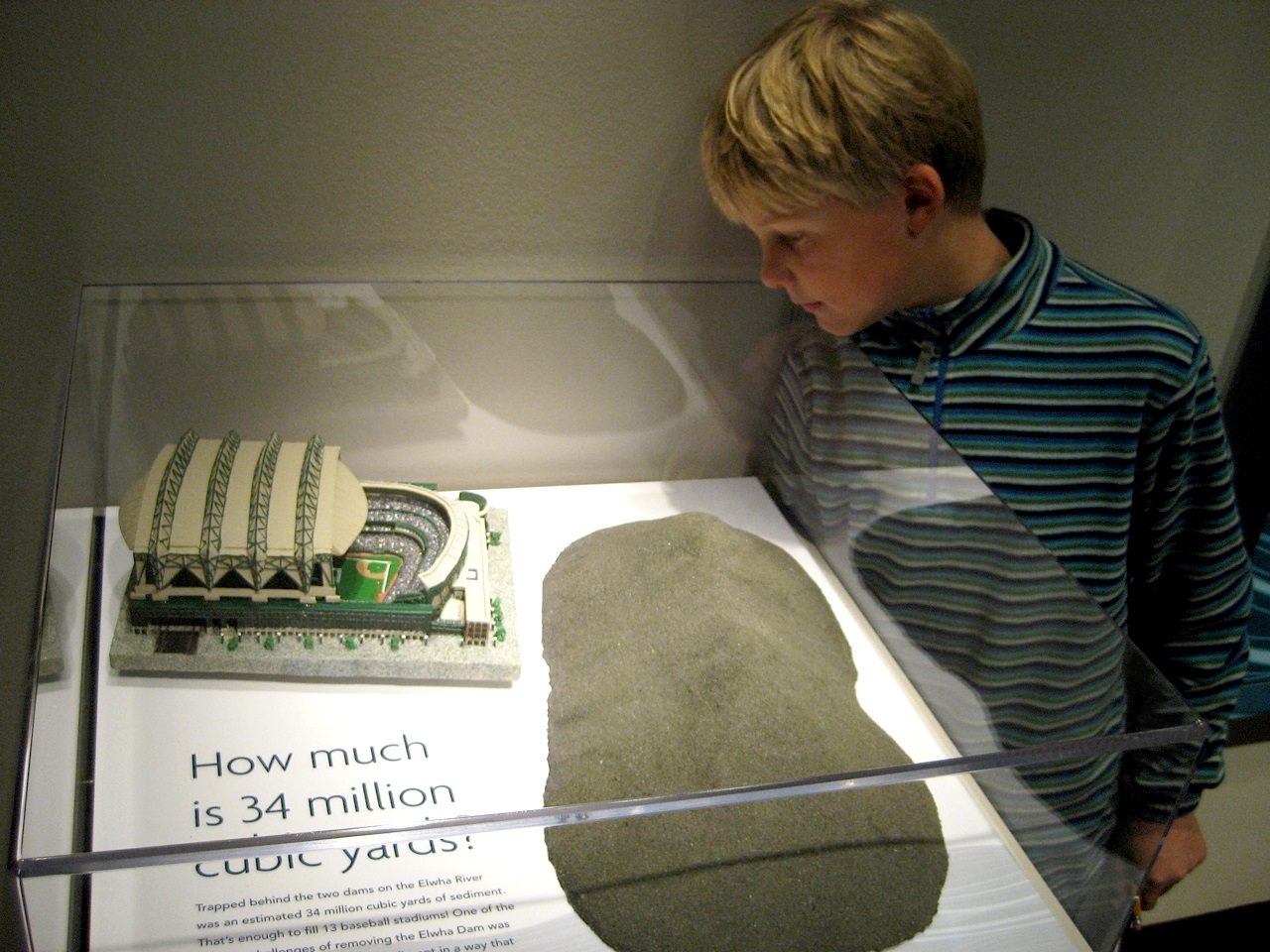
"The salmon are returning to the same spot after 100 years. It seems impossible to restore everything, but they are!" marvels my 9-year-old as we explored the new "Elwha: A River Reborn" exhibit at the Burke Museum.
More than just an exhibit of historical photos and artifacts, Elwha sparks emotions of hope, loss and wonder. It launches conversations about values, our environment and the future. It tells the story of the Elwha River, a 45-mile-long river that flows from the Olympic Mountains to the Strait of Juan de Fuca. It tells of the 390,000 salmon and trout that returned from the ocean to spawn there every year before the dam was built. And it tells of the Klallam tribal community that lived alongside of them.
Once inside the exhibit, sounds from the Elwha surround you as lights mimicking the blue waters of the river reflect on the rocks in the floor. It is a beautifully designed exhibit that evokes a sense of calm, even for younger children.
One of the first artifacts you encounter is a piece of a basket, radiocarbon dated to 2,800 years old. Other artifacts include an ancient harpoon and a one-million-year-old salmon fossil, which made my son feel "very, very young." This connection to the past, present and future is what makes "Elwha" an educational family adventure.
As you move through the "Dam Building" section of "Elwha," there may be a lot of questions from children wanting to know why anyone would want to stop the flow of this beautiful river. This is a great opportunity for a discussion of values. In 1894, when Thomas Aldwell came up with the idea to build a dam, he had the good intention of helping his Port Angeles community to grow and prosper. His idea was in turn devastating to the Klallam people, and to the environment. However, many people took pride in the dam and its accomplishments.
"Camp Elwha" is an exhibit designed for the youngest visitors, but has something for everyone. Parents may want to take turns staying with the kids in Camp Elwha, allowing one adult time to freely explore and read through the rest of the "Elwha" exhibit. It features a life-size scientific field camp, complete with microscopes and specimens to view. Children may dress up and play in a tent with a toy cook stove and tools. We played with a clever wooden Keystone puzzle that demonstrated the ecological balance of the Elwha habitat.
There were opportunities for scavenger hunts and scientific drawing instructions. Cases filled with animal specimens gave me the creeps, but will fascinate the young scientist. There are preserved shrews, a lamprey in a jar, a duck and many others that you have to see for yourself. If you visit on a weekend, a museum educator and volunteers are available for questions. They lead activities for children and bring out some of these specimens for you to touch and examine.
A quiet spot with four benches surrounding the "river" of blue lights was a good place for a break. We were silent in thought for a few moments, listening to distant thunder, a woodpecker and the river seeming to flow all around us.
Soon we were on to the "Renewal" section, with hope for the future. My son was drawn to a video that showed scientists releasing native salmon into the water. We were impressed with photographs of seedlings and piles of painted rocks, tagged for study by scientists.
We were privileged to view an exhibit of sacred story stones from a Klallam village and burial grounds, recently uncovered.
My son and I stood shoulder to shoulder, with our papers and pens, taking notes. My heart swelled as I observed my young journalist. He used our visit to the museum as an extra credit research assignment for school. This is a great way to explore the "Elwha" exhibit with older children.
When so much of what we see now are stories of trees being cut down, and housing developments replacing native species' habitats, it is inspiring for children to see this exhibit of a restored river running freely again, in its intended path.
IF YOU GO
Where: Burke Museum, University of Washington campus, on the corner of Northeast 45th Street and 17th Avenue Northeast in Seattle.
When: Now through March 9. Open daily, 10 a.m. to 5 p.m.; first Thursday of the month, open to 8 p.m.
Cost: Adults $10, seniors $8, students (with ID) and youth ages 5 and older $7.50, Burke member and children 4 years and younger are free. Admission is free on the first Thursday of each month.
Parking and Food: Parking is available on the UW campus, in nearby lots and on streets near the campus. Free parking is offered on the campus after noon on Saturdays and all day Sundays. Stop in at the Burke Museum Café for lunch, or try one of the food trucks or cafés around campus.
Contact: 206-543-5590; www.burkemuseum.org.
Note: The exhibit is based on the book, Elwha: A River Reborn, by Seattle Times reporter Lynda Mapes and photographer Steve Ringman.
Visit the Burke Museum on Saturday, Jan. 18 with a password found in Seattle's Child's Weekly Updates e-newsletter and you'll receive one free child admission for every paid adult admission. Come visit us at the Seattle's Child table and make a fish print! Visit www.seattleschild.com to subscribe.
Tonya Cunningham is a freelance writer and poet living in Lake Forest Park. When her three children aren’t in their usual cleats and ballet slippers, she loads them into the van and leads them on new adventures.