The art of African, Native American and aboriginal cultures can seem more accessible to children than the more "static" paintings of European art. But don't miss the opportunity to take your children to see world famous works in "Rembrandt, Van Dyke, Gainsborough: The Treasures of Kenwood House, London," on loan to the Seattle Art Museum through May 19.
Many of the 50 paintings, including Rembrandt's iconic "Portrait of An Artist" (himself), have never traveled to the United States before. They're here because the beautiful Kenwood House villa is being remodeled. The works by early Dutch and Flemish masters, and later British artists inspired by them, were collected by Edward Cecil Guinness, the first Earl of Iveagh. Yes, he's the grandson of the founder of the famous beer family, and yes, he collected and exhibited these paintings partly to establish his "gentleman" status.
Let's walk through the six rooms of this exhibit and find ways to make the artworks come alive for children. Be sure to check out the "scavenger hunt" below for a list of animals to search for and keep your kids' attention.
Room 1 is mostly landscapes and waterscapes by Dutch masters from the 1600s. Imagine sailing on those tall ships. What would it be like to live on a house perched on a bridge ("Old London Bridge")?
Room 2 moves on to portraiture. Unlike the Greek classical artists who usually idealized the human body and face or the medieval artists who flattened and objectified them, these artists emphasize the individual personalities of their subjects. Look at Rembrandt's assured and contemplative expression and the tools of the craft he is holding. What do you think those circles behind him mean? (No one knows, so your guess is as good as any.) Do you think you'd like to meet "Pieter van den Broecke" painted with his windblown hair and mischievous smile? What about the lady in "Princess Henrietta of Lorraine Attended by a Page"? Can you tell that her life was one of intrigue, exile and multiple marriages?
Room 3 features allegorical portraits. This means the artists painted the real people in imaginary outdoor settings or in scenes from the Bible or Greek and Roman mythology to make them more interesting. What interests your child most about these paintings? It's said that Lord Iveagh collected a "virtual harem" of portraits of beautiful society women. Kitty Fisher, painted in "Kitty Fisher as ‘Cleopatra' Dissolving the Pearl" and Emma Hart, shown in "Emma Hart as ‘The Spinstress,'" scandalized proper society of the day by taking multiple lovers and parlaying their beauty to get ahead. Look at "Mrs. Tellmache as Miranda" to find her father's face peaking out of the trees to make sure she doesn't get into mischief with men and the menacing misshapen son of a witch with claws for fingers.
Room 4 highlights the work of painters Joshua Reynolds and Thomas Gainsborough, who competed to see who could paint the most portraits of beautiful women. Do you think the gorgeous dresses are more vivid than the women inside them in Gainsborough's portraits? Do you like Reynolds' "Mrs. Musters as Hebe" where the lady is painted as the goddess of youth feeding an eagle on the windy slopes of Mount Olympus? Does the same lady look sad in her portrait by George Romney – she had been forced to marry a man she didn't love, she loved another and her youngest baby had just died. (Yes, the artist is related to Mitt Romney.)
Room 5 counters the portraits with scenes of action and natural violence. "Hawking in Olden Times" throws in our faces the shocking image of a peregrine falcon tearing into a grey heron. Can you feel the panic of the men trying to survive a storm in "A Coast Scene with Fishermen"? Do you think the fox will be able to hold off the hounds in "Hounds Hunting a Fox"?
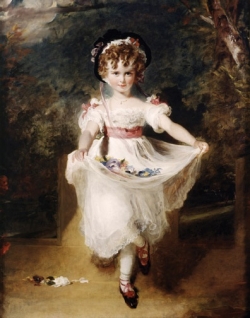
Room 6 showcases the collector's love of children. They are shown sitting serenely, rosy cheeked or pale, dressing up a kitten (are they playful or are they torturing the cat?), painting each other in an allegorical setting, skipping joyfully, riding horses and evidently enjoying a vicious dog fight.
Suggested Scavenger Hunt
See if you can find these animals with your kids as you walk through the exhibit. The dogs are found throughout the exhibit. The other 10 animals are listed in order, beginning with Room 1.
-
21 dogs, especially cute spaniels (if you find more, let us know)
-
Three cows with curved horns
-
A dead deer
-
A white chicken with three chicks
-
A grumpy old donkey
-
Some fish out of water
-
A snarling fox
-
A sow with two piglets
-
A black horse galloping
-
Five little lambs (one in one painting, four in another)
-
A miserable kitten
The main exhibit is enough for most young children. If your older kids or teens want to explore more paintings, continue with the complementary "European Masters: The Treasures of Seattle" in the adjoining rooms. The paintings from local private collections encompass master works from Dutch, Spanish, French, Italian, Belgian and German artists from the 16th to 19th centuries.
If your children know Bible stories, they may be interested in seeing many of them come to life in the paintings. "An Allegory of the Four Elements" renders fire, air, water and earth in human form. Can you figure out which person represents each element? "The Portrait of an Unknown Man" by Frans Hals is especially arresting. The last painting, "Portraits of a Young Woman" by Elisabeth Louise Vigee-Le Brun, is the only work by a woman in the two exhibits. It would be a good opportunity to talk about how being an artist was a "man's job" until the 20th century.
There is an audio tour accompanying the exhibit. I wouldn't recommend it for most children because each segment is quite long and may not hold their attention.
IF YOU GO
Where: Seattle Art Museum, 1300 First Ave., downtown Seattle.
When: Through May 19. Tuesday through Sunday, 10 a.m. to 5 p.m.; Thursday and Friday, 10 a.m. to 9 p.m.; closed Monday.
Cost: Adults $20; seniors (62+) $17; teens 13-17 and students with ID $12; children 12 and younger free. Teen Tix admission $5 (sign up at www.seattlecenter.com/teentix). Admission to the museum is free for all on the first Thursday of each month and free for teens the second Friday of each month, from 5 to 9 p.m.; entrance to the "Rembrandt, Van Dyke, Gainsborough" exhibit is not included, but prices are reduced to: $10 for adults and $8 for students and teens.
Family Programs
"Early Masters" children's art exhibit: Through March 10 in the first floor corridor. Artwork by students ages 7 to 12 enrolled in the Early Masters art studio in north Seattle, inspired by the pieces in the "Rembrandt, Van Dyke, Gainsborough" exhibit. Free. (The first and second floors of SAM are always free, so you can look at these paintings and create work in the Chase Art Studio even if you don't pay museum admission.)
Teen Workshop, “Smile for the Camera: Picturing Celebrity vs. Reality”: March 19, 10 a.m. to 3 p.m., Chase Open Studio. You can smile for the camera or direct the photo shoot. After learning about representation, fame and portraiture, each teen will leave with a personal portrait. Free for teens; registration required.
Community Portrait Day: March 16, 11 a.m. to 2 p.m. Create a self-portrait, join a family tour of the galleries and work with Seattle artist Joe Park on a life-sized embellished masterpiece; for all ages; $5.
Family Workshop, “Artful Inspiration”: May 11, 10 a.m. to noon, Chase Open Studio. Take a family-friendly tour to find lines, shapes and colors in paintings, then go to the studio to design your own mixed-media creation. One adult and up to two kids $15, members $7.50, additional kids $5.
Contact: 206-654-3100; www.seattleartmuseum.org.