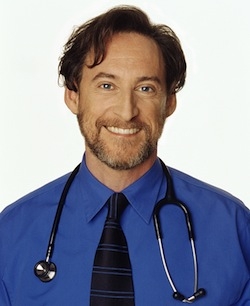
All babies, says Dr. Harvey Karp, have a “calming reflex” – an instant stopper to the kind of colicky crying that leaves new parents feeling not only like bad parents, but also like they just might go crazy to boot. That reflex, Karp has figured out, can be turned on in five simple but specific steps – the famous five S’s outlined in his longtime best-selling book, The Happiest Baby on the Block.
Dr. Karp will talk in person about the five S’s, along with handling toddler tantrums and more on Sept. 15, when he speaks at the Red Lion Hotel in downtown Seattle. His talk will provide valuable insight and specific tips to parents of newborn through preschoolers as well as caregivers, educators and medical professionals. For tickets, click here: Brown Paper Tickets
All proceeds from the event will benefit Postpartum Support International of Washington (www.ppmdsupport.com/index.html) and Postpartum Support International (www.postpartum.net) and their work to overcome the effects of pregnancy and postpartum mood disorders through early identification and treatment, thereby ensuring a healthy environment in which both mother and baby can thrive together.
Dr. Karp first became widely known for this success with one of the toughest challenges faced by new parents: crying babies.
In fact, Karp is the first to point out that he did not discover the newborn quieting sweet spot as so many of his marketing materials purport. The bushmen of the Kalahari did.
“I was working at UCLA and my job had a lot to do with crying children – I was a fellow in child development and I was in the emergency room as well, and you can imagine the number of children crying in the ER,” Karp says. “I was taught that all babies cry, and I was explaining that to parents. They would go home ready to jump off a cliff because they couldn’t put up with this screaming for two to three months.”
“I learned about a tribe in Africa that could stop a child from crying in two to three minutes – all of their babies’ crying. I thought, if they could do it, we could do it,” Karp says. “I knew then that this idea that kids would just cry day after day, hour after hour, just wasn’t correct.”
Once Karp started to research and explore the bushmen’s baby whispering, he says, “I started to understand what they were doing. It all fit into place that they were imitating the uterus.”
And thus was born Karp’s concept of the “fourth trimester.” Babies, Karp theorizes, would stay in utero at least three months longer if human bodies could carry them. That’s why after they are born, the very things that kept them calm and relaxed inside mom should be replicated outside.
“Besides parent sanity, what’s the value in getting the reflex and the anti-tantrum fix down? Well, parent sanity is really THE reason," says Dr. Karp, "Not to mention, neither kids nor babies like to feel hysterical.
“Frustration with crying is a main trigger among parents for abuse, over-treating babies with medications, postpartum depression, even maternal overeating,” Karp stresses. Karp says that the calming reflex is universal, and that when done correctly, his techniques work 90 percent of the time.
Karp won’t be talking only about happy babies. He'll also talk about his newer book/DVD program, The Happiest Toddler on the Block, which describes research-based techniques that parents can use when they are navigating the rough world of toddler/preschool tantrums – behavior many parents assume is just another milestone in their young child’s life.
In Happiest Toddler, Karp offers up what he himself calls a “counter-intuitive” approach.
“They are not so much little children as they are little cavemen,” explains Karp. “They are uncivilized. They are not born saying ‘please’ and ‘thank you.’ The left part of the brain is less mature than the right. With all of us, the more upset we get, we turn off our left brain. We call it going ape. Toddlers have an immature left brain so they go ape on a good day, and when it’s a bad day they go Jurassic. They can’t understand your language, they understand gesture.”
Dr Karp's lecture will be followed by a Q & A session with questions from the audience.
Karp's work is translated into over 20 languages and is taught by "Happiest Baby" educators across North America and around the world. He serves on the advisory boards of Parents, Ser Padres and American Baby magazines and his work has been featured by the Associated Press, New York Times, Time, Newsweek and People Magazine. Beyond his expertise in child development, Dr. Karp has often lectured on breastfeeding issues. He is also one of this country's leading advocates for protecting children from environmental risks. In that capactiy, he has been a spokesman for the American Academy of Pediatrics, founding member of Healthy Child/Healthy World and founding member of The Green Guide. Here's what local experts have to say about Karp's work:
“Dr. Karp’s love and respect for infants and new parents permeates his message.” ~ Penny Simkin, Seattle PT, childbirth educator, doula, author and co-founder of DONA International (formerly Doulas of North America)
"…the best way I know to help crying babies.“
~ Steven Shelov, MD, editor of AAP's Caring for Your New Baby and Young Child: Birth to 5
“Dr. Karp’s insights are a key to reducing the anger and frustration that can lead to shaking.“ ~ James M. Hmurovich, President & CEO, Prevent Child Abuse America