There are shows you see—and then there are shows you carry, the ones you keep thinking about—whose lines, music, characters, questions you are still replaying hours or days later.
In a city where high school students walk off campuses to protest the government, and tens of thousands of people, including many families, swarm the streets during No Kings rallies, Les Misérables—with a storyline centered on a student-led uprising against a government seen as unresponsive and unequal—is the latter. Although the history it depicts is specific to 19th-century France, its questions linger. It resonates in 2026 America. And, it’s now onstage at the Paramount Theatre through April 19.
The show’s themes—justice, poverty, retribution, protest, civic responsibility, and what people do when systems fail them—are all fodder for conversations between parents and kids, especially tweens and teens, who will likely understand the nuances of the show. Despite some very adult, quite risque parts (the brothel scene and “Master of the House” to name two), one dad said the show is worth a family viewing:
“We are a fairly conservative, faith-led family,” the father, who preferred his name not be used, said. “I think it’s worth it for the redemption story, which I wanted them to experience, and its themes around justice and mercy.”
His three daughters, Annaliese, 13, Emily, 11, and Macie, 9, were well acquainted with the show, its music, and the storyline before they attended Tuesday, although their mom felt sure the younger girls “probably didn’t get” some of the more mature references and gesturing.
“There’s a lot going on and a lot to think about,” said Annaliese. “I understood it all and really loved it.”
Annaliese said she appreciated the production’s blend of traditional theatrical elements with modern projections and movement. I agree—the simple sets and digital backgrounds give the story a cinematic sweep without losing the emotional urgency found in its hit songs like “I Dreamed a Dream” to “Do You Hear the People Sing?
Story synopsis: What Les Misérables is about
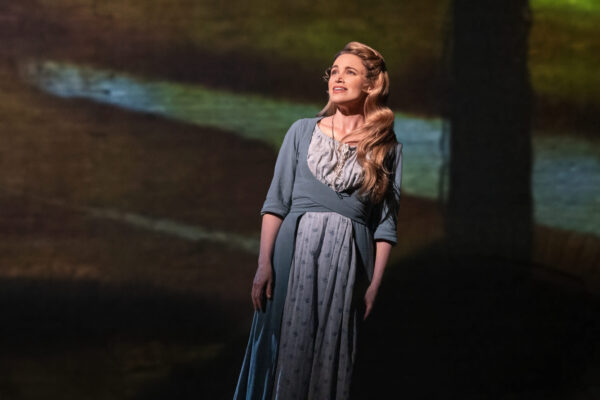
Lindsay Heather Pearce as Fantine (Photo by Matthew Murphy)
The show was written by Alain Boublil and Claude-Michel Schönberg and is based on Victor Hugo’s novel. It is directed by James Powell and Laurence Connor, with design inspired by Hugo’s own artwork. A cast is filled with stellar vocalists who soar and fall through entire ranges in almost every song.
At its core, Les Misérables follows Jean Valjean, a man imprisoned for stealing bread who spends the rest of his life trying to outrun his past—and redefine himself. Pursued relentlessly by Inspector Javert, Valjean builds a new life, only to have it tested again and again by a society that doesn’t easily forgive.
Around him, the story widens: Fantine, a mother pushed to the brink; Cosette, the child Valjean raises as a promise to Fantine; Marius and Éponine, young people navigating love and loss; and a group of students who take to the streets, believing change is worth the risk. Their uprising—idealistic, urgent, and ultimately tragic—sits at the heart of the story.
It’s a sweeping narrative, but the throughline is clear: what happens when people feel unheard, and what they choose to do next. Some characters cling to rules. Others push back. All are forced to reckon with the cost of both action and silence.
Age recommendation and what to expect
Les Misérables is “not a light show,” one mom said, who brought her 8-year-old. She wasn’t sure they would make it to the end. Warning: It’s a long night as you head for the exit after 10:30 p.m. She and all the parents I talked to agree that it helps to go in prepared.
Go through the storyline with your child before the show. It’s generally best for middle school and up (roughly 13+), depending on your child. Surprisingly, Annaliese suggested 15 and up. Where there are no overtly explicit sex or graphic scenes, there are certainly illusions to both, along with hunger, homelessness, and exploitation, which are central to the story. Fantine’s storyline includes prostitution in a scene I would have found difficult to watch even with a 15-year-old. There are multiple onstage deaths, including young characters, and one character dies by suicide.
That said, I talked to a dad who brought his 6-year-old daughter, who already loved the show’s music. She made it all the way through.
“She really enjoyed it,” the dad said. “She is an experienced theater goer, and we did intentional prep over several weeks to build excitement and understanding about the plot. We of course listened to the music, but most significantly, we watched the recorded Broadway musical at home, pausing to explain the characters and relationships, so she was fully briefed beforehand to see the live performance.
“We discussed the play in the context of ongoing education and understanding of history, power, justice, and faith,” he added. “It’s not light material, but we explored it meaningfully as a household and found it stimulated many treasured conversations.”
Talk about it: Questions to ask your kids after the show
- What made the students decide it was time to rise up? Do you think they were right?
- When does protest feel necessary—and when does it go too far?
- Did any characters change your mind about what “justice” looks like?
- Who held power in the story, and how did they use it?
- Where do you see similar tensions—people feeling unheard or systems not working—in the world today?
- What would you have done if you were there?
Bottom line for parents
If your child can handle big emotions, complex moral questions, and some darker storylines, this can be a powerful shared experience. It’s also one of those shows where a quick heads-up beforehand—and a conversation after—goes a long way.
The details
Les Misérables plays through April 19. Tuesday-Thursday shows start at 7:30 p.m., Friday at 8 p.m., Saturday at 2 p.m (captioned April 18) and 8 p.m. (ASL April 18) , and Sunday, April 12, at 1 p.m. and 6:30 p.m. (captioned) and Sunday, April 19, at 1 p.m. (ASL and audio described) and 6:30 p.m. Tickets start at $98 for Mezzanine. Get tickets.