Awwww, those first words from your child. “Mama.” “Dada.” “Kitty.” “Airplane.”
Those early words are a milestone many parents cherish and one we often attach big meaning to. After all, when your baby starts talking, it’s exciting, emotional, and unforgettable.
But what if your baby isn’t talking yet, or doesn’t seem to be meeting typical speech milestones? How do you know what’s developmentally normal, what might signal a speech delay, and when it’s time to seek extra support?
Speech milestones for babies and toddlers can vary widely, but understanding what’s typical and when to worry can give parents clarity and peace of mind.
To help answer these common questions, we spoke with Carson Pyatt, a certified speech-language pathologist at Mary Bridge Children’s, about early language development, common milestones, red flags to watch for, and simple ways parents can support their child’s speech at home.
Typical milestones
Around 1 year: Your child should say something that you recognize as a word. (If your child was born prematurely, go by their adjusted age, not their chronological age.)
About 2 years: A child should have a vocabulary of around 50 words and should be putting two words together. But know this: It will be basic, Pyatt explains. It won’t be grammatical. It might sound like: “Daddy up.” “Mommy cup.” “Go please.” “More bubble.” These are good early statements, Pyatt says. The pattern is usually a noun combined with an action word (“up”) or a request/desire (“please”). As Pyatt explains, at this age kids are motivated by asking for something, describing something, greeting someone or simply getting attention. You’re not going to have a sophisticated conversation, but if these key elements are present, you’ll know the child is headed in the right direction.
After age 2: The vocabulary should continue to increase, and a child’s statements will keep evolving: Expect a kid to sometimes add “ing” to
verbs or to express some things as possessives (“my toy,” “his ball,” “Fluffy’s bed.”) During these years, a child also will develop the ability to answer questions and – this is a big one – when a child starts school, both their pronunciation and their message should be thoroughly understandable.
When to be worried
- Every child develops differently, but Pyatt gave a few potential red flags:
- If your child isn’t expressing themself with either words or signs by 12 to 18 months.
- If they aren’t putting two words together by 24 months.
- If, around the ages of 2 to 3, the child is difficult to understand or becoming frustrated trying to make themself understood. Then it’s probably time to be evaluated for potential speech/language therapy. This is generally done by getting a referral from a primary care provider.
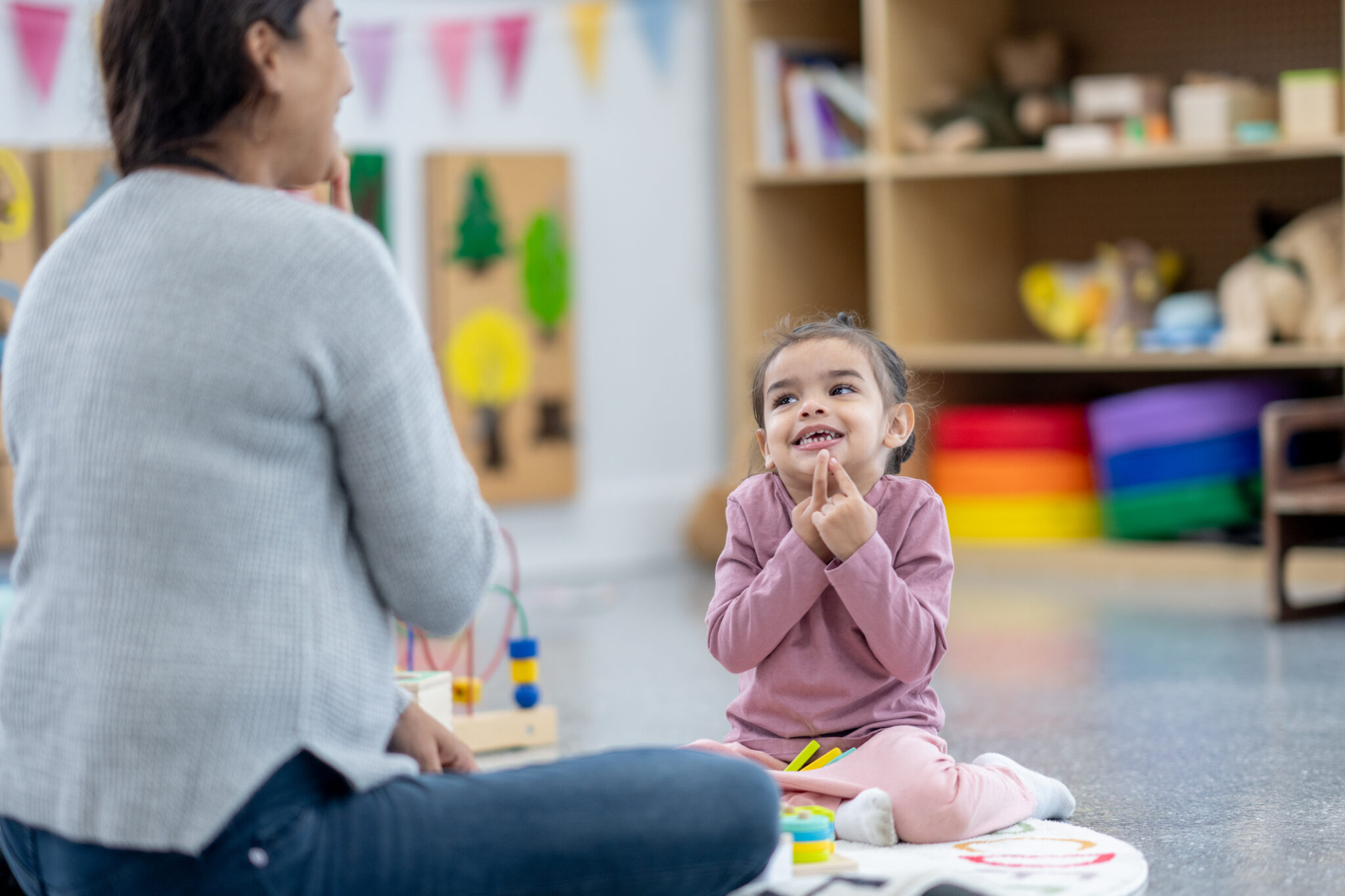
Don’t be alarmed by the label “speech/language therapy,” because guess what? It’s chill, it’s fun, your kid probably will have no idea that they’re “learning” something – and parents will learn, too.
“A lot of it does look like play,” says Pyatt, who should know because she works with kids all day, every day. “Play-based therapy is the most effective.”
And in the process of all of this “playing,” the therapist is giving parents strategies that they can use at home to help develop their child’s language abilities.
As Pyatt explains: “I often tell parents: I don’t do anything magical for your child. I want to teach you how to help them.”
Tips we all can use
“It is never too early to start reading to your child.” This is from a therapist who even visits babies in the NICU (neonatal intensive care unit). “Even at birth, aim for a book a day,” Pyatt says. “Reading together is one of the best ways to boost language development and instill a love of books.”
This one might be counterintuitive, but hear us out: Resist the urge to quiz your child. If you’re always asking, “What is that?” you are likely to get short, one- or two-word answers. A better strategy is to narrate the world for your child: “Look at the dog chasing the red ball.” They will hear you and learn from you – and eventually, they’ll mimic that type of statement. “The more you practice, the easier it gets,” Pyatt says.
Limit screen time. Pyatt realizes that the “no screen time” advice, while sound, might be impossible to put into practice. Her more achievable idea: “Limit it to one hour a day,” and then: content that is soothing and not overstimulating. “CoComelon”? Too much going on. And why the limit? While kids’ shows might appear to promote vocabulary development, here’s the problem: “It’s one-sided. All the kid does is watch,” Pyatt says. Kids are more likely to learn in a more dynamic setting, a conversation with another person that involves back-and-forth, give-and-take.
Also, know that challenges with speech and self-expression can be symptoms of something like autism, and a speech/language evaluation through Mary Bridge Children’s can be a step toward that diagnosis.
For now: Keep talking – and reading – to your child. And be ready to get an earful in return.