Recently, my daughter Cora, 10, and I were fortunate enough to tour the Henry Art Gallery with the Henry’s Senior Curator, Nina Bozicnik. She was thrilled to present Eric-Paul Riege, 32, a Diné/Navajo artist based in New Mexico, in his first exhibition at the Henry. Bosicnik’s daughter Avery, 6, has visited the exhibition many times.
Your Earrings Remember
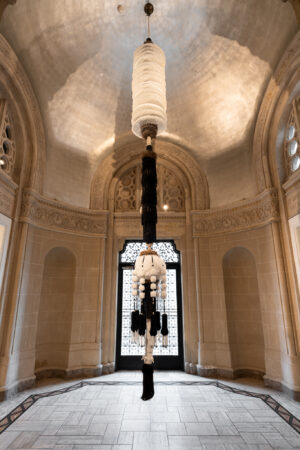
We started in the Rotunda, where Riege’s sculpture, “yoo’4yay,” 2026, hangs from the ceiling like a chandelier, so perfectly at home in the room it looks commissioned for the space.
“The majority of the work in the show is soft sculpture — larger-than-life jewelry-shaped forms that feel at once monumental and toy-like,” said Bozicnik. “The materials and soft forms resonate with kids because they are familiar.”
(Image courtesy The Henry)
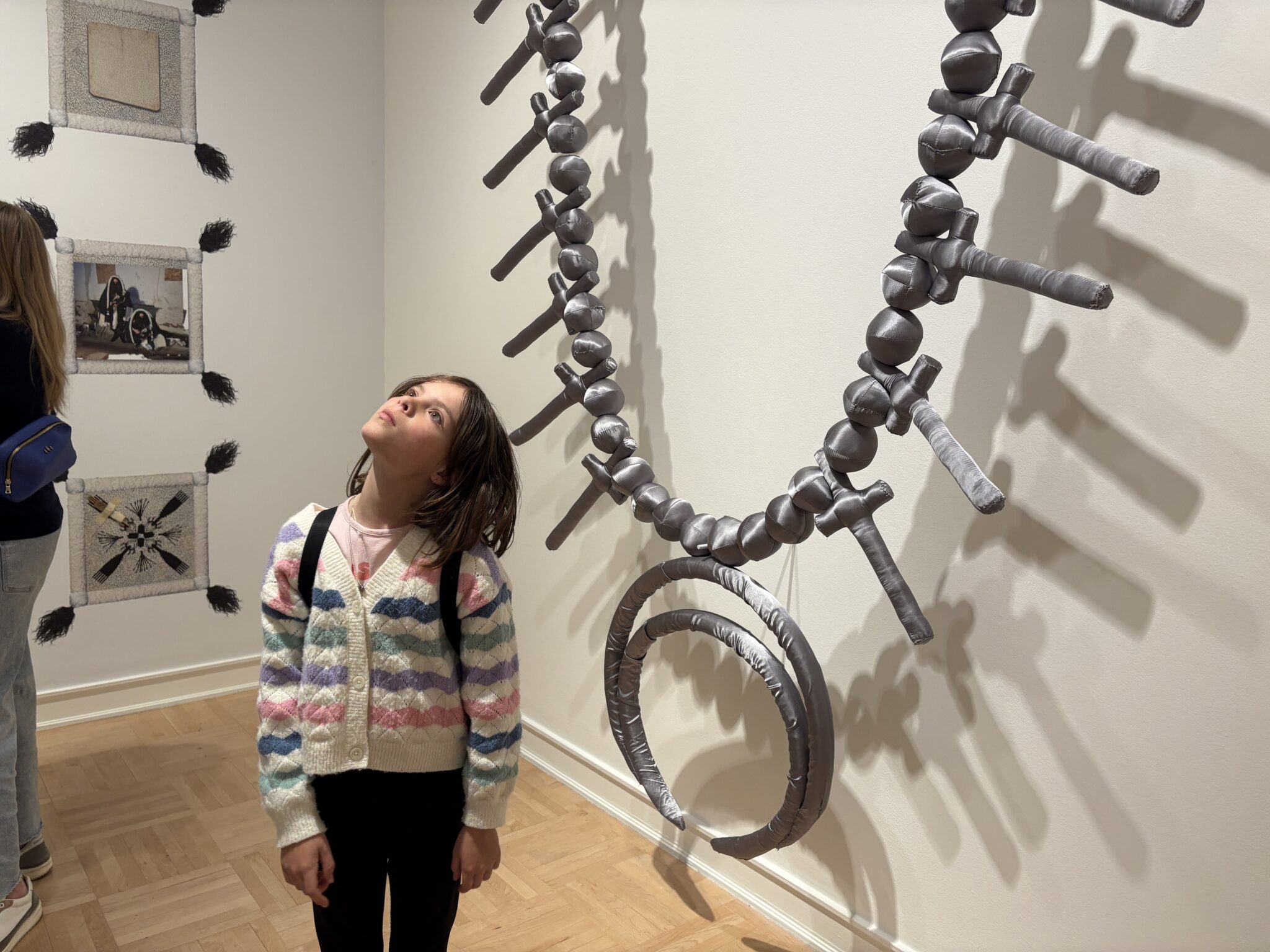
Indeed, Riege’s striking, floor-to-ceiling-sized sculptures evoke Native American adornment, made not with beads or silver, but soft yarn and found materials. These supersized sculptures are rendered in black and white; colors commonly associated with Diné/Navajo jewelry, like turquoise or ochre, are conspicuously absent.
Few crafts are as intertwined with Native American culture as jewelry. In the main gallery, Riege’s glorious “Totems of Memory” hang against yarn backdrops like earrings on display: giant, ornate, black and white, and somehow cozy and comfortable.
According to Riege, “One day when I was younger, I was told by my grandmother that as we navigate the world, our earrings and necklaces — and I’ve extended this further to clothes — are listening, just as much as we are. If you’re having a conversation with somebody and perhaps forget a certain part of that conversation, your earring remembers, so when you take that earring off and put it back on the next day, those memories are still in that earring, and that knowledge is still there.”
(Image: Elizabeth Hunter / Seattle’s Child)
Portals of Curiosity
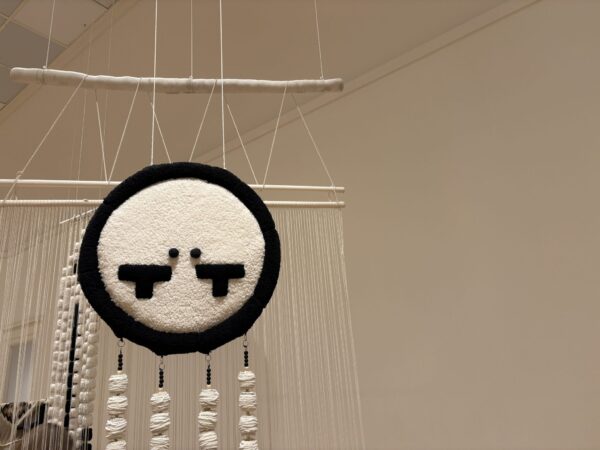
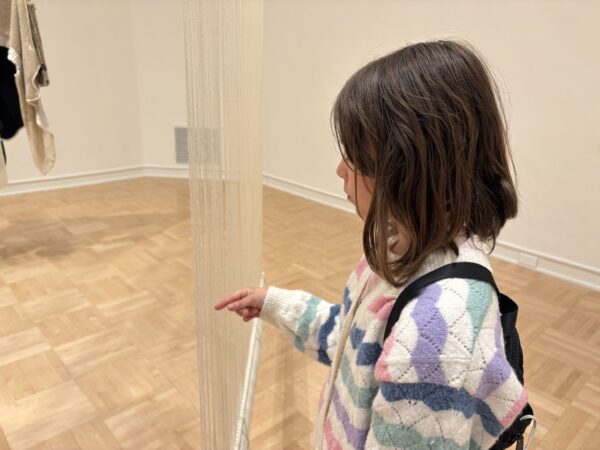
Small details captivate throughout the exhibition. Cora enjoyed the soft jingle of bells at the bottom of the sculptures that trilled as she walked by, strummed her fingers gently on the section Riege has allowed visitors to touch, and giggled at one of Riege’s Totems, “jaatłoh4Ye’iitsoh,” which brought to mind an unamused emoji.
Riege’s work presents opportunities to talk with kids about how adornment and community are intertwined: what we wear and why we wear it, who makes it, and how we come to own it, for example, are worthy questions for kids. At Cora’s age, we were able to discuss adornment as a market and the concept of appropriation versus appreciation.
(Image: Elizabeth Hunter / Seattle’s Child)
Bozicnik’s conversations with her daughter “have centered on ideas of play and adornment. We’ve talked about how Eric-Paul harnesses the power of play and imagination to reflect on family stories and make new narratives.”
Indeed, one imaginative new narrative caught Cora’s eye: a rare miniature sculpture of a Diné/Navajo woman, just five inches tall, in the act of weaving a textile ten times her size. Perhaps she’s there as little reminder of the quietly outsized, unacknowledged influence of Diné/Navajo culture on American society, or a reminder of how often the artist is minimized behind the artwork.
“ojo|-|ólǫ́” runs through October 2026. The Henry Art Gallery is open Thursday through Sunday, and free to all.