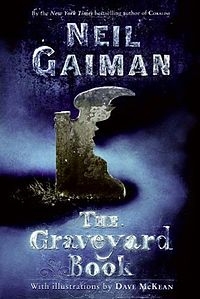
The Graveyard Book, by Neil Gaiman
Recommended for ages 9-12
Neil Gaiman had me at the first line: "There was a hand in the darkness, and it held a knife."
Then, he lost me as I realized that the knife had been the death of a father, a mother and their young daughter.
I'll say up front that Gaiman did get me back – rather quickly at that – and I very much enjoyed what ended up being a sweet, almost old-fashioned tale. First, though, I had to get past that murder scene.
In truth, Gaiman never uses the words "blood" or "kill" or "murder" or any other gory words in his description of what happened to the family of The Graveyard Book's main character, Nobody Owens. The scene takes only a couple of pages – pages that also include illustrations – to tell how the man with the knife, called "the man, Jack," had finished off three of the four family members and was now looking for the fourth, a toddler, to finish the job.
It's a necessary set-up to this tale of a young, very much alive boy and how he ended up raised by ghosts and other graveyard denizens. So, while I don't much care for murder in a children's book, it's handled well enough in this 2009 winner of the Newbery Medal for me to overlook it – largely because the rest of the book is so well worth the read.
Gaiman's inspiration for The Graveyard Book was The Jungle Book by Rudyard Kipling. In Gaiman's novel, ghosts take the place of wolves as the young boy's unusual adoptive parents, and ghosts take the place of the wild animals.
The toddler is named Nobody Owens, Bod for short, because he "looks like nobody but himself." Bod is given the "Freedom of the Graveyard," which allows him to see the ghosts, to fade through walls and otherwise navigate his odd new home. He is put under the protection of Silas, a man neither living nor dead, who, I think, is a vampire.
In the book's tales, we see Bod growing up. He befriends a young witch, buried in an unmarked grave, and a living girl, who discovers him when her family brings her to play in the graveyard, which is also a nature preserve. His curiosity takes him into the oldest grave in the cemetery, older even that of the Roman Caius Pompeius, and it sends him into a desert underground where he has to escape from ghouls.
As he grows older, Bod yearns to learn about the world outside the graveyard, the world of other living people. But, while his treks outside the graveyard gates take him into the land of the living, they also put him in danger from the man, Jack, who is still bent on killing him before he can fulfill his destiny.
I loved the bits of humor scattered throughout. For example, the new ghosts that we meet are all identified by the words on their headstones: "Miss Letitia Borrows, Spinster of the Parish (Who Did No Harm to No Man all the Dais of Her Life. Reader, Can You Say Lykewise?)."
The ghosts are all characters unto themselves – every bit as pompous or motherly or melodramatic as they were in real life.
The stories are sometimes scary, sometimes touching, but it's the lovely relationships with the odd ghosts of many centuries; the vampire Silas, Bod's guardian; and the living girl who befriends him that give The Graveyard Book its sweetness. All of them seem to truly care about Bod. Even with his family tragically gone, he is surrounded by love. And that, in the end, is how Gaiman got me back.
Much as I hate to categorize by gender, this feels like a boy's book to me. There's the boy main character, the boyish adventures. I hope I'm wrong and that you'll all tell me so, but I don't think it has the same cross-gender appeal as, say, Harry Potter. There's no Hermione Granger here for girls to identify with. I will urge my daughter to give it a try, but I'm going to be strongly recommending it for my friend's son.
Ruth Schubert is the managing editor of Seattle’s Child.