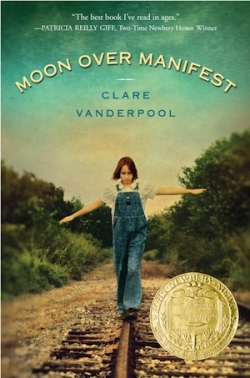
Moon over Manifest, by Clare Vanderpool
Recommended for Ages 9-12
This year's winner of the Newbery Medal, Moon over Manifest, is a historical novel times two. Part of the story takes place in 1936, when 12-year-old Abilene Tucker is sent by her father to Manifest, Kan., a prairie town that has seen better days. Abilene's father, Gideon, tells her that it's no longer safe for her to ride the rails with him, stopping in hobo camps along the way in the depths of the Depression, and sends her to stay with Pastor Shady Howard.
The tale is full of mystery. Abilene doesn't know who Howard is or why exactly her father has entrusted her to his care. She doesn't really know the significance of Manifest to her father or where he fits into the town's history. She doesn't, in fact, know much about the town's history at all. As she approaches Manifest, readying herself to jump from the train she's hitched a lift on, she sees that the sign, which once read "MANIFEST: A TOWN WITH A RICH PAST AND A BRIGHT FUTURE," has been shot up so badly that now all she can read is "MANIFEST: A TOWN WITH A PAST."
During her stay, Abilene learns about the events of 1918, largely told by the owner and operator of Miss Sadie's Diving Parlor, a Hungarian woman whose part in the history of Manifest is as mysterious as the tales she tells Abilene about two boys named Jinx and Ned. The events in 1918 are in many ways more vivid and compelling than what happens in 1936. In fact, in many ways, Abilene is the vessel into which Miss Sadie pours the town's past, teaching Abilene about her father's past along the way.
Manifest is based on the real town of Frontenac, Kan., where both of Vanderpool's maternal grandparents grew up. It was fascinating to learn that in 1918, the town was filled with immigrants from all over Europe who came to work (and be exploited, really) in the big mine there. The families, though, stick with their countrymen, both by choice and because the mine owners try to keep them apart and play them off each other, a common practice to prevent the workers from uniting to demand better working conditions or pay. And 1918 is the middle of World War I, another important element in the story.
Manifest if filled with a bunch of real characters, who keep the story rich and lively.
This novel is recommended for 9- to 12-year-olds. It is rather complex, with the shift between historical time periods. And the story deals with the consequences and emotions of loss, guilt, prejudice, revenge and, finally, love. For those reasons, I don't think it would make a particularly good read-aloud for younger kids. I think ‘tweens, though, would be drawn in by both the mystery and the history. And the story leaves a lot to talk about. It's a great one to read with your daughter or even in a Mother-Daughter book club.
Ruth Schubert is the managing editor of Seattle’s Child