So everyone throws around this term "Basic Education" all the time when talking about K-12 funding in Washington State – and how some of the money we spend on schools is constitutionally protected from cuts and some is not. "But," you ask, "How can I tell the difference when there are literally hundreds of K-12 line items in the state budget?"
Here is a little primer to help you navigate:
In 2009, the Legislature passed a bill (HB 2261) to revise and expand the definition of "basic education" – this is the program of K-12 education for all children that is determined by the Legislature to meet Washington's primary constitutional (or paramount) duty. Another bill the following year (HB 2776 – 2010) laid out the path for the phase-in of all the new or enhanced pieces of basic ed. And according to the law, the new basic education must be fully operational in the 2017-18 school year.
So, it might then seem obvious what is basic and what is not, but there are some catches.
-
Catch 1: Some of the pieces have their own timelines within the overall timeline. (Example: the increased amounts for Maintenance, Supplies, and Operating Costs (MSOC) must be completed in the 2015-16 school year.)
-
Catch 2: Most new pieces do not get the protection of "basic ed" until they have been fully phased in and the final dollar is added. (Example: full-day kindergarten (FDK): Half-day kindergarten is part of basic education. And since 2007, the state has been funding full-day K for about 20% of elementary schools. In 2009, it became part of the revised definition of basic ed but no money was added. In fact, no money was added to FDK until this last 2011-13 budget. The state funds for FDK will only become protected when funding is provided for 100% of elementary schools)
-
Catch 3: Some components just become basic ed on a specific given date regardless of whether they are serving all eligible students or just some. (Example Highly Capable: the original legislation from 2009 said state funding for highly capable (gifted) programs would become a protected part of basic ed on September 1, 2011.
-
Catch 4 (the biggest catch of all): Even if something is already basic education, the constitutional protection only goes so far. The Legislature can still cut (or eliminate) something considered basic education and then someone would have to sue the state and have the courts agree with them to have the constitutional protection enforced. And sometimes not even then. (Example: the Legislature cut 1.9% in teacher salaries in the 2011 session. Most of basic education funding goes to the salaries of the staff who carry out or administer the programs of basic ed. So that 1.9% cut was most likely a cut to basic education and yet it still went ahead. Now, how districts dealt with that cut when it came down to them is a different matter covered in a previous blog post.
Basically Speaking
There are a couple of buckets that are clearly part of basic education: general apportionment (dollars per student), transportation, special education, institutional education (school in the juvenile justice system), Transitional Bilingual Education and the Learning Assistance Program (English language learner support), and now highly capable programs.
Everything else, including some parts of general apportionment (for FDK and K-3 class size), is not.
The Chopping Block
So back to the question of what is at stake. And the answer is, well, everything. The programs and funds that are not part of basic education are the most vulnerable, and then come the programs that are not yet part of basic ed but will (or may) be, and then even "basic education" has a good chance of being on the chopping block.
When the 2011 Legislature wrote the 2011-13 budget, they started out with a maintenance level of $15.6 billion for K-12 education. Maintenance means what the state would need to spend to keep the same programs and services for students over the coming two years in addition to funding other commitments that were deferred or required by law to begin.
At the end of the 2011 first special session, the Legislature made cuts of $4.6 billion to deal with most of the $5 billion dollar shortfall. Nearly 40% of those cuts, or $1.8 billion, came from K-12 education.
Of this amount, $1.1 billion came from the continued suspensions of Initiatives 732 and 728. Another $524 million came from other cuts to the compensation of current or former K-12 employees. The remaining $167 million in reductions came out of K-12 programs, most notably: most of the K-3 class size funding, adjustment to the alternative learning experience (ALE) funding formula, and the delay of assessment graduation requirements in math and science.
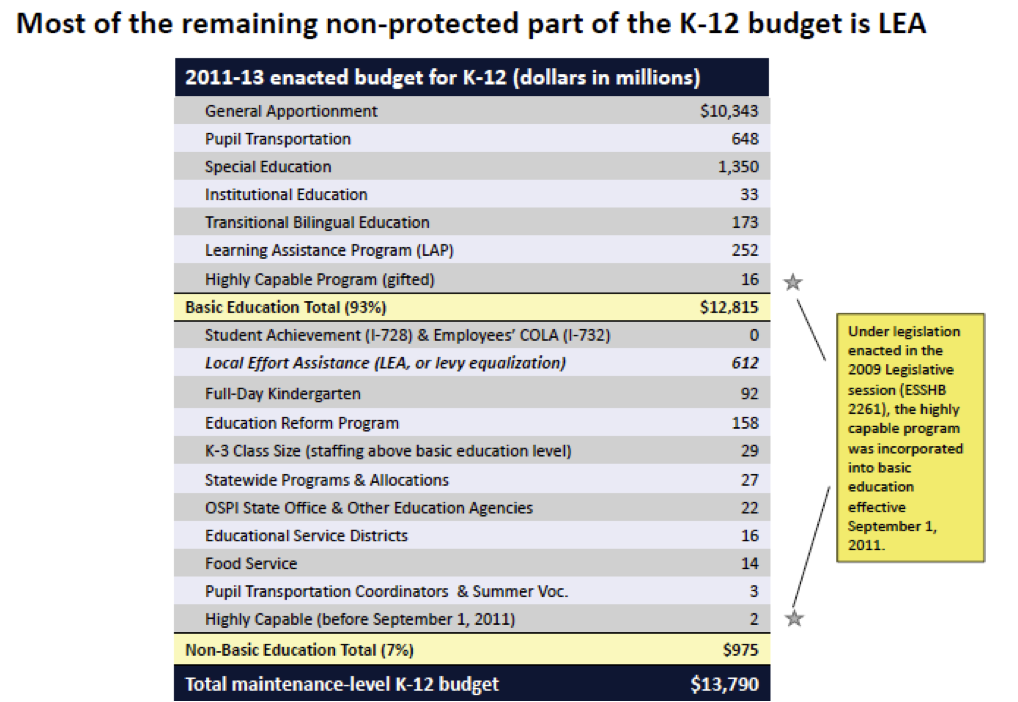
That left the total K-12 budget for 2011-13 at $13.8 billion, of which $12.8 billion is "above the line" or basic education (see above). Of the remaining $975 million in "below the line" funding, over 75% is basically basic education anyway:
-
$121 million in ‘would be' basic education (FDK and K-3 class size reduction funds) and
-
a whopping $611 million in levy equalization (also known as Local Effort Assistance or LEA) which we know districts mostly use to fill the gap between what basic education really costs and what the state spends on it.
The September 2011 revenue forecast gave grave news: that we are facing another $1.4 billion shortfall which will likely grow by the November forecast. And in order for our state to keep some reserves on hand, the Legislature will likely have to make at least another $2 billion in cuts. This is why the Governor is planning to call the Legislature back into a 30-day special session beginning November 28th. Because, she and many legislators believe that we just cannot wait for more bad news.
K-12 funding currently makes up 43% of the entire state general fund budget. And in the last round, K-12 took 40% of the cuts. If the pattern holds, the upcoming special session will likely see K-12 education cut by $800-850 million or more. That is basically everything "below the line" and that which is really basic education when all is said and done.
The only question left is: Can our kids afford what is coming next?
Another resource for people on basic education and K12 finance: K12 finance Citizen's guide: