Wow!
There's nothing subtle about the new Chihuly Garden and Glass exhibition at Seattle Center. In all but one room, it throbs with brilliant colors and fantastical shapes, layered on, piled together, juxtaposed and entwined. For some adult critics, including myself, it's a bit much. But for kids, it may seem like a magical wonderland.
Despite the steep price, this world-class Seattle attraction is a good bet for school age children who love color and art. It's not a good idea for active preschoolers because there are no interactive exhibits. Amazingly, there's no physical barrier between many of these fragile works and little hands. "I can't help touching it," one 9-year-old said, gently fingering one of the luminescent stalks in the Mille Fiori ("Thousand Flowers") room. I can understand the urge.
Dale Chihuly was born in Tacoma in 1941, studied in the earliest glass programs in the U.S. and at the Venini Glass Factory in Venice, and came home to the Puget Sound area to revolutionize glass art by stretching the boundaries of the medium. The new museum showcases four decades of his art, through many distinct periods of experimentation.
It begins with a timeline of his life. (Biggest question: How did he lose his eye? Answer: In a car accident in Ireland in the late 1960s). The first room is the Glass Forest, created in the 1970s. It's a forest only in the imagination, with bulbous forms in weird, neon-infused tints of pink and blue at the base of long tendrils of creamy white. The glass was actually dropped from stepladders to the floor below. If you think the pieces look like beautiful toilet plungers, you won't be the only one.
The Northwest Room is the exception to the over-the-top exuberance of the exhibition. Most of the nested bowls are a soft tobacco color, overlaid with threads of glass for patterning. After Chihuly learned to make symmetrical cylinders in Venice, he experimented in the ‘70s with trying to create the look of Indian baskets by making the glass as thin as possible and letting it slump naturally. The baskets that inspired him, along with trading blankets and portraits of Native Americans line the walls.
We step into fantasy land in the Sealife Room, dominated by a tower of blue and green waves … or eel grass… of snakes … or whatever you and your kids imagine them to be. It's easy to find the gold-colored jelly fish, sea stars and spiral shells. The Persian Ceiling takes Chihuly's seaform shapes of the 1980s, reminiscent of huge translucent jellyfish, and layers them overhead in a confusion of colors and shapes. Look for "snooters" – little abstract shapes – and see if your kids can spot nine "puttis" – small cherubs looking at first like lumpy blobs. Several kids going through when I visited it called this their favorite room.
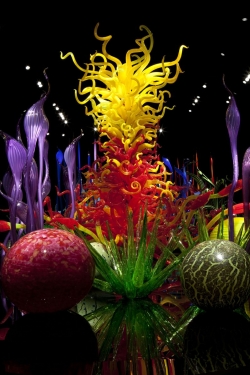
Mille Fiori, a form Chihuly worked with in the 2000s, was inspired by his mother's garden. The plants on steroids, in all of their fantastical colors and shapes, are mirrored on a base of black Plexiglas. Ikebana and Float Boat features glass shapes piled into two wooden rowboats: one containing ikebana-like plant forms and the other colored balls, called Niijima Floats. Less like the simplicity of ikebana it could not be.
The Chandelier Room, like the Niijima Floats, showcases Chihuly's passions in the 1990s. I think of it as his "hanging intestines" period. Dozens and dozens of individual sinuous pieces are assembled for each site-specific, overhead piece. One with creepy red forms squirming out of egg shapes is truly frightening. Macchia Forest isn't a forest at all, but a collection of huge, translucent bowls, in which Chihuly tried to use all of the 300 colors available to glass artists.
Gasp at the streams of 1,340 red, orange, amber and yellow flowers suspended in a 100-foot-long chain on the ceiling of Chihuly's own signature Glass House. The Space Needle is visible through the roof.
Outside in the Chihuly Garden, you'll see more glass reeds, cattails, trumpets and balls, all color-coded with the surrounding plantings, moving from cool to warm tones. The addition of 17,000 bulbs to be planted this fall will make the garden even more spectacular in the spring. You can see the huge, squirming "Pacific Sun" sculpture on a mound of black mondo grass and the towering golden-green column of glass grass even from outside the fence.
Before you leave – or if you don't want to pay admission to the whole exhibit – check out the Collections Café. It's got bottle openers on the walls, accordions overhead and ceramic dogs, alarm clocks, transistor radios and other Chihuly personal collections under glass. The menu is pricy and precious, but there are a few children's selections.
A rudimentary children's guide to the exhibits is available, suitable for school age children. One of the best ways to enjoy this vibrant museum is to encourage kids to have fun guessing at the shapes and enjoying the colors.
IF YOU GO
Where: Seattle Center at the base of the Space Needle, 305 Harrison St., Seattle.
When: Daily, 10:30 a.m. to 10:30 p.m.
Cost: Adults $19, youth $12, children 3 and younger free.
Contact: 206-753-4940; www.chihulygardenandglass.com.
Wenda Reed is a Seattle-area writer and art lover.