Go to any student robotics competition, and overwhelmingly, you’ll see boys behind the remote controls. As for technology classes, it’s no secret that girls are underrepresented, sometimes stunningly so. But go to any class in the creative arts, and you’ll find girls — lots of them.
Now there’s a movement afoot to bring these disparate areas together; all of these elements are pathways into the fields of tomorrow, fields that require a solid basis in science, technology, engineering, math — and creativity. Until recently, much of the buzz in education innovation was all about STEM courses, but lately many educators say the arts are critical too — making it STEAM education: science, technology, engineering, the arts and math.
Backers say this introduces elements of risk-taking and creative thinking into STEM — the kind of out-of-the-box brainstorming needed for breakthroughs in nearly all technical and scientific fields. The arts, from creative writing to photography, engage students who might otherwise be turned off by what some might mistakenly view as rote learning in STEM education, or subjects that are beyond them.
One local school embracing STEAM is the Seattle Girls’ School, located in a cozy warren of classrooms scattered through linked former storefronts and manufactured structures in the Central District. The school’s student body currently numbers 106.
“At SGS, we realize that an artistic performance commands attention through storytelling and pure emotion, making people sit up and take note,” says the head of school, Rafael del Castillo, himself trained in engineering. “The same compelling and creative thinking will be required to solve the awesome challenges of the 21st century. Designers and engineers need to embrace their ‘inner artist’ in order to tell stories that move, inspire, persuade, and yes, sometimes entertain. STEAM is not a passing trend in education; it is a key part of workforce development that will bring more ‘creatives’ into the sciences — and, yes, more women.”
Seattle Girls’ School curriculum addresses the fact that girls develop spatial abilities differently than boys. Also, by also emphasizing the arts — areas with high female representation — in a STEM initiative, it aims at fostering a connection between the subjects for girls. The curriculum helps combat the pernicious message threading through everything from toys to popular entertainment that science, technology, engineering, and math are primarily for boys.
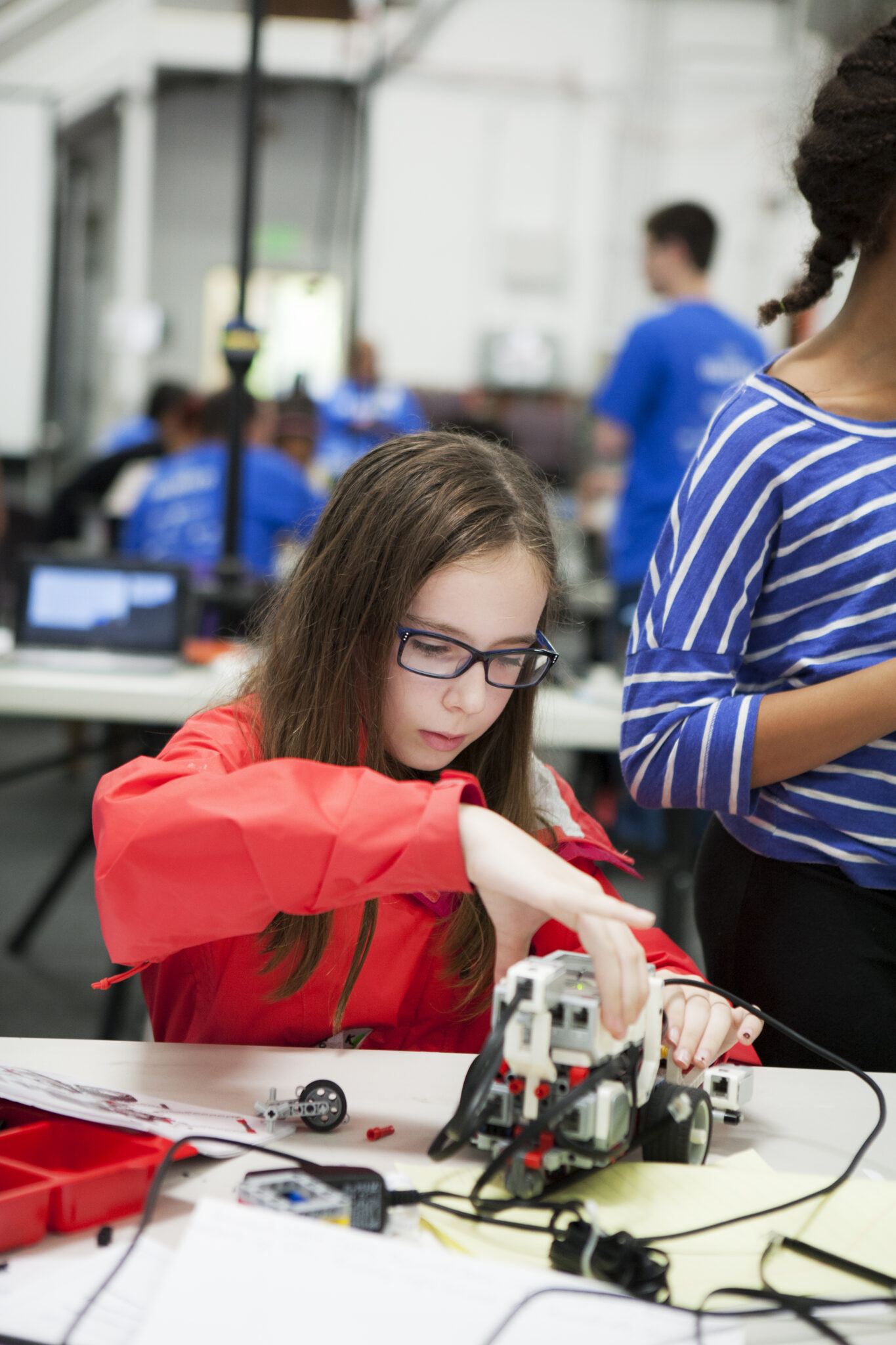
Some of the projects tackled by students at Seattle Girls’ School include programming, robotics and building hydraulic arms. During this time, the girls often meet with women working and achieving in STEAM fields.
“Our sixth graders start with an engineering project, building go-karts, using power tools,” says Leslie McDaniel, communications director. “It’s an experience many of these girls have never had before. The project is day one, day two and day three of their school year. They learn how to put a nail in a board, put a screw in a board. By the end of the third day, they have actually built a manually powered go-kart.”
By the time they finish eighth grade, “We want them to learn they can be a math person, they can be a science person,” McDaniel says.
And certainly by graduation, the girls know they can be a power-tool person, too.