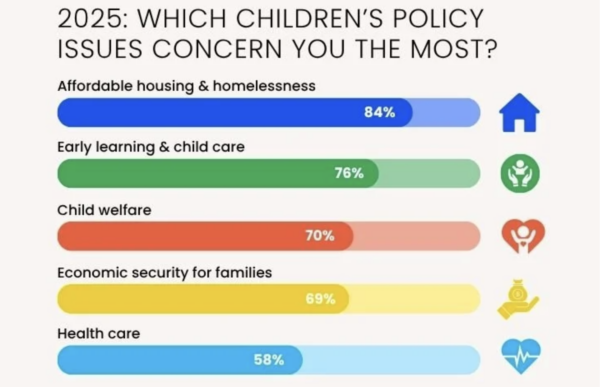
Each year, Washington’s leading child advocacy organization, the statewide Children’s Alliance, asks its members a big question: “Which children’s policy issues concern you most?”
Source: Children’s Alliance
The annual member survey is one of the tools the alliance uses to ensure it is pushing for policies that represent the real needs of children. More than 150 responded to the organization’s 2025 survey.
Several of their top concerns mirror Children’s Alliance’s ongoing priorities, including access to early learning and child care and economic security for families. At the top of the list, affordable housing and homelessness remain top concerns for child welfare advocates, as does health care, likely reflecting concerns about the impending federal changes to Medicaid and other social services.
A troubling picture
With that input in mind, this week, Children’s Alliance released its list of priorities for the 2026 session of the Washington State Legislature, which begins Jan. 12, 2026, and runs for 90 days, ending on March 12, 2026. The organization’s legislative agenda reflects its concerns about data presented in the 2025 KIDS COUNT ® data book, including:
- Washington ranks 30th in the nation for economic well-being
- 31% of Washington kids live in households with a high housing cost burden
- Washington ranks 27th in education nationally
- 57% for children aged 3 and 4 not enrolled in preschool, compared to 54% nationally
An agenda to address racial injustice
“We envision a Washington where every child has an abundance of what they need to flourish,“ the organization noted in announcing its agenda. “Achieving that future requires confronting the racial injustices embedded in our laws and policies. Our legislative agenda prioritizes the communities most impacted by systemic racism and economic exclusion, advancing policies that sustain early learning, health equity, and economic justice.“
The organization stressed that ending racial inequity includes “addressing the historic devaluation of care work, rooted in the forced labor of enslaved Black women, and ensuring that the majority female and BIPOC early learning workforce receives the recognition and economic security they deserve.“
2026 legislative priorities
Early Learning
- Preserve and protect funding commitments so children get a strong start and parents can work.
Health Equity
- Protect Washington kids online by regulating addictive online platforms. House Bill 1834 and Senate Bill 5708 turn the recommendations from Washington Thriving and Children & Youth Behavioral Health Work Group into action to combat our state’s behavioral health crisis and improve services and strategies for children, youth, and their families.
- Protect and prioritize access to safety net programs such as Medicaid and SNAP to help meet the basic needs of children and families who are already furthest from opportunity.
Economic Justice
Pass new, progressive revenue to balance our state’s tax code and avoid future harmful funding cuts to essential programs.
Support Agenda
- Allow flexibility in mixed-age ratios to ensure child care providers have reliable access to meal and rest breaks.
- Remove administrative barriers so child care teachers can access affordable care for their own children through Working Connections.
- Prioritize required facility inspections for child care facilities and classrooms so that providers can open and serve communities.
- Ensure Washington’s public preschool program, ECEAP, is as accessible as possible for qualifying families, including military families.
- End isolation in school settings.
- Codify the Cost of Quality Care model developed with providers across the state to survey the actual cost of providing high-quality child care.
- Support implementation of the Ballmer investment in ECEAP.
- Create a state commission that identifies strategies to improve outcomes for boys and men of color, especially those with low incomes and those who live in rural communities.
To learn how you can advocate for the needs of children in Washington, go to the “Get Involved“ page on the Children’s Alliance website.