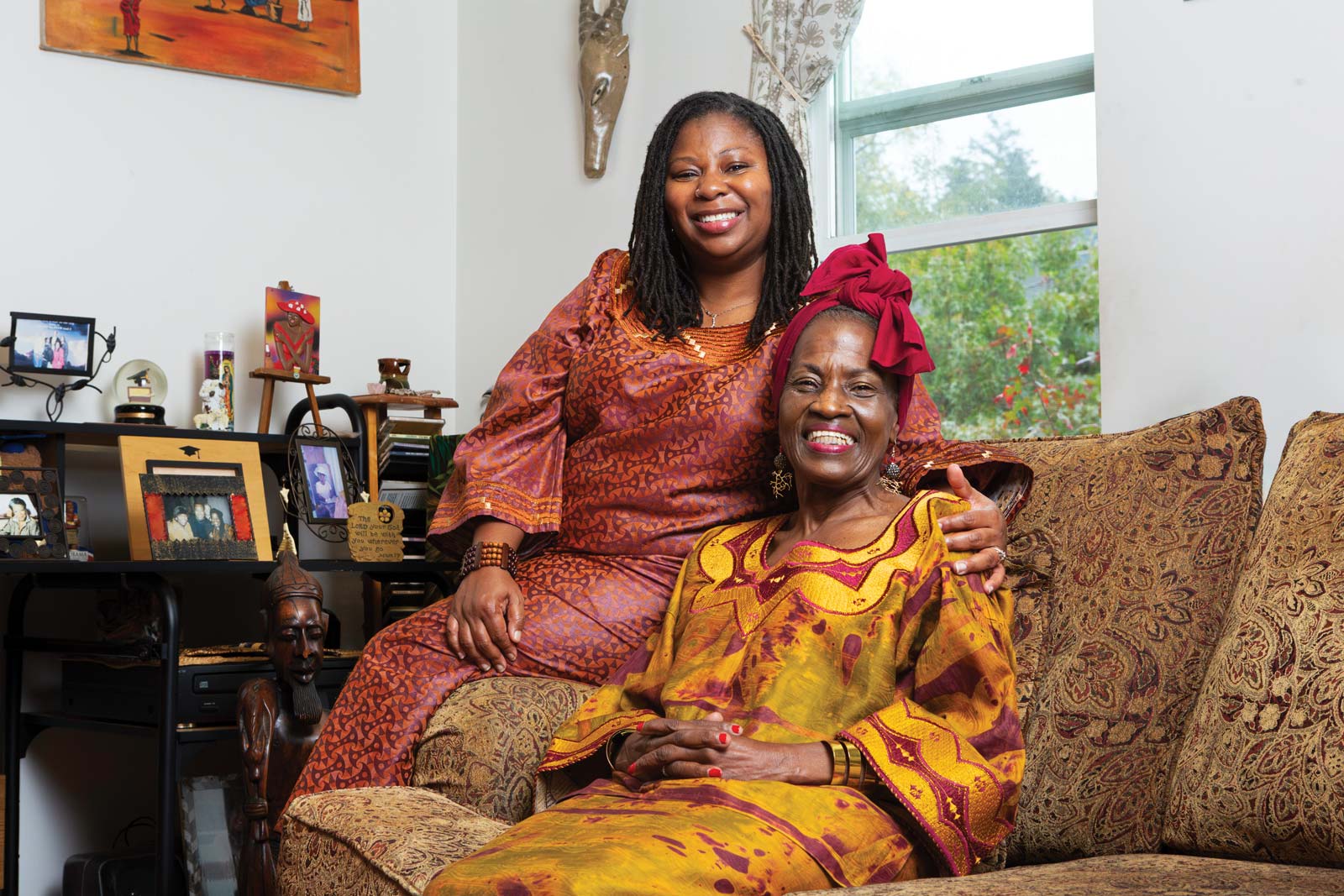
A framed photo of Maya Angelou sits by the window. Above the computer is a candid snapshot with the playwright August Wilson. In her Central District apartment, Nana Kibibi Monié is surrounded by mementos of a life devoted to African-American performing arts.
The executive director of Nu Black Arts West Theatre and a respected elder in Seattle’s Black community, Monié is often invited to Kwanzaa celebrations to participate in pouring libations. She leads community members in paying tribute to Black ancestors, giving a libation statement, and performing the ritual of pouring water on a living plant.
A cultural holiday is born
Now in her 70s, Monié was among the earliest in Seattle to celebrate the holiday. In fact, she remembers first hearing about Kwanzaa in the 1960s, not long after it was created by scholar and activist Dr. Maulana Karenga to celebrate Black heritage.
“During that time there was a vigorous embrace of Black cultural expressions like art, Black music, Black poetry, Black dance,” explains Lanesha DeBardelaben, president and CEO of Northwest African American Museum. “And this cultural holiday was [born].”
A week celebrating guiding principles
Starting on December 26 and lasting until January 1, each of Kwanzaa’s seven days centers on a guiding principle: Unity, Self-Determination, Collective Work and Responsibility, Cooperative Economics, Purpose, Creativity, and Faith.
The holiday is often celebrated communally in Seattle, with events hosted each night by different organizations.
“We’re not just gathering in our nuclear family around the hearth,” explains DeBardelaben. “We are getting together as a larger community to recognize what our cultural values are and to reaffirm them.”
The place of gifts in Kwanzaa
While gift-giving during Kwanzaa is technically part of the celebration, many families minimize the emphasis on presents.
“We don’t want it to be about giving presents, like Santa Claus,” notes Monié. “The gift is the gathering itself.”
Monié’s family would gather every year with many others at Life Enrichment Bookstore on Rainier Avenue, a beloved Black community space known as LEMS.
Monié has two daughters, and her youngest, Sauda Porter, is herself a mother of three. She says that as a child, she experienced Kwanzaa as pure joy. Going to celebrations was, and remains, a tremendous gift to her and her children. “During December it’s kind of dreary, and then walking in the door, it was just vibrant,” Porter recalls. “Everyone had on beautiful colors. You walk in and you’re getting hugs immediately. There’s just something about being around other brown-skinned people that feels nurturing.”
Recognition of history and abundant harvest
At the celebration, a prominent table would display a kinara or candleholder, fruits and vegetables to represent an abundant harvest, and unity cup, among other Kwanzaa symbols.
Many Kwanzaa celebrations follow a program of events, which affirm Black heritage from America and the African diaspora.
“I took my children because I wanted them to know their history,” says Monié, “but also to know a community that celebrated their blackness with pride and purpose.”
‘Steeped into her spirit’
Through drumming, dance, song, speeches, rituals, art, and food, Porter says that she was able “to hear culture, and to see and feel it.”
Those learning experiences, she said, were “steeped into her spirit,” and helped her make sense of what it meant to be Black. Celebrating Kwanzaa showed her the beauty of her culture in an environment “that doesn’t always honor us as Black people.”
Instilling love of community
Like her mother before her, “I am completely and utterly in love with Black people,” Porter declares. And that’s her hope for the next generation, too.
“I want my children to love their community,” she says. “For me, that’s what Kwanzaa did.”