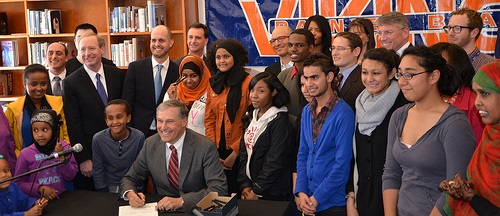
On Tuesday, Governor Jay Inslee signed House Bill 1472, opening the door for schools across the state to count advanced placement computer science as a math or science credit. The law's goal is to improve and expand access to computer science education, a high demand skill in Washington's technology-fueled economy.
Prior to the law, AP computer science, often one of the most difficult classes offered, did not count as a math or science credit. Instead it counted as an elective. By granting the course academic credit, the bill aims to encourage more students to take the course and many more schools to offer it. Currently, only 35 of the state's 622 high schools offer AP computer science. The bill, sponsored by Rep. Drew Hansen, Rep. Cyrus Habib, Rep. Roger Freeman, and Rep. Chad Magendanz, passed the Legislature with nearly unanimous support.
"I applaud the Legislature and Governor Inslee for ensuring our students will be able to compete for the jobs of today and tomorrow," said Brad Smith, executive vice president and general counsel of Microsoft and a founding board member of Washington STEM, a statewide nonprofit advancing excellence, equity and innovation in science, technology, engineering and math (STEM) education. "This is a step forward to help close the skills gap in Washington, and a move that will make our state a national STEM leader. Every young person in our state should have the chance to learn computer science; it's the new language of opportunity."
"Technology companies like Amazon and Microsoft, just a few miles from where I live, want to hire local kids from Washington state schools like me," said Bishal Acharya a senior and AP computer science student at Rainier Beach High School in Seattle. "If more students took computer science they would understand the opportunities it can lead to. Now that House Bill 1472 is law more students will be encouraged to enroll in computer science classes across the state."
A recent study conducted for the Washington Roundtable by the Boston Consulting Group found that there are 25,000 unfilled jobs in Washington because the state's residents don't have the right skills. That number could grow to 50,000 by 2017, with 90 percent of the jobs in STEM and healthcare fields. A recent poll by Washington STEM found that 77 percent of Washington state voters believed that computer science should count as a math or science credit rather than an elective course; 92 percent agree the next generation of Washingtonians will have more opportunities if they have STEM skills.
To learn more about Washington STEM, visit www.washingtonstem.org.