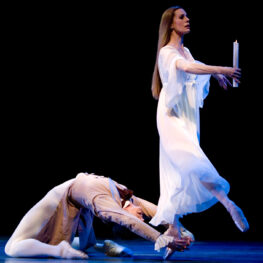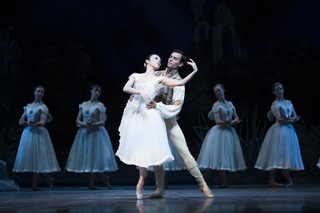
Pacific Northwest Ballet has created a Giselle that is lush and hypnotic, a production rooted in the ballet's 19th century origins in everything from the choreography to the newly created costumes and sets. It is a top-tier performance of one of ballet's great masterworks.
Is it a good ballet for kids? Well, for some kids. Giselle has none of the fairy-tale fascination of Sleeping Beauty, or a corps of young dancers like you see in Coppélia to hook the younger set. But, if like me you have a child who is interested in ballet, perhaps even studying ballet, seeing Giselle is as foundational as, say, reading War and Peace or seeing a Globe-inspired performance of Macbeth or experiencing the thundering Ode to Joy. It is a pillar of the classical ballet cannon, and PNB's production provides a historically fascinating recreation of the Romantic-era ballet. It is one of my 11-year-old's favorites, along with the equally tragic Swan Lake.
PNB has touted this run of Giselle as the penultimate chance to see principal dancer Kaori Nakamura before she retires at the end of the season. (She'll reprise several roles in the Season Encore performance.) Nakamura is enchanting in this role. In her leaps and turns she is as light as a sparrow. Nakamura also nails the considerable acting required of this part, transitioning from the flirty peasant girl, to the betrayed madwoman, to the haunting Wili. (If you are interested in seeing Nakamura as Giselle, get tickets for the Saturday, June 7 matinee. You can see casting for all of the performances at www.pnb.org).
Giselle is, at its heart, a ghost story. A vivacious peasant girl, Giselle, falls in love with a young peasant man who is really a Duke in disguise. The disguised Duke, Albrecht, hides when a noble hunting party stops in the village, including the noblewoman Albrecht is engaged to marry in his undisguised life. When a jealous suitor of Giselle's unmasks the Duke, Giselle goes mad, then dies.
In Act II, she joins the Wilis – brides who never made it to their wedding day. The veiled/shrouded brides/ghosts try to make Albrecht dance to his death, as is their way, but Giselle saves him by dancing with him until sunrise, when he is free of the Wilis' spell.
Act II is my and my daughter's favorite, with the ghostly woods, the haunting Wilis and the iconographic choreography. The Wilis float on fluttering feet, swarm unsuspecting men, and hop like banks of fog across the stage with legs and arms held at perfect horizontals to the ground.
PNB researched old rehearsal scores and choreographic notations to create a production of Giselle that is true to its Romantic, 19thcentury, Parisian origins. For the company's 2011 debut, they used rented costumes and scenery, which for this year's production have been replaced with new scenery and costumes created by French designer Jérôme Kaplan.
Drawing from historic woodcarvings and styles of the mid-19th century, Kaplan's designs, like the ballet itself, are richly evocative of Giselle's origins, with layer upon layer of texture, color and history. The opening night audience audibly gasped when the curtain rose on the misty forest in Act II. Ditto when the Wili's veils/shrouds were snatched from the Wilis' heads and invisibly drawn up and out of view.
I can't imagine a better introduction to Giselle than PNB's awe-inspiring production.