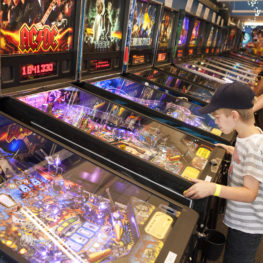
At a recent MathWays night presented by Explorations in Math and hosted by KidsQuest Museum in Bellevue, the room was packed with moms, dads and kids sitting at tables and having a wonderful time playing math games. Laughter and cries of triumph filled the room as the games were played and won. Equally important, math skills were being reviewed and reinforced in a way that turned math into a fun family activity. A repeated comment throughout the evening was, "We didn't know math could be so much fun!"
The things we, and our children, do well, are the things we enjoy doing. If, from an early age, we can make math something our children want to do, we will have taken a big step forward in increasing their understanding, enjoyment and confidence in doing math.
The MathWays night described above is proof that making math fun is, well, fun. And – it's something families can do together at home every night. The ideas, activities and resources you'll find presented here are intended to do just that: bring your family together to have fun with math.
These activities will engage your child because they're fun and they're challenging. And make no mistake: our children not only need to be challenged, they enjoy it!
Here are two things to keep in mind, however. First, it's OK if your child makes mistakes. As a matter of fact, one of the things I repeat regularly to the classes I work with is that a wrong answer is good. Not as good as a correct answer, of course, but a wrong answer tells me three good things about the student: she's listening, she's thinking, and she's trying. We can't ask more of our children than that; those are the three key ingredients for learning. In addition, telling the child this builds in a safety net that encourages her to take risks.
Second, there are two things you never say to your child: "I was never any good at math!" and "I hated math in school!" All this does is give your child permission also to do poorly in math and to hate it. After all, your child reasons, you made it through school hating math, why shouldn't I? And, when was the last time you heard an adult make those kinds of comments about reading?
Now to the Fun!
Mental Math
Mental Math means no paper, no pencil, no calculator. And it can be done just about anywhere: at the breakfast or dinner table, in the car or while taking a walk. Mental Math will challenge your child in an entertaining way. Here's how it works:
Younger Children:
Limit the operations to two: addition and subtraction. You might begin as follows, saying the numbers and operations slowly and clearly:
2 + 4 + 5 = ?
9 – 4 + 6 = ?
As your child gets better at doing these problems, you can increase the level of difficulty by making the string of numbers and operations longer.
Older Children:
For older children, add multiplication and division problems. Here are a couple of examples:
8 – 4 x 6 + 1 / 5 = ?
10 + 17 / 9 x 7 + 14 = ?
Games
There are many games you and your child can play (or that a child can play with siblings) that involve nothing more than cards, dice, or paper and pencil.
Fingers
Here's one that requires nothing but your fingers, and it's suitable for both younger children (addition and subtraction) and older ones (multiplication).
Two players face each other, holding one hand behind their back. At the count of 1-2-3, each player displays any number of fingers. The first to announce the correct sum or difference (for younger children) or the correct product (for older ones), wins the round.
When your child is comfortable playing with one hand, you can start using both hands to increase the level of difficulty. You can also increase the level of difficulty for addition and multiplication by having three people play. (I suggest that you make a rule when playing with multiplication that no player can show zero fingers – it's an unfair advantage!)
Find Ten
One of the addition benchmarks for first grade is finding combinations of numbers that add to 10. Doing this speeds up doing an addition problem and encourages children to look for connections in math, an important ability. This game will reinforce that skill.
Similar to Concentration, in this game children try to make 10 by turning over two cards that total 10. You'll need a deck of cards with face cards and tens removed (aces = one). Mix up the cards and place six rows of six cards face down between the two players. Taking turns, the first player turns over two cards. If the sum is 10, the player takes the cards and plays again. If the sum is other than 10, the cards are replaced face down and that player's turn is over and the next player tries. The game is over when no more tens can be made. The player with the most combinations of 10 wins.
Get to 100
Two or more can play this game, which requires a deck of cards (face cards removed, aces = one). Each player is dealt five cards. Players are allowed to use the numbers on those cards to create any numbers they can to add up to as close to 100 as possible, either over or under. Each student plays five (or whatever they determine) times and tries to have his or her total score equal zero. See below for examples:
First hand: 2, 3, 5, 5, 7
75 + 25 + 3 = 103
Score: +3
Second hand: 1, 9, 6, 2, 3
91 + 6 + 2 + 3 = 102
Score: +2
At this point a student would try to get a total score on the next hand to be less than 100, preferably at 95 so that the score for the hand would be –five and the total score would be zero.
For more math games, puzzles and resources visit our Web site, https://explorationsinmath.org.
Dave Gardner has taught at both the elementary and university levels. He is currently a Mathematician in Residence with Explorations in Math, a Seattle-based nonprofit whose vision is that every elementary student will succeed in math.