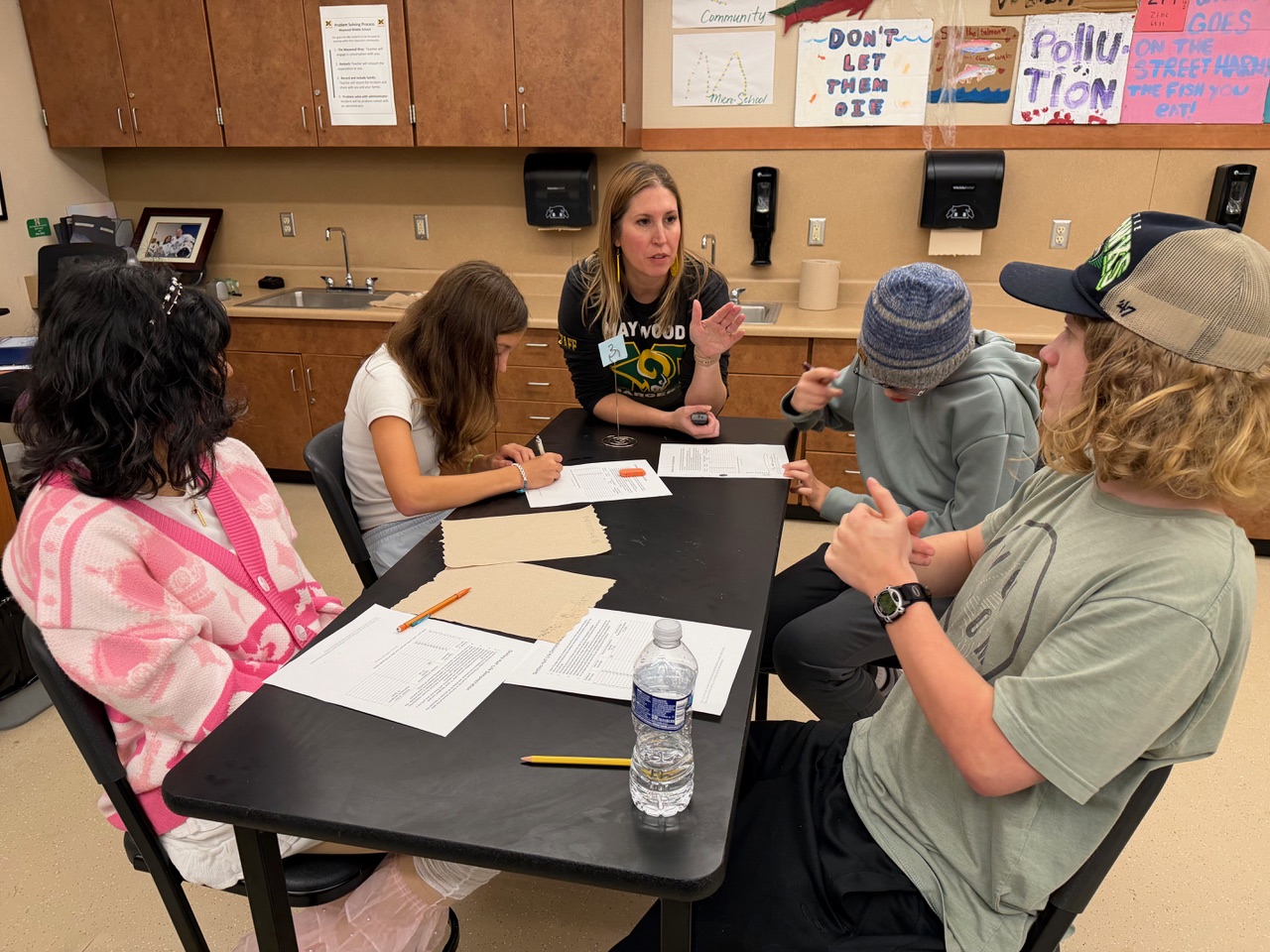
When Cadence was deciding which 8th grade classes to take at Maywood Middle School, a couple of things influenced the 14-year-old’s choices.
“I don’t like ELA,” she said, referring to English Language Arts, the term schools use these days for reading and writing.
So Cadence chose to spend part of her day in Issaquah School District’s experimental microschool, which combines science and English with a focus on the environment, and an emphasis on hands-on learning.
On a recent Friday afternoon, Cadence and her classmates were conducting an experiment to better understand radiation, using skittles and math — and both reading and writing. Earlier in the period, she participated in a class review session employing both writing and conversation. And her class also spoke briefly about the book they had been reading about the groundbreaking chemist and physicist Marie Curie.
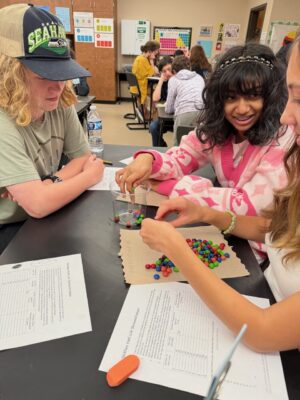
Students count “radioactive” Skittles in Valerie Buck’s 8th grade class at Maywood Middle School. (Image: Donna Gordon Blankinship)
In other words, her teacher, Valerie Buck, weaves reading and writing into every day and every project, with or without Cadence and her classmates realizing. It’s a creative approach to meeting students where they are academically.
Customizing education to the needs of individual students is not new. Research has shown for decades that every child requires a slightly different path to academic success. But most schools find it easier to talk about than to actually do in large classes during short class periods.
Issaquah’s microschool program is just one notable example where a Washington school is working hard to overcome those obstacles. Creativity in educational programs appears — in my limited view — to be growing again in these post-pandemic years. Microschools are one option.
Some consider microschools, which are more popular on the East Coast, a leftover from the pandemic. Some families who felt online learning wasn’t working formed their own learning “pods,” where students could both quarantine and learn.
The Maywood program doesn’t exactly fit the microschool model, because it’s not an all-day, standalone program. But it has many of the elements: It is small (50 total students in two classes) and different and has a focus on personalized learning.
Students opted into the program, which the school views, in part, as a way to get them ready for the project-based learning approach at a district high school. Building community is another major goal in Buck’s classroom and another emphasis at many microschools.
The Issaquah project is not offered as an all-day standalone program, although that is a goal, because school officials could not cobble together enough money to launch a larger pilot.
They are lucky to have enough space — tucked away from regular classes — to give them the feeling of being special and unique. And this corner of Maywood has a couple more empty classrooms just begging to be filled with an expanded program, which Buck said would allow them more time for hands-on learning.
Buck chose to focus on the Salish Sea and sustainability and has integrated community service projects to add real-life experience. For example, students did a water use study about shorter showers and visited the Gates Foundation to learn about water and toilets.
“I think it’s important because kids really need purpose with what they’re learning,” Buck said.
Penelope, 13, agreed. “It seemed more interesting than normal classes,” she said between counting “radioactive” skittles in Buck’s class. “You get to do nice hands-on things, which is fun.”
Julia Bamba, the microschool principal who oversees special projects and innovation for the district, said Issaquah started experimenting with alternative school models because they wanted to give students more control over their learning.
The district takes a slow and steady approach to innovation, starting with prototypes that are thoroughly tested before scaling. It’s not good enough for the innovations to meet student desire for variety (or more science and less language arts); they also must meet the district’s high academic standards, Bamba said.
She pointed to a few other public school programs that both inspired Issaquah and keep them thinking about how they can innovate.
Big Picture Learning is a network of schools across the nation and in Washington that emphasizes student-directed learning. And Tacoma Public Schools has become a center for creativity through a maritime education partnership with the Port of Tacoma, and by providing numerous ways students can earn college credit while still in high school.
‘Customer’ focus and creativity in Spokane
One of my favorite examples of school innovation is Spokane Public Schools. A recent conversation with Kristin Whiteaker, who is director of charter schools, satellite schools and program support for the district, revealed there’s more going on in Spokane than I was aware of.
You may remember that when Washington state started experimenting with charter schools, Spokane was the only district that decided to embed that choice inside their public school walls. But they’ve done a lot more. They not only provided intentional remote learning years before the pandemic, they have strengthened and grown their online school since then. Spokane Virtual Learning welcomes students from across the state and has higher graduation rates (88% in four years) than a lot of regular public schools.
Spokane offers many other choices from the school innovation checklist: Dual-language immersion in Spanish and English, project-based learning, a parent-teacher cooperative model, special resources for homeschool families, a biomedical institute, a standalone highly capable program, and a Montessori school. Spokane also has district-wide school choice so students and families can choose which program is best for them.
Why so many choices? That’s what the community wanted, Whiteaker said.
While many districts across Washington lost enrollment during and after the pandemic, Spokane didn’t. Whiteaker credits their “customer” focus and ongoing academic success.
“We’re constantly surveying families to ask questions about what their interests are and what their perspectives are before we make decisions,” she said.
Whiteaker emphasized that Spokane isn’t just interested in creativity, but academic success.
“We lead with data and research and have a focus on best practices,” she said, adding, “And the heart. Care that comes from the heart is part of our culture.”
They don’t have a microschool, but I’m guessing that’s because Spokane parents haven’t heard of them yet.
An evolving trend
Microschools most closely resemble one-room schoolhouses, although they usually have more than one room. But the idea is the same: small school, multi-aged classes, hands-on, differentiated learning. The concept blossomed during and after the pandemic, but existed well before.
Their size makes the economics more difficult than the academics, and state regulations can also be a stumbling block. A few states have passed laws giving microschools the right to exist, including Georgia, Tennessee and Texas. Other states, including Oregon, Illinois and Massachusetts, require hybrid authorization similar to private schools.
Many microschools in other states (and potentially in Washington) operate under homeschool laws or as private schools. A 2025 report from the National Microschooling Center estimates that between 750,000 and 2.1 million students attend microschools in the U.S. They are in every state as well as Washington, D.C., and nearly half were founded by parents.
Sixty-one percent of microschools nationally get their funding from tuition, while 38% get at least some of their money from state school choice dollars, such as vouchers. Ten percent get regular public school or charter school funding.
A Washington proposal to establish a pilot project to authorize certified teachers to operate microschools failed to pass during the 2022 legislative session. But districts and private schools are allowed to experiment with the model under existing laws.
Tailored approach
Another Washington microschool, the Kineo School in Kirkland, is private, tuition-funded and designed to serve a neurodivergent student population. It has a multi-age classroom and operates as a one-room schoolhouse for children in kindergarten through third grade.
Flexibility and personalization are two main values at Kineo, explained school Director Elizabeth Kent. Everyone learns at their own pace and in small groups based on ability, not age.
Kineo and other microschools are not for everyone, Kent said. Children who thrive in larger social groups do better at larger schools. But the benefits outweigh the disadvantages for some children, such as individualized learning, which is much harder to do in a regular classroom of 30 kids with one teacher.
“I don’t know how teachers can work with large groups of students and tailor things,” Kent said.
But Kineo’s low student-teacher ratio — 10 students with two teachers, plus specialists like occupational and speech therapists — comes with a hefty price tag of about $26,000 a year. Kent said that’s about middle of the road for private schools in the area.
The school was bigger before a large group of students graduated. Kent said they hope to grow again, but won’t go above 40 or 50 students in a few class groups.
Kent said size is an important element of a microschool, but other things, like community and personalized learning, are what make the schools special.
“Meeting individual student needs is huge. I do think you can do that with a traditional program,” she said. “What doesn’t work is if a family expectation doesn’t align with what the school is offering. It’s just not enough to desire a small school.”
Support non-profit journalism
This article has been reposted with permission from the Washington State Standard, part of States Newsroom, the nation’s largest state-focused nonprofit news organization and committed to shining “a light on policy and politics in all 50 states.” Click here to support nonprofit, freely distributed, independent local journalism. Read this article and others online at Washington State Standard.