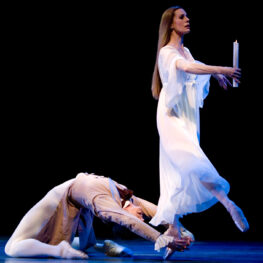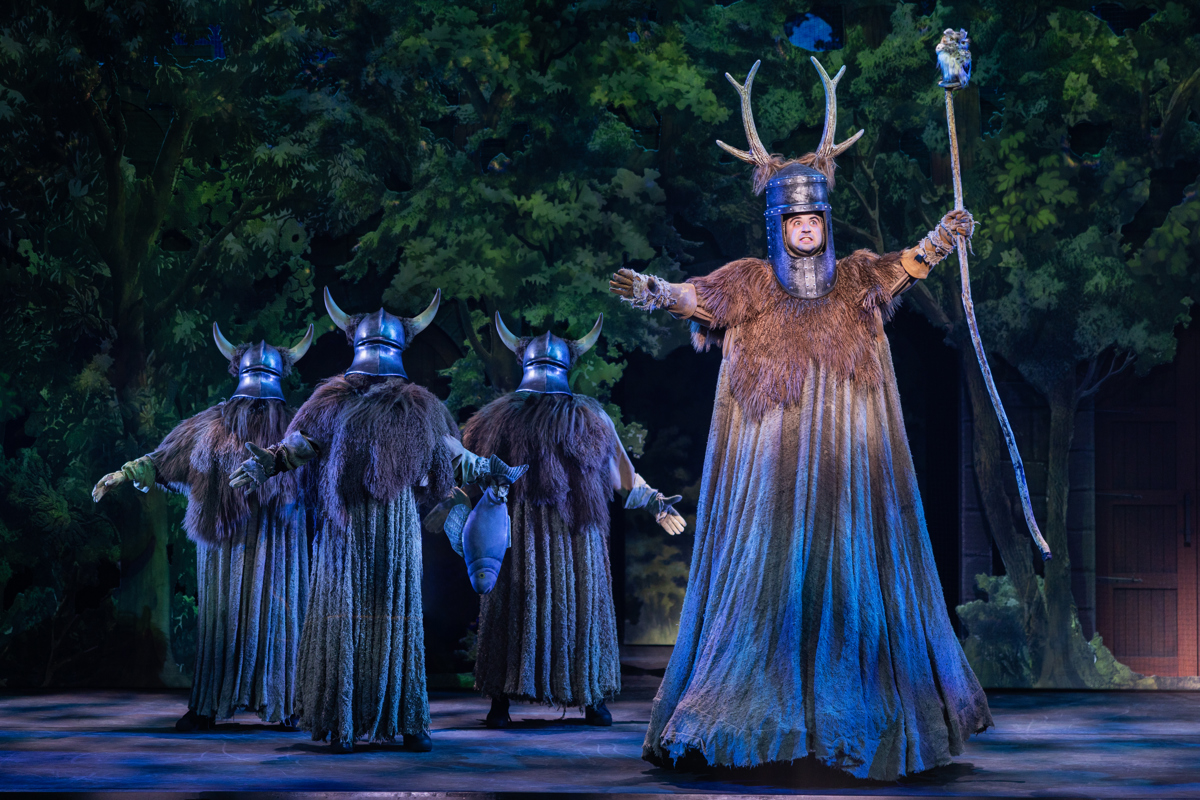
The 5th Avenue Theatre Company presents “Monty Python’s SPAMALOT,” a revival of the Tony Award-winning musical. Spoof, goof, and sometimes woof, it first premiered in 2004 to critical and commercial acclaim. Based on the 1975 cult classic film “Monty Python and the Holy Grail,” the musical adaptation has taken on cult status of its own, and if you haven’t always been “looking on the bright side of life,” then gear up for a whole (spama)lot of nonsense.

(Image: Matthew Murphy and Evan Zimmerman)
“The [Synopsis] That Goes Like This”
King Arthur (Major Attaway) comes coconut shell-clopping through drab and dreary medieval England with his servant Patsy (Blake Segal). He is on a mission to assemble his Knights of the Round Table, travel to Camelot and, what else, find the Holy Grail. What ensues are consecutive slapstick, absurdist gags that generally support Arthur’s end goal, though to fully summarize all of the ludicrous plot points of this comedy would be a fool’s errand.
The musical opens in “Finland” with “Fisch Schlapping Song,” a kitschy parody that sets the tone for the ensuing 2.5 hours. The musical number, “He is Not Dead Yet”, finds plague-ridden peasants vying to stay out of the corpse wagon. But the production’s farcical timbre finds its stride when Arthur beckons the Lady of the Lake (Amanda Robles) to authenticate his sword Excalibur and confess their generic love (“The Song That Goes Like This”). She brings along her Laker Girls, scantily clad dancers with pom poms. The mockery train finds fantastically preposterous speed and is completely runaway when the group of nincompoops make it to Camelot, a medieval Vegas, where they party (“Knights of the Round Table”) until God commands them to find the Holy Grail.

(Image: Matthew Murphy and Evan Zimmerman)
The second act is far easier to settle into, given the first act’s chaotic preparation. Arthur and Patsy must find a shrubbery for the barbaric Knights Who Say Ni, leading to the production’s most well-known number “Always Look on the Bright Side of Life.” When the group is then forced to put on a Broadway musical to appease the creatures, “You Won’t Succeed on Broadway” laments the necessity that they find Jewish people in order to fulfill the tall order, an inside joke for SPAMALOT-admirers that doesn’t quite land for those of us new to the musical.
“You Won’t Succeed on [Common Sense Media]”
There is a nuance that requires some explanation to younger viewers about this particular sequence, which goes on to depict “Jewish” cultural moments, like a spoof of Fiddler on the Roof and a drag Barbra Streisand. The production wants to capture the zeitgeist of their cultural relevance, but the sequences could come off as cliché and offensive. The comedic quality of the joke only works because it is done with love and admiration, not explicit antisemitism, but this is a difficult concept to explain to a young person who has no context for it. As a mid-30s viewer who isn’t a Pythonite, I found myself uncomfortable with their implications, but reassured by the reaction of those in the theater that this was a friendly joke made with love.

(Image: Matthew Murphy and Evan Zimmerman)
There are jokes personalized to Seattle audiences throughout. (A Seahawks jersey may have found its way into the costume racks.) But for impressionable audience goers, there are some moments of inappropriate allusions. They are often quick – a character makes a crude, sexually charged gesture with his hands and mouth on a broomstick – though some are more intrinsic, like the lack of women in the production.
The Lady of the Lake is the only female presence, apart from her Laker girl back-up dancers. When she is ignored for much of the second half, her solo “Diva’s Lament” pokes fun at it, but highlights the fact that this is a man’s show with predominantly male-leaning and male-centric skits.
Overall, I think many of the inappropriate jokes would fly over the heads of younger viewers. Even I missed many of them; the cast speeds from one to the next without slowing down for the punchline to hit. I couldn’t imagine, however, that there is anything for anyone under 13 to enjoy.

(Image: Matthew Murphy and Evan Zimmerman)
Even the silly, idiotic jokes are a bit too smart or mature or require context for viewers under that age to fully understand, and while the physical comedy provides much of the musical’s laughs, even that may get old over nearly two and a half hours of sitting.
“[Dissenter’s] Lament”
As I sat quietly through the inane routines and absurd skits in “Monty Python’s SPAMALOT,” fellow theater-goers around me cackled and cheered, laughing and quoting along with the glorified fart jokes (and a few literal flatulent punchlines too). At first, I thought perhaps the affected British accents were losing me in translation. As the production progressed well into the second half, the sketch-based absurdity never quite grew on me.
A quote by Michael Scott kept flitting through my thoughts: “I love inside jokes. I’d love to be a part of one someday.” The inside jokes in “SPAMALOT” are almost imperative to enjoying the scattered premise that contains no urgency or interest in even a semblance of plot, conflict, and resolution. The musical doesn’t want to be confined by an arc, both in terms of premise and character, and this is evident for the entire show, which moves from punchline to punchline as cheaply as it can.

(Image: Matthew Murphy and Evan Zimmerman)
The disparity between my thoughts on the musical and the obvious reaction of others in the theater leads me to the conclusion: you are either a fan of Monty Python’s humor, or you are not. Do yourself a favor before seeing “SPAMALOT”: watch or rewatch “Monty Python and the Holy Grail” to get a sense of whether or not you will be able to stomach it.
Know Before You Go
- Dates: The show runs through February 15, with times in the afternoon and evening
- Runtime: Approximately 2 hours and 20 minutes with one 15-minute intermission
- Recommended Age: 13+.
- Special Performances
- The ASL Interpreted and Open Captioned Performance is Friday, February 13 at 7:30 p.m.
- The Audio Described Performance is Saturday, February 14 at 1:30 p.m.
- Location: The 5th Avenue Theatre is located at 1308 5th Avenue, Seattle, WA 98101