This article originally appeared in the August 2010 issue of Seattle's Child.
Every time I drove from Seattle down to Portland, I passed the sign to Mount St. Helens and thought, "I really want to go there sometime." But it's too far off I-5 to make a reasonable side trip and too far from Seattle to make a reasonable day trip, so I continued whizzing by the exit.
All that changed earlier this summer when I discovered Mount St. Helens can make a perfectly reasonable, and truly awe-inspiring weekend trip. It took the 30th anniversary hullabaloo to get me up the mountain, but boy, I'm glad I got there.
Mount St. Helens blew 30 years ago on May 18, 1980. The magnitude of the eruption and the enormity of the destruction it caused have made Mount St. Helens a learning lab for volcanologists around the world as well as a tourist destination.
The most destructive volcanic eruption in the history of the United States sent a blast cloud that hurtled at more than 300 miles per hour, flattening hundreds of square miles of forest, filling Spirit Lake with mud and trees and taking the lives of 57 people. At the end of the day, Mount St. Helens was 1,300 feet shorter.
A remarkable amount of new life has sprung up since in the last 30 years, and the waters of Spirit Lake are clearer than ever, but the evergreens are small and few around the volcano. Plants have softened the edge, but they haven't covered the towering piles of ash or vistas of dead tree stumps.
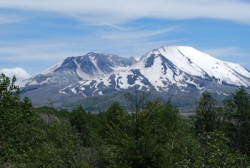 |
For our trip, we met up with friends from Portland at the Mount St. Helens Motel in Castle Rock, a nice, clean, simple motel a few hundred feet from the I-5 off-ramp. We ate pizza, drank root beer floats and planned for the day ahead. The next morning, on a beautifully warm and clear day, we headed the 52 miles up to Johnston Ridge Observatory, named for Geologist David Johnston, who died in the blast. There, you get the closest and best view of the crater from a bluff a mere 5 miles away. On a clear day, it's spectacular.
The visitor's center has a number of interesting exhibits, including the enormous stump of a Douglas Fir that was snapped by the blast, a seismograph that records the "earth's" movement when you jump up and down on the floor in front of it. The 16-minute movie about the eruption remains the main attraction, though. The video explains, through words and video, the three phases of destruction 30 years ago: the initial landslide, the blast, and the flow of mud and rocks that buried the Toutle Valley.
The movie can be scary for some kids, and we had to remind our 5- and 7-year-olds that scientists learned a lot from the 1980 eruption and monitor the volcano every moment of every day, so they'll know if there's another eruption coming. Ditto for Mount Rainier.
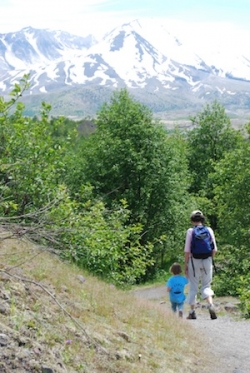
We took a hike around the "hummocks," hills of ash in the Toutle Valley, then headed out. It was, in the words of my girls, "awesome" – in this case, a truly appropriate use of the word.