This exhibition ended on 5/17/2015.
There’s no word for “art” in any North American tribal language, according to David Penney, curator of Seattle Art Museum’s new exhibit, “Indigenous Beauty: Masterworks of American Indian Art from the Diker Collection.” The native people carved, wove or embroidered beauty into everyday objects for their own creative enjoyment. Or they fashioned pieces to contemplate in the intimacy of their homes or share as gifts or use in ceremonies. Pick up a “SAM Kids Activity Guide” at the admissions desk, and let’s walk through the rooms on a scavenger hunt for bug-eyed bulls, an embroidered elk head and stars.
Nevertheless, Charles and Valerie Diker began collecting Indian artifacts from across the United States and Canada, primarily for their beauty. They have loaned 122 masterworks to SAM, representing an astonishing array of objects spanning 2,000 years and going far beyond the familiar totem poles and teepees. The works are arranged geographically in five rooms: Look at the map at the beginning of the exhibit to get a good overview. Keep in mind that the artisans used the materials they could readily find around them, often decorating with things they were able to trade.
First Gallery: Alaska, the Arctic and northern regions. Because there are few large trees in the region, you’ll find things made of driftwood and walrus tusks, among other materials. Many of the pieces are useful items, like pipes and fishing tools, decorated to look beautiful. The masks combine animal and human faces to tell stories before people had written language. Most interesting are a set of tiny snow goggles made hundreds of years ago and masks representing the souls of evil dead people. Can you spot a polar bear face, a walrus face and a seal swimming downward?
Second Gallery: Northwest Coast, Great Basin and California. Notice how people used what they found around them, from animal skins and wood to roots and grasses. Some of this coastal art is familiar to us, in the curving, geometric forms and vivid, abstracted images of people and animals. Can you find a man riding a bird (made of glass instead of the traditional wood)? How many birds can you find? How many fish? In the California basket section, look at the life-sized photo of Louisa Keyser/Datsolalee – a cook in a mining camp whose stunning Washoe baskets were discovered by a businessman – then find the baskets shown in the photo.
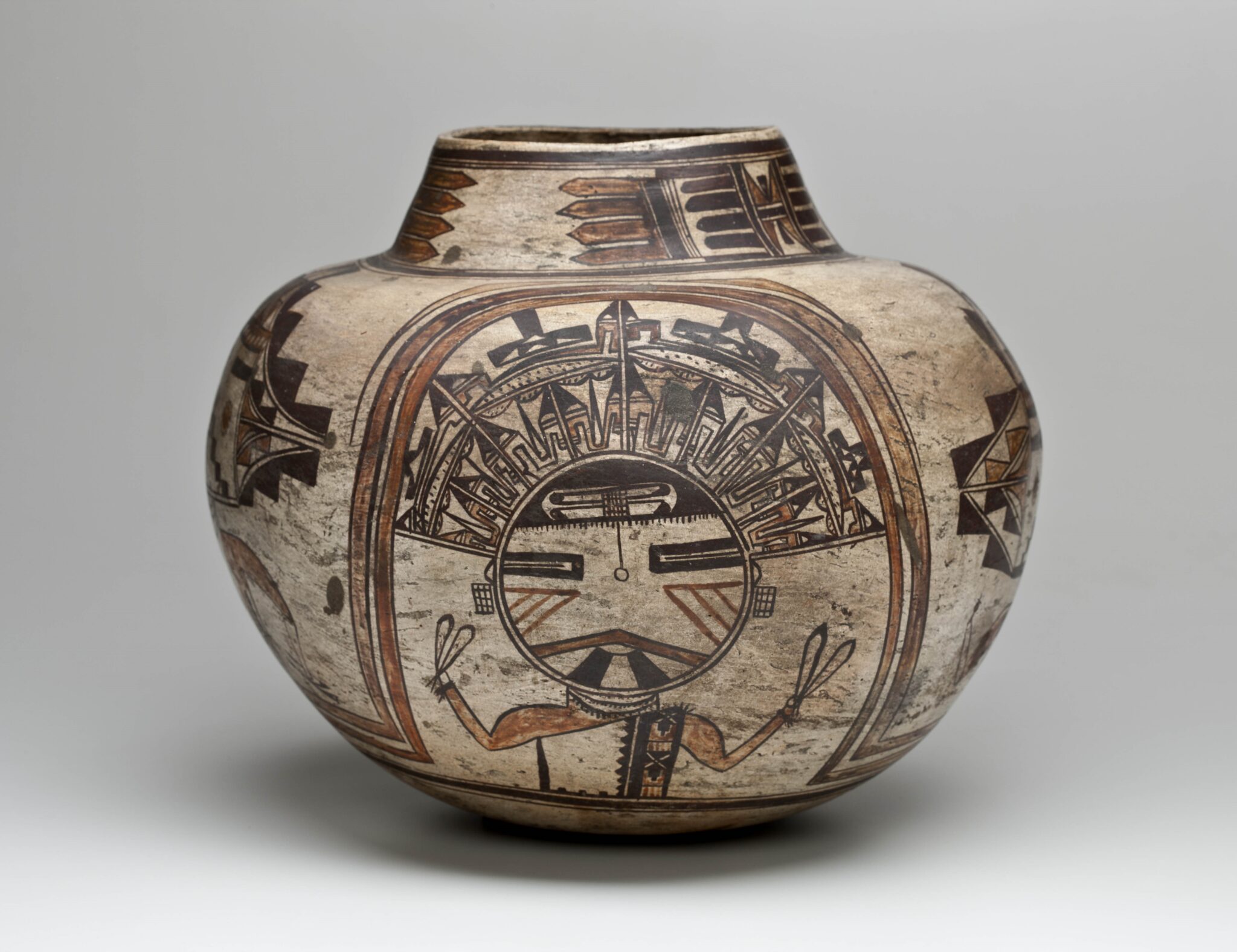
Third Gallery: Southwest United States. There’s a lot of clay in the area, and so you'll find pottery as a main art form, but you’ll also see things made with cornhusks, horsehair and cottonwood. On the walls, you’ll see pictures of families who set up firing places in the mountains to make their pottery, with sources of materials and techniques passed down from generation to generation. The black-on-black affect, stunningly shown on the jar with the serpent, was a firing “mistake” that artists later decided they liked. Katsina dolls in this room were first given to girls to teach them feminine virtues, but some of them could be scary. The one with the saw – for cutting up bones – was meant to frighten children into behaving. Can you find a bird eating a seed, a pumpkin and a doll with a bug-eyed bull’s face?
Fourth Gallery: Great Plains. “Maternal Journey,” a recent installation by Rhonda Holy Bear, dominates this room. The artist uses wood, clay, cotton, wool, aluminum wire, buckskin, fur, feathers and thousands of beads to create this vignette of a mother traveling with her children. Half of the room showcases marvelous pieces of clothing, shoes and bags, mostly created by women. Why do you think one of the baby carriers has skis attached to it? The other side of the room has pieces created by men to commemorate war exploits, including a depiction of the Battle of Little Big Horn drawn and painted by Lakota artist Standing Bear who fought there. Can you find an embroidered elk head, a papoose and a blue horse in this room?
Fifth Gallery: East Coast and Woodlands. You can spot local materials, such as polished wood, porcupine quills and animal skins, but Indians on the east coast had much earlier contact with Europeans, and so you’ll see ribbons, cotton, bits of metal and, of course, beads integrated into the artworks. There’s an emphasis on intricate carving and highly decorated clothing and bags – fancier than European couture in the view of one of the curators. How would you like to wear the heavy hide coat with all of its decorations? Can you find a tiny beaver, a turtle and stars (or maybe starfish)?
As a complement to the Diker collection, there are three rooms of local Northwest Coast art loaned by Seattle collectors. Notice the old and contemporary pieces set side by side, showcasing striking new interpretations of traditional designs. Most eye-catching is Michael Nicoll Yahgalanaas’s “Red,” a large mural of a Haida legend told in the style of Japanese manga comics. In these rooms, can you find two frogs, seven tiny heads, a heron and a wolf skull?
Maybe when they get home, children can create their own “native” artwork from things they find in their own house and yard or things they can buy or trade. They can always create free art in the Chase Art Studio on the lower level of the museum.
IF YOU GO
Where: Seattle Art Museum, 1300 1st Ave., downtown Seattle.
When: Now through May 17. Wednesday, Friday, Saturday and Sunday, 10 a.m. to 5 p.m.; Thursday, 10 a.m. to 9 p.m.
Cost (includes all exhibits): Adults, $19.50; seniors, $17.50; students and teens, $12.50; children 12 and younger, free. On the first Thursday of each month, adults $6 to $9; children and teens, free.
Special Events:
Family Community Day: Saturday, Feb. 28, 10 a.m. to 3 p.m., features Native American art, culture, music and dance with storytelling and workshops; free for kids; free for adults with admission.
Family Fun Workshop: Patterns and Textures: Saturday, March 14, 10 a.m. to noon, gives kids a chance to sketch and make mosaics; $15 for one adult and two kids.
Teen Art Lab: Indigenous Art: Thursday, March 5, 4 to 6:30 p.m., gives teens a chance to make art inspired by original artists of the Pacific Northwest; free, registration required.
Teen Art Lab: The Power of Cedar: Thursday, April 2, 4 to 6:30 p.m., provides materials to make a cedar necklace or wall hanging; free, registration required.
Teen Night Out: Friday, May 8, 7 to 10 p.m., lets teens take over the museum with music, art tours and contemporary art-making workshops; free.
Contact: 206-654-3100; seattleartmuseum.org.
Wenda Reed is a Seattle-area writer who enjoys and studies art.