Approaching the gym at Bellevue’s Highland Community Center, the familiar sounds of bouncing balls and kids calling out to each other echo down the halls. Inside the doors, more than a dozen young athletes, from grade school through high school, are rolling across the floor in specialized sports chairs — a typical practice session for the Seattle Adaptive Sports (SAS) wheelchair basketball teams.
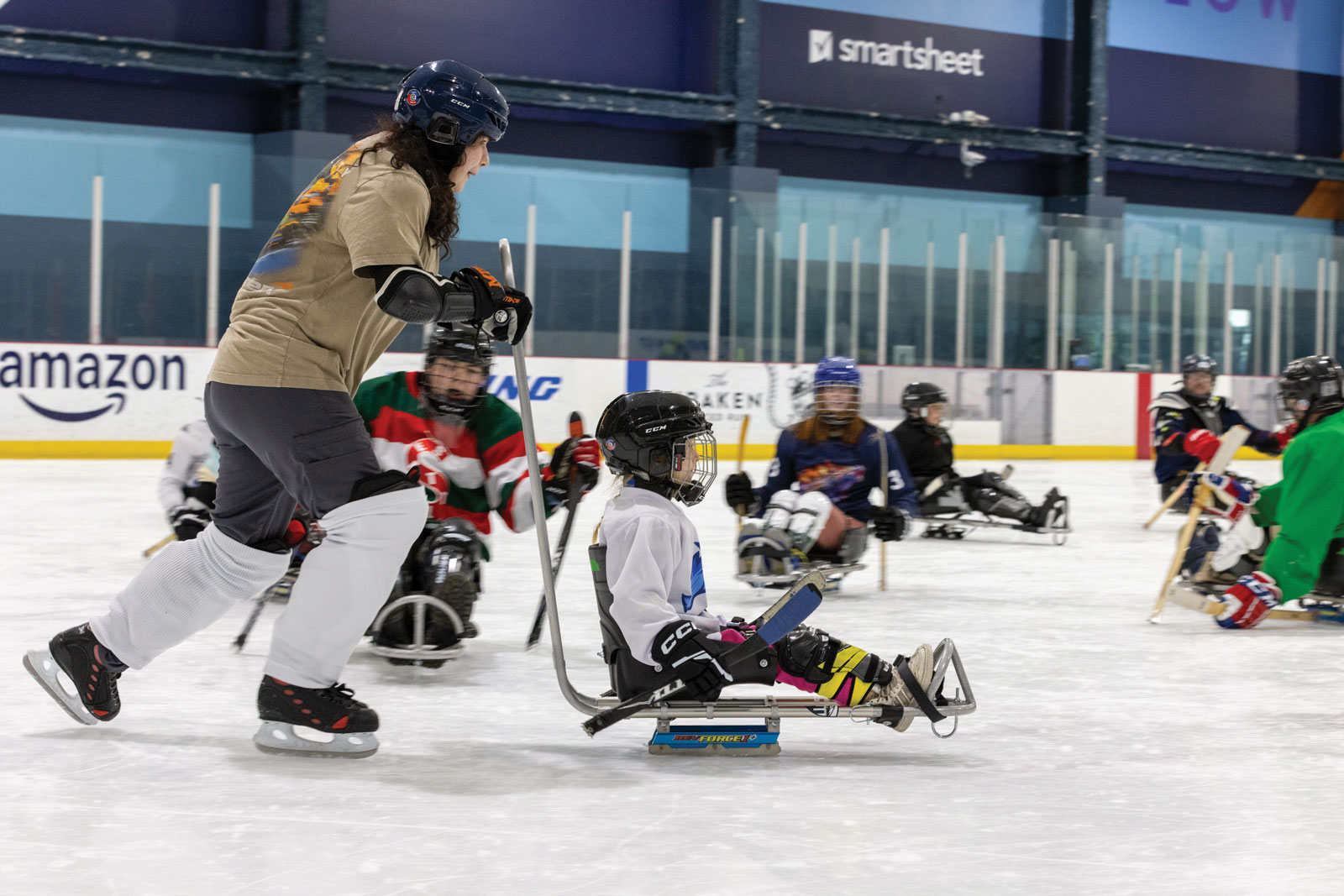
Sports have been adapted to meet the special needs of student athletes in Greater Seattle for decades, providing opportunities for countless athletes to compete on teams and producing several current and former Paralympians. Seattle Adaptive Sports has been part of the community since the early 90’s, organizing teams that compete in sled hockey (players sit on specialized sleds low to the ice), soccer for athletes in motorized wheelchairs, goalball for visually impaired athletes, and wheelchair basketball (players propel themselves across the court and older age groups shoot on regulation hoops).
SAS teams regularly compete against programs from Tacoma, Spokane, and Portland, and travel to compete nationally.
Back at the community center, the younger athletes are wrapping up their practice session while older players are gearing up for more intensive drills. SAS runs three youth teams: varsity for ages 14 to 18, prep for kids ages eight to 13, and the Micro Sonics for players ages four to seven. Their overlapping practice times create mentoring opportunities between age groups, and many of the older players have passed down sport chairs they’ve outgrown to younger athletes.
SAS designs all its programs to be as accessible as possible and to lower or eliminate the many barriers to participation, including the significant cost of equipment, facility rental, and travel. They use grants and fundraisers — including their annual gala, coming up on March 7 — to fund scholarships for athletes and purchase and maintain equipment that can be loaned out to new members. All of this is with the goal of increasing the number of participants and growing adaptive sports locally.
Current SAS families come from as far north as Bellingham and as far south as Auburn.
Brennan Henderson, 16, attends Auburn Riverside High School and began playing wheelchair basketball just before turning seven. He is now one of the most experienced players in the program.
“I started with power soccer. I’ve tried sled hockey before, but my main sport with SAS is wheelchair basketball,” Henderson says.
The sophomore doesn’t remember being nervous their first time on the court.
“My mom showed me videos of wheelchair basketball, so that probably helped me know what to expect,” Henderson says. “I kept turning in circles because I didn’t know how to use the chair and my arms were really impacted by cerebral palsy. Over time, I became stronger and my arms became stronger and I learned how to adapt myself to use the chair.” Henderson has not only adapted but excelled, earning “most valuable player” honors at the West Coast Championships in 2024.
Jess Thomson has watched a lot of kids like Henderson develop and find success through SAS programs. A member of the board and parent of an SAS athlete, she first introduced her son to playing sled hockey with the adult team at the Kraken Community Iceplex before becoming a founding member of SAS’s new youth team. Her son now participates in multiple sports with SAS and Thomson has seen him compete in ways that a lot of kids with disabilities aren’t able to access.
“I think one of the things that able-bodied people take for granted is the luxury of being able to compete,” explains Thomson. “Every kid in this organization has been through surgeries and procedures. These kids have grit, they are really tough.
But it’s a very different kind of toughness to learn how to compete athletically. And every person in Seattle Adaptive Sports has that opportunity,” Thomson says. “Once kids come out and try it, they wind up sticking with it because they are drawn to sports the same as anyone else.”
SAS works with new members to help orient them to the sports they are interested in. For some, like Thomson’s son, who uses forearm crutches off the court, it may be their first time in a sports chair. And with sled hockey, where able-bodied siblings are encouraged to join practices, it may be their first chance to play a sport with a family member.
Interested in becoming involved with Seattle Adaptive Sports? Contact [email protected] for more information.