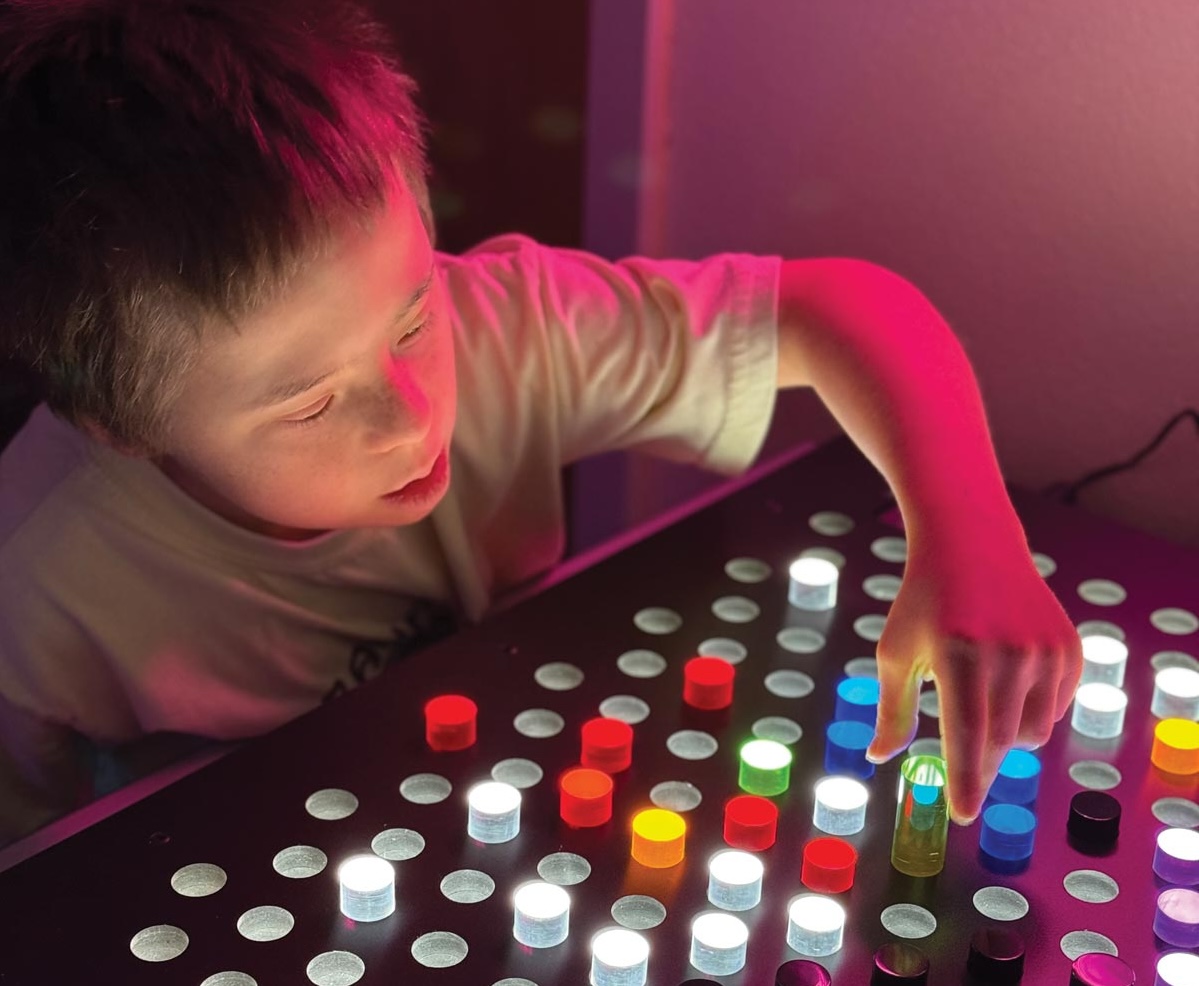
Walking into Sensory Tool House in Lacey, you’re immediately surrounded by subtle clues that the store was purposely built for neurodivergent people. The flooring was installed so that its parallel lines direct you inward. The walls are painted in calming colors that research has shown to be conducive for sustaining regulation. And, perhaps most important, all merchandise is kept out of the package for curious hands to explore.
“It’s try-before-you-buy,” explains Sensory Tool House Vice President Lauren Howard. “You’re not gonna know if that neato squishy everyone is talking about is gonna be a good fit for you if you aren’t able to engage with it before you buy it.”
Walking the aisles, you’ll find every possible product for supporting an under- or over-stimulated neurodivergent mind, from lava lamps, whose slow, mesmerizing visual display can soothe anxiety, to compression swings that help develop balance and motor skills while enveloping the user in a calming, hug-like embrace. They have weighted blankets, wiggle seats, adaptive feeding accessories, crash pads, and “chewelry” (chewable necklaces). And, of course, there are the fidgets — that ever-evolving array of self-regulation aids. The folks at Sensory Tool House stay on the cutting edge of tactile toy innovation.
“Our staff is roughly 95% neurodivergent, and we have a wildly talented inventory and purchasing team,” says Howard, “They’re always saying, ‘I saw this on TikTok. Is this something we should be carrying?’”
Howard and the store’s founder and CEO, Katie McMurray, are driven by a commitment to accessibility and inclusion. It’s personal for them; they’re both neurodivergent, with neurodivergent children. They understand the stigma and judgment that can arise from something as simple as going shopping with a neurodivergent kid who might be overwhelmed or stimming. To counteract this, the store has a simple rule: no apologies needed.
Howard says, “As a parent, a lot of times your gut reaction is to apologize for your kid’s behavior, and why? It’s a regulatory behavior, it’s natural, it’s not gonna cause any harm. For us the goal has always been to get rid of some of these antiquated ableist notions and allow families to show up authentically. We’re not shushing!”
For the child or caregiver who needs to take a break from shopping there’s the Sensory Room, a shoes-off “Zen Den” designed to help calm anxiety with soft furniture, low lights, and engaging colors. You can even schedule a 30-minute consultation to design a sensory space in your own home, on your budget.
Kristina Hawley traveled down from Bothell with her two neurodivergent kids to visit the store for a “Sensory Santa” Christmas event and left delighted.
“It was super well thought out,” said Hawley. “The lighting was low yet still festive and visually engaging, and the space was quiet. They had soft cushions on the floor for seating, a sensory bin set up for kids to play in, and flexible, non-fragile decorations that were clearly selected by someone who knows how some kids can turn nearly anything into a weapon!”
As someone with AuDHD, Hawley sometimes struggles to meet social expectations, and she appreciated the intentionality behind the store design and her interactions with staff: “I definitely felt seen there.”
Since the store’s founding in 2021, Howard has worked to populate the calendar with in-store activities.
“One of the things I set out to do was to have more events in our space: dance classes, watercolor classes, toddler playgroups, a neurodivergent teen book club,” she explains, “But it was still ‘othering.’ We were saying, ‘There can be a place for you in this other place.’”
She’s now working to make Sensory Tool House extend outward into the broader community, facilitating access to events for neurodivergent kids in locations like Olympia’s Hands On Children’s Museum and the public library. Last month they set up a Sensory Recovery Area amid the bustle of the Lacey Cultural Celebration to give attendees a space to regulate and reset.
For Howard, the move now is to work on making the world outside the shop more welcoming for the people who come inside:
“Instead of saying, ‘You can have access and you can be included in this specialized store that was built to support people like you,’ we can find ways to facilitate these events in their spaces, so that the community is being more inclusive, we’re not just an inclusive space within the community.”