When her first novel started taking off, Kate DiCamillo's publisher suggested that it might be time for her to quit her day job – fairly unheard of advice for a first-time author. Good advice, though.
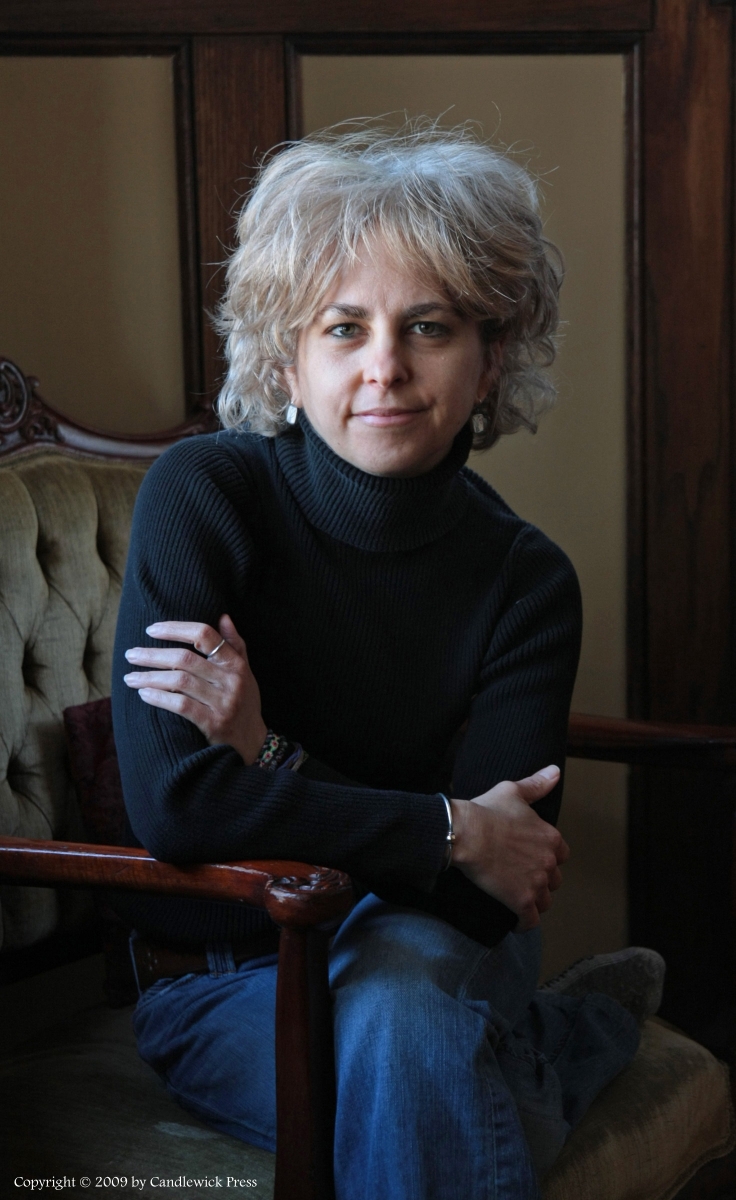
That novel was Because of Winn-Dixie, which quickly became a best seller, won a Newbery Honor and was made into a feature film. Since then, DiCamillo has written a parade of best-selling and award-winning books: The Miraculous Journey of Edward Tulane, The Magician's Elephant, the Bink & Gollie early chapter book series, the Mercy Watson series and, of course, The Tale of Despereaux, winner of the 2004 Newbery Medal.
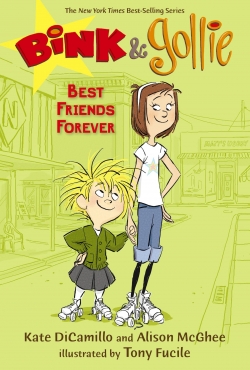
DiCamillo was in Seattle in May promoting the latest in her Bink & Gollie series, Bink & Gollie: Best Friends Forever, co-authored by Alison McGhee and illustrated by Tony Fucile.
She was also here offering a preview of her September release, Flora and Ulysses: The Illuminated Adventures, the comics-inspired tale of a squirrel that nearly expires when an unusually powerful vacuum cleaner sucks him up. Thanks to CPR administered by neighbor girl Flora Belle, the squirrel survives … and emerges with SUPER POWERS! (Of a sort. One of my 10-year-old daughter's favorite lines is, "For heaven's sake, what kind of superhero types?")
Flora Belle, a self-diagnosed cynic, is reminded of the transformation of her favorite comic-book hero, Incandesto, an unassuming janitor who turns into a superhero after falling into an industrial-sized vat of cleaning solution. Parts of the story are told through graphic novel, comics-style illustrations by K.B. Campbell.
Seattle's Child talked to DiCamillo about her career, her stories and her advice for young aspiring writers.
Did you always want to be a writer? Did you always want to be a children's writer?
I wanted to be a writer since college. An English professor encouraged me to go to graduate school, and I thought why bother? Why not just write?
For about a decade after college I worked all kinds of odd jobs while telling myself I was a writer, telling everybody else I was a writer, reading books on writing – and not writing, right? … So, then right before I turned 30 I thought, "Wow, I'm going to have to write something if I want to be a writer." So I started to write.
For me, after that long decade of not doing anything and thinking I wanted to do it, what worked for my psyche was to do two pages a day. As soon as the two pages were done I could get up. But before I could go to work, I had to get those two pages done. Very early on in my process, that was the way that I trained my subconscious, and that's still the way I work.
At the same time, I got a job in Minneapolis at a book warehouse for a book distributer. I was a picker, and I was assigned to the third floor, which was all kids' books. I had a pick list, you know, an order form, and I would sort orders, put the books in a shopping cart.
I entered into that job with a prejudice that I think a lot of adult readers have, which is that kids' books are not really literature. Then I started to read what I was picking, and the first thing I read was The Watsons Go to Birmingham – 1963 by Christopher Paul Curtis. I loved it. The next was Bridge to Terabithia by Katherine Paterson, and that was it. I started reading my way through the warehouse. It was like a free education.
Where do you get your ideas for books? Maybe you can start with Because of Winn-Dixie.
So it's one of the worst winters on record in Minneapolis, which is a considerable statement. I grew up in Florida. I'm also homesick. I love Minnesota but it's like this winter defies any kind of comprehension; the high for a couple of days was 30 below zero. I don't have a dog, and I've always at least had access to a dog in my life, and I can't have one.
So, one night right before I go to sleep, I hear a girl's voice, with a southern accent, saying, "I have a dog named Winn-Dixie." When I got up the next morning, I just started with that sentence. I followed that voice because she sounded like she knew what she was talking about.
What about The Tale of Despereaux?
Winn-Dixie had just come out. My best friend's son was 8 years old, and I was visiting them. He had never been that impressed with me, but he was a big reader and all of a sudden here was a book with my name on the spine, so that gave him pause. He asked if he could talk to me privately, and we went to his room.
He told me he had the idea for a story for me, and I said, "You know, it's not usually someone else's idea, it usually something that comes to me, but you can tell it to me." And he said, "It's the story of an unlikely hero with exceptionally large ears." And I said, "What happens to him?" And he said, "I don't know. That's why I want you to write the story."
He didn't say a mouse, but large ears … unlikely hero … that's kind of how it coalesced in my brain.
Then there's your upcoming book, Flora and Ulysses, about a squirrel super hero. Why a squirrel?
A squirrel was expiring on my front steps and I called a friend and I said, "I don't know what to do. I don't see any blood, but he looks like he's dying." And she says, "Do you have a shovel?"
This is the sweetest friend in my pack of friends, and she was going to come over there and whack him over the head! So somewhere in my twisted psyche I thought, "I want to figure out a way to save this squirrel"." And that's what happens in Flora and Ulysses.
Something that surprised me when I went back and started reading children's books again, was how dark a lot of it was. I mean, they're dealing with really heavy stuff, and I didn't remember that. I'm wondering what your thoughts are on what is too much for kids to handle? And, how serious do you think is appropriate for kids' literature?
It's one of my favorite topics, because the first thing I think of is what you said, that you didn't remember that they were that way.
I think that as adults we kind of drink the Kool-Aid and forget how intense it is to be a kid, and that everything that's going on you're aware of. I think you block that out, particularly when you have kids, because you think that you want to make it safe for them.
But they're out there. Any kid who gets on the school bus every day knows just how rough the world is. So, I think that it's a disservice to lie to kids about the way the world is.
On the other hand, I'm very much in Katherine Paterson's camp, that you have a moral obligation to end with hope, at the same time that you tell the truth.
You've written for different age groups. I'm wondering if the story idea comes first or the age group comes first.
The story. Story/character. And then they tell me what it is, age-group wise.
Bink & Gollie started as characters that came when Alison [McGee] and I were both in between projects, and she said, "Let's do something together, because it's so scary to write alone." And I said, "I don't think I can work that way," and she said, "Come on, it'll be fun." And I said, "What'll we do?" And Alison's tall, so she said, "We'll write the story of a tall girl and a short girl."
We treated it like a little job. We went over to her office, and we sat there for like 15 minutes. Nothing happens, and I say, "See, I told you, I can't work this way," and she's like, "Sit down."
And we sat there until we got the first little story done and then we were kind of hooked. It was so much fun to have someone in the room to kick it back and forth with.
What about Mercy Watson?
I turned Mercy in to my agent – the first one – and I said, "Here it is." And she said, "I don't know what it is, but I love it." So she sent it into Candlewick, and my editor said, "I don't know what this is, but we really like it." So it's kind of in some gray area age-wise.
Do you have your whole story outlined in your head before you start, or does your story develop as you're writing?
The latter. I've never known what's going to happen. And that's the same as writing two pages a day. That's not right or wrong. I know people who wouldn't think of writing a novel without having an outline before they start. For me, I wouldn't write the book if I knew what was going to happen.
How do you work with illustrators? Do you go and find an illustrator you want to write a book with?
This is the best kept secret in children's publishing – that you have nothing to do with it. What I have, contractually, is something called rights of refusal. So not only do I not pick the person, but I don't talk to the person until everything is done.
Were you a comics reader as a child?
I was a Peanuts reader. I was obsessed with Peanuts. My brother and I would go to the library and check out Peanuts anthologies. We loved them, we lived in them, and it shaped a lot of how we looked at the world.
A lot of mean things happen to Charlie Brown, too, don't they?
Those strips are just permeated with existential despair, which is balanced out by Snoopy. There's Linus and Charlie Brown at one end, and then there's Snoopy, and then there's just the utter violence of Lucy van Pelt.
What advice would you give to a kid who wants to be a writer?
That's so funny to me, because you hear that more now, and it just never occurred to me when I was a kid.
I would say to a kid: Don't let your parents talk you into being a lawyer, which is what they're going to do if you have any verbal facility.
And, read as much as you can. And anybody who wants to be a writer, who's not thrilled with that assignment, doesn't really want to be a writer.
Then, write. It's a thing that you teach yourself. You can go and get a master's degree in writing, but ultimately it's between you and the page. So teach yourself. You teach yourself by reading the people who came before you, and you teach yourself by writing. You learn by doing it.