The grocery store is already a font of information for parents – nutrition facts, marketing language and more – but this fall, voters will decide if they want one more piece of data to consider.
Washington voters will choose in November whether or not to approve Initiative 522, which would require food labels to indicate whether the food has been genetically engineered.
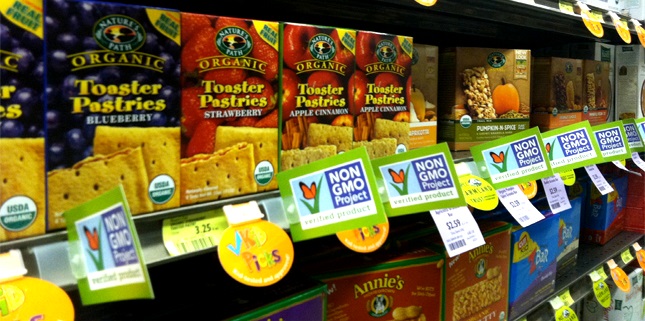
Photo courtesy of the Non-GMO Project.
Today, 64 countries require genetically modified foods (GMOs) to be labeled, but the U.S. isn’t one of them, although earlier this year, both Connecticut and Maine passed laws making GMO labeling mandatory. New York and Vermont also have pending legislation, while a similar effort, Proposition 37, failed in California last year by a narrow margin.
Most Washington shoppers don’t know what a prevalent part of our everyday lives genetically modified foods have become. In fact, around 70 percent of processed foods in the U.S. contain GMOs.
There is currently no federal or Washington law that requires food producers to identify whether foods were produced using genetic engineering. At the same time, the United States Food and Drug Administration (FDA) does not require safety studies of such foods. I-522 would require food produced entirely or partly through genetic engineering and sold in Washington to be labeled as such, beginning July 1, 2015.
The Argument for More Information
Supporters of I-522 say labeling is about empowering the consumer, and tracking any health issues that potentially could arise from GMOs. Opponents of the initiative believe the decision to label these foods will only scare and confuse consumers, while also putting additional burdens on food manufacturers and suppliers which could lead to increased grocery costs and reduced options.
“We are not making a judgment on whether GMOs are good or bad,” says Elizabeth Larter, communications director for Yes on 522. “We are simply trying to provide Washington State grocery shoppers with as much information possible about the food they are purchasing.”
This past summer the Washington State Nurses Association announced its support of I-522. Executive Director Judy Huntington, MN, RN, states: “As health care professionals, Washington’s nurses want everyone to have information to make important decisions about their health. It is ‘informed consent.’ That’s why we support labeling of genetically engineered foods. The more information our patients and we have to better trace potential allergens, toxins and the food supply chain the better. This information allows our patients to make the best decisions for their health.”
Kelly Hughes-Berardi, a Seattle resident and mother of two young children, does not understand the objections to labeling. “I am surprised that this is an issue. Doesn’t everyone want to know what is in our food? It should just be a given. We already have the right to know how much sugar, protein and sodium are in our food, and we know if a food is produced in a facility with tree nuts, dairy or other allergens,” Hughes-Berardi explains. “If we don’t know what is in a package we can’t make a truly informed decision as to whether it is the right choice for us.”
Dr. David Epley, MD, a pediatric ophthalmologist with Children’s Eye Care in Kirkland and the father of two children, opposes the idea of mandatory labeling of GMO foods. “There is no evidence that these foods are harmful. A whole generation has grown up eating these foods,” says Epley. “But, with these labels, they become a tainted food.”
Dana Bieber, spokesperson for the NO on 522 Coalition, echoes Epley. “There is nothing that says a warning is needed,” she says. “We believe posting these labels would mislead parents, and as parents we have enough difficult decisions to make.”
As an eye-care expert, Dr. Epley references the potential benefits on a global level that come from using technology to engineer food crops that are designed to increase food production and boost nutritional value. As an example, Dr. Epley points to the controversial Golden Rice which is currently being engineered with the goal of producing a fortified food that could be grown and consumed in areas of the world where a shortage of dietary vitamin A is estimated to kill 670,000 children under five each year and cause 350,000 to go blind. “We can use this science to help keep kids healthy and protect them from diseases,” says Dr. Epley. Here in the United States, Dr. Epley fears that these labels will sway low-income consumers from getting the nutrients they need.
Potential Cost to Consumers
Bieber and others opposing Initiative 522 believe that if it passes it will put a burden on food suppliers and manufacturers, which could lead to increased grocery costs and limit options for all budgets. “Any item sold in Washington would have to be labeled, but since this is not a federal law, a unique distribution system for Washington State would be required. Manufacturers would either need to relabel or reformulate for distribution to our state,” she says. “This will drive up the cost of conventional groceries and that is not practical for most families.”
According to a report released in September, the Washington Research Council estimates that the average family of four will pay a minimum of $200 more each year on groceries if I-522 passes.
Larter disputes this claim. “Food manufactures are constantly relabeling, constantly updating their packaging for nutritional reasons, and also for branding and promotional reasons. It will not burden manufacturers,” she says. She notes that other countries have moved to require labeling of GMO foods. “Many of these same brands that are opposing I-522 and opposed Proposition 37 in California are already labeling their food for overseas distribution and sales.”
Arran Stephens, CEO of locally based food manufacturer Nature’s Path, agrees with Larter. “We, as with most manufacturers, are continually updating our packaging,” Stephens says. “It is a regular cost of doing business – a small one at that – and is already built into our cost structure. Claims that labeling GMOs would significantly increase the price of food for consumers just aren’t true. Companies would certainly be updating their packaging for other reasons within the 18 months they will be given to comply with the new law, and could simply make the additional GMO labeling changes at the same time.”
Supporters of Initiative 522 make comparisons to the decades-old nutrition facts label required on most packaged food around the world, which always lists the total fat, sodium, carbohydrates and protein, and often includes details such as saturated fat, trans fat, cholesterol and dietary fiber. The nutrition facts label currently appears on more than 6.5 billion food packages.
Bieber points out one key difference about the GMO label from existing nutritional labeling. “This label would be on the front part of the package. It is meant to alarm parents.” She also notes that GMO labels will not be required on all foods (see sidebar). “School lunches would be exempt from I-522, as would hospital meals,” says Bieber.
Larter explains that the labels on GMO foods are designed to conform to common labeling standards. “The initiative is very simple. Today, manufacturers label food in the grocery store, but if you go to your local pizzeria the dish won’t be labeled,” she says. “The same logic applies here. It is not confusing. It’s really just common sense.”
An Important Decision for Voters
Even though Proposition 37, a similar measure, was defeated last year in California, supporters of I-522 point to the tight margin – 51.41 percent to 48.52 percent – and the fact that the “No” side outspent the “Yes” side 5 to 1.
Here in Washington, I-522 has received significant support from recognized national brands, including Whole Foods and Ben & Jerry’s, as well as local companies such as PCC Natural Markets and Theo Chocolate. However, opponents are outspending proponents in Washington. Monsanto – the leading producer of genetically engineered crop seed and a major contributor to the fight against Proposition 37 – has contributed $4.6 million to defeat 1-522, while the Grocery Manufacturers Association, which represents brands including Coca-Cola, General Mills, Kellogg and PepsiCo, has given more than $2 million to the campaign against I-522.
Supporters note that Washington has a history of being on the forefront of the labeling movement. In 1993, the Washington State Legislature unanimously passed the nation’s first law requiring labels on salmon to tell consumers where the fish came from and whether it was farm-raised or caught in the wild. And, in 2003, a Seattle law firm filed a class action lawsuit against the three largest grocery chains alleging that they failed to disclose to shoppers the coloring additives that turn farm-raised salmon pink.
“The conversation about transparency at the national level has increased, and here in the Northwest people tend to be especially interested in owning the issues intellectually for themselves. We know that this is very true of our customer base,” says Susan Livingston, a spokesperson for Whole Foods, which has taken an active role in supporting I-522. “Our focus is on letting the customer make the right decision for them with the best information available. They have a right to that information. It is inappropriate to not provide it to them.”
One thing both sides agree on: the importance of Washington voters taking the time to get educated on the issue and then taking the time to vote.