Being a parent is nonstop hard work, making it challenging to stay on top of news that impacts families in Washington state. This Hits Home is your weekly hit of news, commentary, and, occasionally, opinion. Want to have a say? Look for the “Take action” prompts. Here’s the update for the week of June 22-28.

New Listening Mothers survey: Pregnant patients struggling on Medicaid
A survey of more than 3,800 people nationwide who gave birth in 2023 and 2024 found those using Medicaid described worse outcomes than those on private insurance, that access to care remains limited for some, and that women often feel unheard and disregarded during pregnancy and labor and delivery.
The Listening to Mothers survey, conducted by the nonpartisan nonprofit National Partnership for Women and Families, was released earlier this month. The partnership says the survey is the largest of its kind, and it’s the fourth time the organization has published this type of survey since 2002. The organization says its survey represents approximately 90% of the childbearing population, defined as those at least age 18 who gave birth in a U.S. hospital to a single baby with whom they lived.
The survey highlighted what it called “hard-won gains” in policy changes, such as the expansion of Medicaid coverage from 60 days to 12 months postpartum in all but one state (Washington covers for 12 months). The other gains were expansion of state paid leave programs and new investments in maternal health and perinatal quality. But it said those wins are threatened by hospital maternity units closing in many states, as well as deep cuts to Medicaid programs at the state and federal levels. Read the full story and connect to the survey.

(Photo courtesy ThirstyOwlVintage on Etsy)
Progressive Washington? Not when it comes to baby names
When it comes to naming babies, Washington parents are in a bit of a time warp. The state’s most popular baby names —including Noah (#1), Oliver, Henry, and Theodore for boys; Olivia (#1), Charlotte, Eleanor, and Evelyn for girls — read like a Victorian parlor roll call. The trend is not, however, a quirk of the Evergreen State. The same pattern holds in cities across the country, especially those known for progressive politics and highly educated populations, according to a report in The Washington Post last week.
Article author Rob Henderson points out the gap between the values progressive parents espouse and their baby-naming decisions: Communities that champion individuality and push back against convention tend, when it comes to naming their own children, to reach for the safest, most time-tested options. To find out why, head to The Washington Post.
(Photo courtesy of the state Department of Children, Youth and Families.)
WA child welfare deaths drop significantly after record year
Washington saw a sharp drop in child welfare deaths and near-deaths in early 2026 — seven incidents in the first quarter, compared to 22 in the same period last year.
Four children died and three suffered critical injuries between January and March, and a preliminary look at quarter two data looks like the trend is continuing, according to the state Department of Children, Youth and Families.
The decline tracks with a broader fall in opioid overdoses. Fentanyl drove roughly half of the deaths or serious injuries to children in the system last year, which hit a record 58 — 23 deaths and 35 near-deaths — up from 48 the year before. One caveat: The figures cover only children with prior involvement with the state child welfare system. Read the full story from the Washington State Standard.

Golden Gardens Park (Photo by Peter Alfred Hess)
Golden Gardens here we come: New bus route pilot launched
Getting to Golden Gardens by public transit got a little easier this week, when Metro launched the new Golden Gardens Direct bus route, which runs straight to the popular beach from 15th Avenue NW and NW Market Street in Ballard.
That means: No fighting for a parking space on a busy weekend (or a weekday during the summer); No need to descend and then climb back up the 272 steps from the Loyal Heights neighborhood above Golden Gardens after parking there to avoid the fight for parking at the beach; No two-mile slogwalk from central Ballard to get to the beach without a car.
The pilot route, a partnership between King County Metro and the City of Seattle, runs every 30 minutes from 11 a.m. to 9 p.m., seven days a week, through August 30. The bus will make 10 stops along Market Street and Seaview Avenue, with connections to RapidRide D, Route 40, Route 44, and Route 17.
According to an announcement by Seattle City Councilmember Dan Strauss, five of those stops serve areas with no existing transit:
“I proposed and funded this new bus through a budget action last fall to give everyone better access to Golden Gardens,” Strauss said. “This is one of our city’s most beautiful but least accessible public spaces.”
With the new route, Strauss added, “everyone will have access to the beach — no hiking, scrambling, or parking required.”
Fare for Golden Gardens Direct is $3 — cash, ORCA card, or transfer — and free for kids and youth aged 18 and younger. Bonus: Pets ride free, as do bicycles.

(iStock.com)
Washington’s trafficking prevention mandate: Let’s take it seriously | Op-Ed
By Tanya Fernandez
Seattle continues to grapple with violence and child sex trafficking. As local leaders debate how to address its consequences, we should spend at least as much time implementing real-world strategies to prevent young people from ever being exploited in the first place.
In King County, the average age at which commercially sexually exploited (CSE) minors are first exploited is 14. That is one reason Washington now requires school districts to provide trafficking prevention education beginning as early as seventh grade. If exploitation often begins during early adolescence, prevention education in middle school is not only far from premature; in many cases, it may be too late. The environments young people navigate today are fundamentally different from those of previous generations. Relationships can be formed with strangers in seconds. Trust can be built in an instant. Young people can be targeted, manipulated, and recruited through platforms that didn’t exist until recently.
Kids need information to stay safe
Young people need more than warnings. They need practical skills to recognize manipulation, understand healthy relationships, navigate digital environments safely, and identify when someone is attempting to exploit their vulnerabilities. Parents, educators, and youth-serving professionals need better tools.
Schools are one of the few institutions that can reach nearly every young person before exploitation begins. Washington schools are required to provide students with trafficking-prevention information. Yet a mandate alone does not protect young people. The challenge is implementation. Districts, educators, and community leaders must ensure that students receive meaningful prevention education. That means providing professional development for educators, implementing safety protocols that clarify and standardize staff responses to disclosures, and adopting evidence-informed curricula that reach every student—not just those already identified as at-risk.
Demand more
We should absolutely hold traffickers and buyers accountable. We should demand regulatory safeguards for the technology companies that knowingly platform abusers and exploiters. We should increase social safety nets, fund survivor housing, and invest in long-term recovery services. It is time to treat prevention with the same urgency we bring to the visible consequences of exploitation.
Right now, somewhere in Seattle, a fifth grader is receiving a private message from a stranger on a gaming app. An eleventh grader is getting in the car to meet her online boyfriend for the first time in real life. The next trafficking case that captures our attention may already be happening.
Prevention is our opportunity to intervene. Washington has created that opportunity. Now we need to use it. This Op-Ed has been edited for space Read the full opinion.
**Tanya Fernandez lives in Shoreline and is the program director and leads anti-trafficking education at Everstrong.

(Photo by Kieferpix / iStock)
A beautiful reflection on fatherhood from The NYT
Zach Ellams has lived as a trans man since he was 18 years old. But when his child came along, he had to learn how to become a trans dad. His child had questions. He sought to answer them honestly while at the same time supporting his child’s strong sense of self and confidence. Turns out, his child has also supported both of these in Ellams. Don’t miss Ellams’ precious NewYork Times essay, illustrated by Hannah Jacobs.
(Image courtesy Apple)
iPhone family? Apple will release much stronger parental controls in the fall
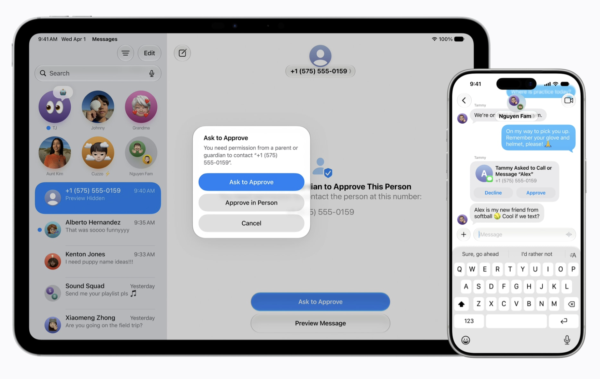
If iPhones are your family’s cellphone of choice, Apple has news for you. The company announced last week that it’s overhauling its parental controls this fall, with updates aimed at giving parents tighter management over what their children can see, who they can talk to, and how long they spend in any given app.
The centerpiece of the update is a child account system — required for kids under 13, optional through age 18 — that Apple says will automatically apply age-based restrictions across the device from the moment it’s set up.
Apple says that using the controls, parents will be able to require kids to ask permission before opening a new website, not just before downloading an app. Time limits can be set by category — capping social media separately from games, for instance — with the company suggesting guardrails based on the child’s age.
Having a hard time with devices at the table? A revamped dashboard will give parents a real-time view of usage while allowing them to make quick adjustments. For example, rather than arguing about the phone at the table, parents will be able to lock a child’s phone at the dinner hour. The company is also expanding its existing nudity filter in Messages and FaceTime to cover violent imagery. The updates are scheduled to ship this fall alongside iOS 27.
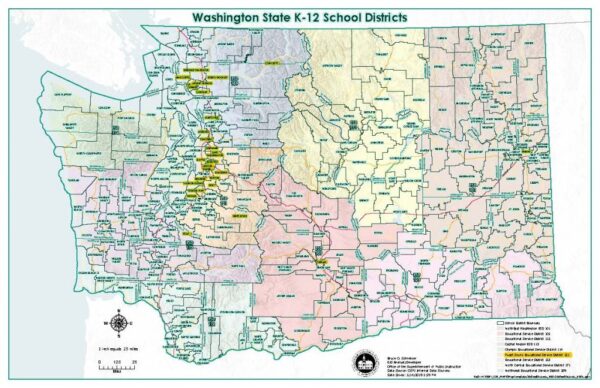
Washington State school districts map (Graphic courtesy smartcenter.uw.edu)
Will the Governor’s call for statewide school cellphone ban make it happen?
This summer Washington Gov. Bob Ferguson says he will travel across the state to build momentum and support for a statewide ban on cellphones in schools that state lawmakers will actually approve and get to his desk in 2027 to sign into law. He’s already started the campaign, with an email to his supporters calling a ban one of his legislative priorities for 2027 and asking them to sign a petition supporting the policy.
Whether or not Ferguson’s push will be the pressure that tips the scales in favor of a ban remains to be seen. Several lawmakers (of both parties) and the state superintendent of public instruction have all tried, and failed, to move such a policy through the Legislature over the past three years.
More than half of states (29 others at last count) are a step ahead of Washington when it comes to bell-to-bell bans on phone use, according to Education Week. The national Phone-free Schools Report flunked Washington for its inaction. Supporters, including Ferguson, say removing phones from the classroom is critical to improving grades and kids’ mental health.
“Science supports a phone-free school environment. No single policy can solve every challenge in education, but this one will make a big difference in our students’ social and academic engagement,” Ferguson said in an article by Washington State Standard last week. “I won’t let Washington be the last state in the nation to step up for our kids.” Read the full story from the Standard.
TAKE ACTION: Have a child in a district that has banned cells and want to share input on how the ban is effecting your child? Contact Gov. Bob Ferguson.
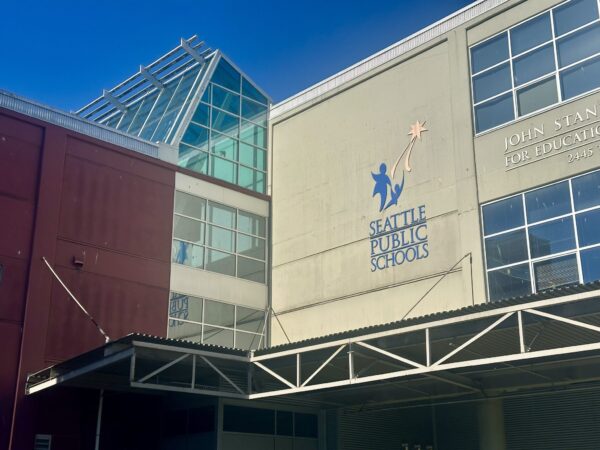
SPS headquarters (Photo by Cheryl Murfin)
Sex abuse claims in Seattle area raise insurance rates for all Washington school districts
About 130 Washington school districts received an unwelcome surprise in mid-May: their rates for the state’s shared liability pool jumped 45%, on average. The hike is bad news for districts, like Seattle Public Schools, that are fighting tooth-and-nail to close severe budget deficits.
The cause of the increase is even more distressing: The state has seen a surge in sexual abuse claims. Recent changes to statute of limitations laws have opened the door to cases dating back decades, and a 2020 state Supreme Court ruling established that districts are strictly liable for employee misconduct, even when they had no knowledge of it. Settlements have climbed accordingly — Seattle Schools paid $16 million to a former student in 2024; Federal Way paid $15 million last month to two assault victims.
The Washington Schools Risk Management Pool, which covers more than a third of Washington’s school districts, had projected an 18% rate increase in February. A spike in claims costs in second quarter forced a last-minute revision. When one member district faces a large claim, rates rise for everyone — including the majority of districts that have never had a sex abuse case filed against them. For smaller districts like Anacortes, for example, the unexpected increase meant having to lay off teachers. Read the full story.

Concealed gun (Photo by Ron Bailey / iStock)
Washington gun control advocates say ‘Bring back the vampires!’
The U.S Supreme Court struck down so-called “vampire laws” last week in a 6-3 ruling that states cannot require gun owners to get explicit permission before carrying firearms onto private property. While Washington does not have such a law on the books, five states do: Hawaii, California, Maryland, New York, and New Jersey.
Still, gun advocates here say the SCOTUS decision will compromise safety in all communities.
“The case boils down to a really simple question: If someone wants to bring a gun into a private business that’s open to the public, should they have to get the owner’s permission first? The Court just said no,” wrote Mike McIntyre, director of government affairs for the Seattle-based Alliance for Gun Responsibility, to gun control advocates last week. “Now, someone carrying a firearm can just assume they’re allowed to walk right into your local coffee shop, grocery store, gym, or restaurant unless the owner has already jumped through hoops to explicitly ban them.”
McIntyre said the ruling “flips the script.”
“Instead of expecting a gun owner to respect someone else’s property, the Court is forcing busy shop owners to post signs, draft new policies, and deal with the stressful fallout themselves,” McIntyre wrote.
Writing for the conservative majority, Justice Samuel Alito held that forcing gun owners to seek advance approval before entering private land places too heavy a burden on Second Amendment rights. The nickname comes from Bram Stoker’s Dracula, in which the vampire must be invited in before crossing a threshold.
The ruling is the latest fallout from the court’s 2022 decision requiring gun regulations to have historical precedent at the nation’s founding — a standard that has since unraveled nearly 100 firearms laws nationwide. Supporters of the struck-down laws argued that the founding-era trespass rules supported their position; the majority disagreed, finding that most private spaces would effectively become no-go zones for gun owners if permission were the default requirement.
LISTEN: Spectacular Specimens
Ok, so it’s not news. But Spectacular Specimens is a wonderful local podcast — and collaboration between KUOW and Seattle’s Burke Museum — to listen to with your kids. In each episode, Brandi Fullwood and Paige Browning dive into the drawers, cabinets, and freezers at the Burke Museum of Natural History and Culture. It’s a great opportunity to learn about all kinds of animals (dinosaurs, sea otter, flesh-eating beetles) and get to the science of how they help us understand our planet. Learn more at KUOW.