Being a parent is nonstop hard work, making it challenging to stay on top of news that impacts families in Washington state. This Hits Home is your weekly hit of news, commentary, and, occasionally, opinion. Want to have a say? Look for the ‘Take action’ prompts. Here’s the update for the week of March 9-15.
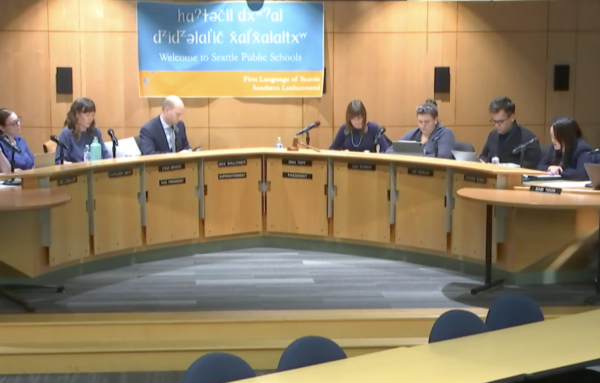
Seattle School Board Meeting, Feb. 11. (Image: SPSTV)
SPS Board to change its approach
The Seattle Public Schools Board of Directors is modifying a governance approach focused almost entirely on student outcome metrics and instead restoring committees designed to strengthen policy review, financial oversight, and operational transparency.
Board members say changing how it operates within Student Outcomes Focused Governance (SOFG), the board governance model it began implementing in 2021, toward a more traditional standing-committee structure, gives them more agency and better allows them to do their job they
The SOFG model was designed to keep board members focused on student achievement rather than the day-to-day operations of the district. In this approach, the board sets clear goals for outcomes such as reading levels, graduation rates, and college readiness, and regularly reviews data to determine whether those goals are being met. The superintendent and district staff are charged with determining how those goals are achieved. The model keeps the board focused on whether students are learning, but critics argue it can reduce the board’s ability to examine district decisions in depth.
The Seattle Public Schools board’s recent decision to restore standing committees changes how oversight is conducted. Committees on finance, policy, and operations allow smaller groups of directors to review budgets, policies, and operational issues before they come to the full board for a vote.
In practical terms, the move gives board members more opportunities to closely study district decisions while still keeping student outcomes as a central goal. Read the full story.
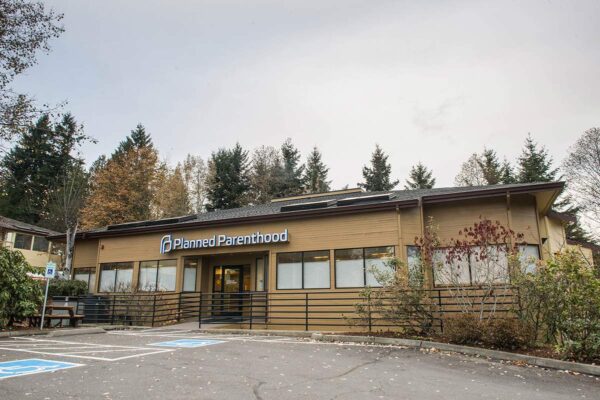
Planned Parenthood in Bellevue (Image: Planned Parenthood)
Bill passed would fund abortion access in WA
Insurers selling plans through the Washington Health Benefit Exchange would help fund abortion access in this state if Washington Senate Bill 6182 is signed by Gov. Bob Ferguson. The bill, which requires carriers offering plans on the exchange to pay a small monthly assessment per enrollee, received final legislative approval on March 12.
Under the proposal, insurers would pay 82 cents per enrollee per month in the first year, then about 16.5 cents in later years. The first payments would be due in March 2027. A fiscal analysis estimates that the assessment would generate roughly $10 million in the first year and about $2 million annually thereafter – funds intended to support abortion services in Washington. With Ferguson’s approval, organizations like Planned Parenthood of Greater Washington and North Idaho, along with independent clinics and some hospitals, would likely benefit indirectly by receiving payment for care delivered to eligible patients. Insurance carriers that fail to provide required information to the state’s insurance commissioner could face fines, and unpaid assessments would accrue interest.
The bill also says insurers must absorb the cost themselves — meaning they cannot pass the assessment on to customers through higher premiums or fees, unless doing so would create a serious risk of insolvency or consumer harm. The measure has been sent to the governor’s office for final approval. Read more on this story at the Washington State Standard.
TAKE ACTION: Do you have an opinion on whether or not the governor should sign Senate Bill 6182 into law? Reach out to the governor’s office and share it.
The Fascinating Read: What is it about “Judy Blume: A Life”?
 “Are you there, God? It’s me, Margaret.” Or Sarah or Danielle or Maggie or, in my case, Cheryl. When I was in middle school, Judy Blume’s book by that same questioning title flew through the bedrooms of every girl I knew — and a lot of daring boys as well.
We were Margaret. Her struggles were ours. Her discoveries and enlightenments, ours too. And, as her author, Blume belonged in our secret hideaways. Hers was our voice, whether that connection was made with Margaret or her many other middle school and young adult titles (“Blubber,” “Then Again, Maybe I Won’t,” “Starring Sally J. Freedman as Herself,” “Deenie” all come to mind). Blume was that mysterious adult who “got” tweens and teens. She got me.
As a writer and parent, I’m eager to know where all that understanding came from. No surprise, then, that I dove into last week’s article in The New York Times about writer Mark Oppenheimer’s new bio, “Judy Blume: A Life.” The book was years, tons of research and many, many interviews with Blume and others in the making. Blume, however, has distanced herself from its publication. If you are a parent who loved Judy Blume books or a tween/teen still reading them, the mystery behind this beloved author continues. Read the full story in The New York Times.
Millionaire’s tax goes to Governor for signature

(Image: NoDerog)
You’d have to have been sleeping for the past week not to have heard that the state legislature has passed Washington’s first income tax, referred to as the “millionaire’s” tax. Senate Bill 6346, which would impose a 9.9% levy on adjusted gross household income above $1 million, was debated for more than 24 hours before final passage.
Next step: It has to be signed by Gov. Bob Ferguson, who says he’s eager to do so. It would take effect Jan. 1, 2028, with first payments due from filers in 2029. The legislature estimates that 21,000 households would pay the tax.
What’s that mean for families? Here’s a recap of where the projected $3-4 billion in tax income will go. Funds will be used to:
- Strengthen support for families by using 5% of annual tax proceeds for the state’s Fair Start for Kids Act. The hope is that these funds will offset cuts to state early childhood and preschool programs.
- Expand the state’s low-income resident Working Families Tax Credit to 810,000 households from its current 350,000 beneficiaries.
The bill will also eliminate the sales tax on diapers, personal care products, like shampoo and deodorant, and many over-the-counter drugs, and exempt public schools from paying the new state sales tax on services. Read the full Washington State Standard converge.
TAKE ACTION: Should the governor sign the “millionaire’s” tax into law? Share your opinion by contacting his office.
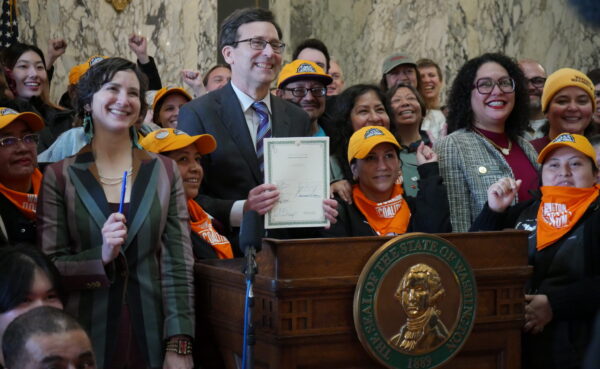
Gov. Bob Ferguson after signing bill giving labor rights to nannies, housekeepers and other domestic workers. (Image: Aspen Ford/Washington State Standard)
Nannies, housekeepers, domestic workers to gain state protections
New protections for domestic workers in Washington will take effect next year under a bill Gov. Bob Ferguson signed on March 9.
Before the bill signing, close to 100 people gathered on the north steps of the state Capitol to celebrate the passage of the Domestic Workers Bill of Rights.
Sponsored by Rep. Brianna Thomas, D-West Seattle, House Bill 2355 enshrines protections for workers such as nannies, housekeepers, and gardeners, who work four or more hours a month.
“This industry was born out of slavery and indentured servitude, and today we say ‘no more,’” Thomas told the crowd. “We say ‘we matter, we’re here and we deserve the same protections as anyone else.’”
The bill requires employers to pay domestic workers the minimum wage and overtime pay, mandates written agreements between employers and workers, allows workers to file labor claims with the state Department of Labor and Industries, and requires advance notice of termination. It goes into effect July 1, 2027. Read the full Washington State Standard story.

Mask ban approved and sent to governor
The Washington legislature passed a bill banning law enforcement officers from wearing face-concealing masks while interacting with the public, sending the measure to the governor’s desk. Senate Bill 5855 prohibits local, state, and federal officers — including agents with U.S. Immigration and Customs Enforcement — from wearing opaque face coverings such as balaclavas, tactical masks, gaiters, and ski masks during routine public interactions. The measure builds on existing Washington law requiring officers to be reasonably identifiable through visible names or other identifying information. It now sits on Gov. Bob Ferguson’s desk, where his signature would turn it into state law.
TAKE ACTION: Should the governor sign the police mask ban into law? To weigh in, contact the governor’s office.
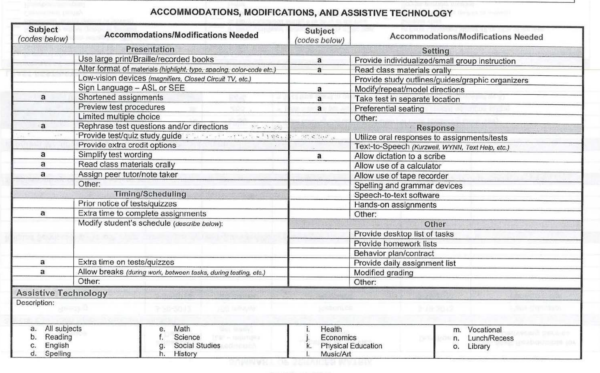
Accommodations are part of a student Individualized Education Plan (IEP)
New law allows parents more time to review special ed evaluations
Getting the Individualized Education Plan (IEP) for a student with disabilities right is a team effort, and parents are a crucial part of the team. Thanks to a bill signed into law by Gov. Bob Ferguson last week, parents will now have the time they need to review all the information a school district relies on to determine what services a student may need to thrive in school.
Under the new law (ESHB 2557), parents or legal guardians of children who may need special education services will have five or more days to review their student’s school evaluation report before attending a district eligibility meeting. The law kicks in on June 11.
Ferguson’s mother taught special education. “Parents and guardians, it’s fair to say, deserve to have timely and clear information, and this bill helps achieve that important goal,” the governor said at the bill signing. Read the full story in The Seattle Times.
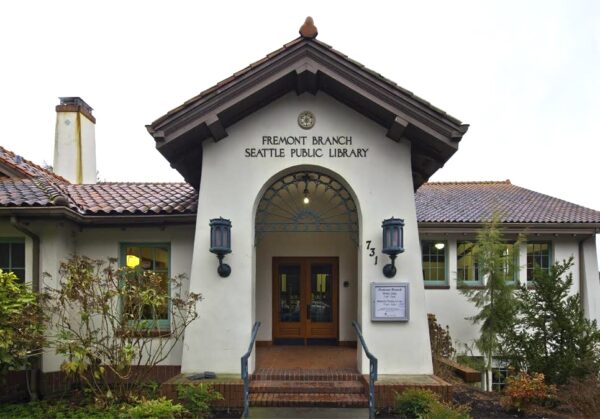
Seattle Public Library Fremont Branch. Photo courtesy Seattle Public Library
Mayor Wilson pitches library levy
Seattle’s reputation as a city of readers is backed by data. The Seattle Public Library reported about 10.8 million physical and digital checkouts in 2024, and national literacy studies have repeatedly ranked Seattle among the country’s most literate cities. From library storytimes for kids to homework help for students to genealogy help for families, local libraries are popular information sources and gathering places.
Mayor Katie Wilson says she feels confident that reputation will move city residents to vote yes on a $410 million property-tax levy renewal to support and maintain the Seattle Public Library system. The proposal, expected to appear on the ballot in August if the Seattle City Council approves it, would replace the current library levy. About $90 million of an approved levy would go toward maintaining the system’s 26 branches and the Central Library buildings, including needed repairs and upgrades. Another substantial portion would support cybersecurity efforts and technology needs. If approved by the city council and passed by voters, the proposed levy would cost homeowners $0.19 per $1,000 of assessed property value. Read more from KUOW.
TAKE ACTION: Have thoughts on the need for a levy to maintain Seattle library buildings, some of which are more than 100 years old? Contact the Seattle City Council and share your opinion.

USS Thomas Hudner fires a Tomahawk land attack missile into Iran Mar. 1, 2026. (U.S. Navy photo)
Tips for talking to kids about the U.S.-Iran conflict
Kids hear the news. They see worry on their parents’ faces. Many in middle and high school are following current events at school. When our country is at war, kids have questions. And more importantly, they have feelings.
Not sure how to start or hold a conversation about what is happening in Iran? Check out this helpful article from Education Week.
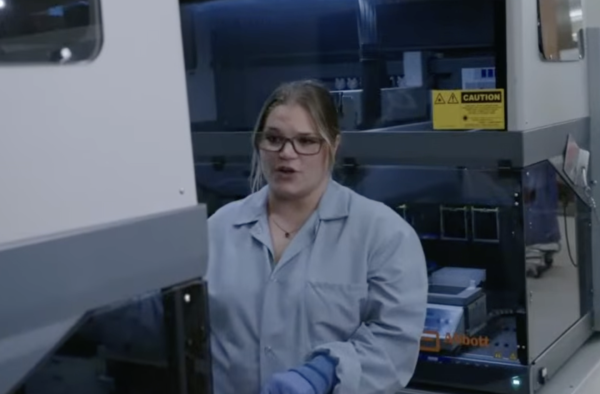
UW measles testing machinery. (UW New)
UW Medicine ramps up testing for measles in preparation for World Cup
Medicine’s virology lab is ramping up its ability to test for measles in preparation for an expected increase in visitors — and potential exposure to disease — during the World Cup in Seattle this summer.
The highly contagious virus has been spiking in Washington state this year, including a recent outbreak in Snohomish County and multiple cases or exposures in King County connected with travelers through Sea-Tac International Airport. The in-house ramp-up is unusual for the university medical center.
“Typically, the virology lab would not be doing measles testing; we would send test samples to the state lab,” said Dr. Alex Greninger, who leads UW Medicine’s Division of Infectious Disease Diagnostics in Laboratory Medicine and Pathology.
In a recent press conference, UW Medicine’s Associate Chief Medical Officer, Dr. Shireesha Dhanireddy, discussed the lab testing process and the clinical implications of crowds of visitors from nations whose vaccination rates for measles are much lower than those in the United States. Dhanireddy is an infectious-disease specialist.
“After someone with measles has been in a space, if somebody else comes into that space immediately, there’s a potential for transmission,” she said. “That’s why, when we’re thinking about large numbers of people in small spaces or crowded spaces, it becomes much bigger of a concern.” Watch the news conference online at UW News.
Family travel: Where are you going?

It’s mid-March and that means time to think about summer travel if you haven’t started already. Which is why I read with great interest an article published in The Seattle Times all about bedbugs and barf — two very popular topics and problems when traveling abroad, especially with kids.
Need tips on protecting your kids’ health while traveling? Ideas on where to go this summer? Don’t miss the March issue of Seattle’s Child, now online and in stands. From camping across Washington to castle-hunting in Scotland, there’s adventure on every page.

WA Legislature 2026 Round-up: Education wins and losses
With so much talk about budget cuts and “millionaire’s” taxes over the past three months of the 2026 state legislative session, it’s easy to lose track of the wins and losses in the education arena. I asked Arik Korman, executive director of the statewide advocacy group League of Education Voters (LEV) to provide a rundown.
Education wins in 2026 include:
- Passage of an income tax on wealthy residents would increase early learning funding and aim to provide free breakfast and lunch to all K–12 students every school day. “Cuts to education would have been more significant without the additional revenue generated by SB 6346,” Korman said.
- A $3.5 million partial restoration of funding for Treehouse’s Graduation Success program will help foster youth graduate from high school. Funding for this program was completely eliminated in the 2025 budget. “When our education system is underfunded, students who need the most support face even more barriers,” Korman said. “It’s essential that we provide the resources and services these students need to access their education.”
- More than $400,000 in funding to expand demonstration sites for districts using evidence‑based practices to reduce restraint and eliminate isolation in classrooms. Says Korman: “These demonstration sites provide real‑world examples showing that these changes can improve outcomes for both students and staff.”
Education losses include:
- Funding cut for Working Connections Child Care, which provides subsidies to low-income families to access child care. The program was cut by $150 million. Transition to Kindergarten saw a 25% reduction in funding. “For the second year in a row, early learning faced some of the biggest budget cuts,” Korman said. “These reductions, driven by the state’s budget deficit, make it harder for families and communities to access child care—especially affordable child care.”
- Cut to Local Effort Assistance (LEA), a program designed to help districts with lower property wealth which are able to raise less money through local levies, had its funding cut by $27 million. “Both Washington’s state and local funding formulas disadvantage communities with less property wealth,” Korman said. “Cutting a program meant to reduce this gap only increases funding inequities between districts.”