Biljana Tutorov and Petar Glomazić’s “To Hold a Mountain,” screening this week at Seattle International Film Festival, unfolds with the patience of a film confident in its own stillness. And while its slow pace and subtitling will likely challenge Seattle tweens and teens used to our faster-paced and highly digitized lived experience, those who sit through the documentary film—of their own volition or with the encouragement of a parent co-viewer—stand to receive much.
And I hope they do. “To Hold a Mountain,” opens the mind to the experience of a different teenage life, one with far less materialism and in which the love and work of a parent and child are intwined without resentment.
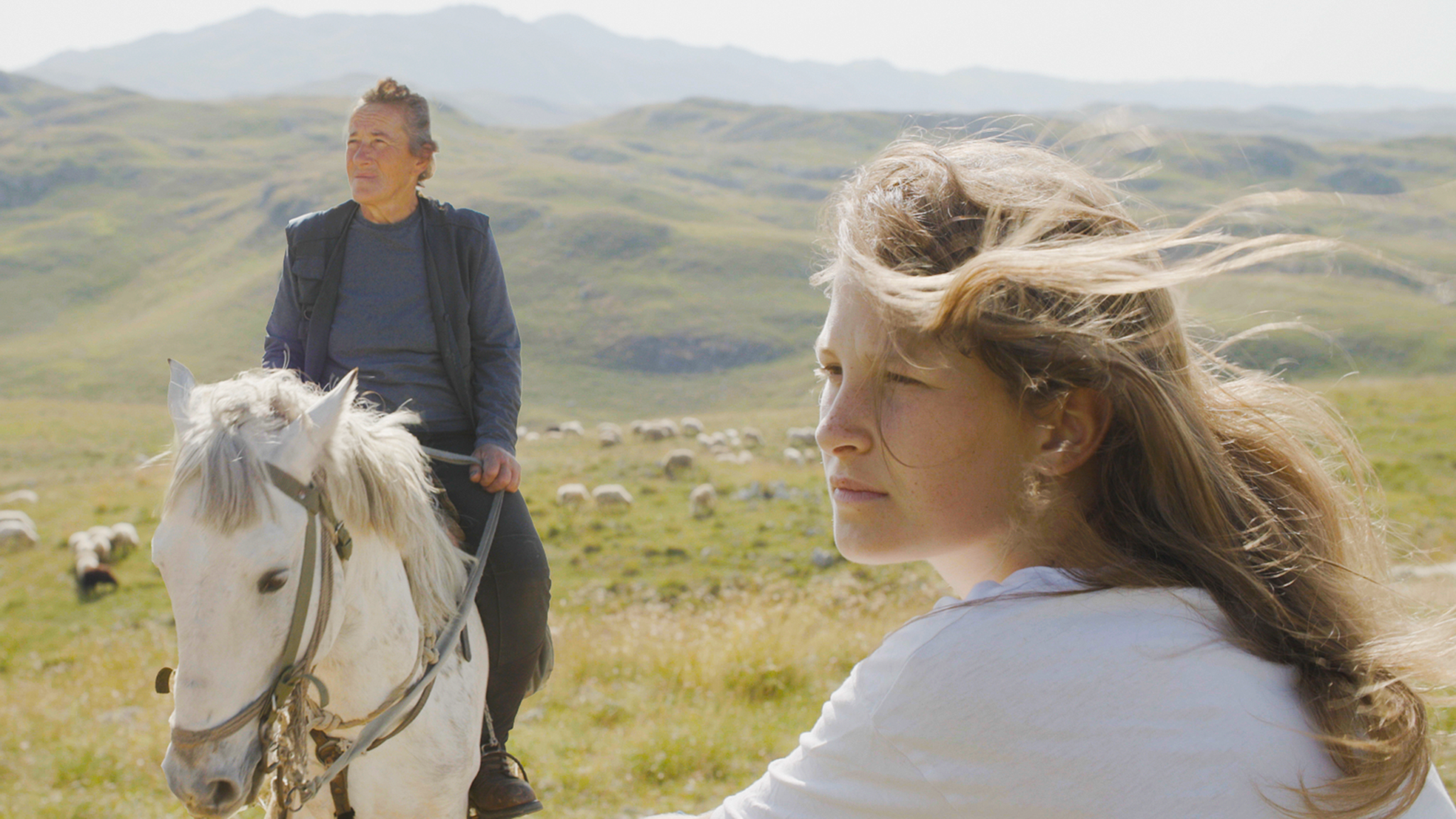
At first, the subtitled film appears to be an quiet portrait of pastoral life in Montenegro’s Sinjajevina plateau, where a shepherd named Gara and her teenage daughter Nada move through routines shaped by land, weather, and necessity. The film lingers—intentionally, slow, almost plodding like cows up a mountain—on these rhythms: tending animals, preparing food, navigating the terrain.
What emerges from these textures of their daily lives is not a narrative pivot so much as an expansion. The film unfolds around interconnected stories of land stewardship, generational tension, and political resistance. Gara is not simply a shepherd; she is also a central figure in a grassroots effort to prevent the ancestral lands in the highlands of Montenegro from becoming a NATO shooter training ground. As a teachable moment, that tension reveals the power that a small group of people can have against a far mightier power—without violence.
The bond between a mother and daughter
At the center of the film is the relationship between Gara and Nada, rendered with a clear and sweet intimacy. Nada, raised by Gara after the death of her mother, moves through the film with a quiet self-awareness. She is at once rooted in the mountain and subtly pulling away from it—the united experiences of teens across the ages and planet.
Yet here there are no explosive tantrums, no curses thrown at a mother by a teenage girl tired of being suffocated. Instead, that universal teenage call of independence lives in pauses, in glances, in the spaces between words. Their bond—part maternal, part something less easily named—carries the emotional weight of the film. Another review aptly described the pair as sharing an “unspoken intimacy shaped by hardship and proximity,” a phrasing that captures the film’s emotional core without overstating it. When it is eventually revealed that Nada’s mother was murdered by her father, and that Gara is, in fact, Nada’s aunt, it worth noting that Nada doesn’t lash out. She ponders this truth, trying to piece together her own memories of her parents.
Some questions will linger for teens
Conversations about family, loss, and the future unfold here with a candor that borders on intrusive, yet never feels exploitative. At the same time, though, the film sometimes struggles under the weight of its own ambitions. The political storyline—particularly the community’s resistance to militarization—feels underdeveloped in comparison to the emotional core.
And there are a lot of unanswered questions about what happened to Nada’s mother, when, where her siblings are. Adults won’t need these questions answered, they aren’t the point, but tweens or teens will likely feel underinformed.
A story about place and universal norms
Still, what holds the film together is its deep sense of place. The mountain is not backdrop but presence—constant, shaping, and inescapable. Eva Kraljević’s cinematography renders the landscape with a clarity that borders on reverence, capturing both its vastness and its intimacy. The terrain becomes a kind of emotional anchor, reflecting the characters’ inner lives as much as their physical reality.
By the film’s close, the resistance effort begins to show signs of impact, though the outcome is less important than the act itself. A quick Google check reveals the resistance did, indeed, stop the land from becoming a military shooting range. But what lingers is not that resolution. What lingers is the continuity—the sense that this struggle, like the mountain, will endure beyond the frame. As will the process of caring followed by separation that mothers and daughters, mothers and sons, fathers and daughters, fathers and sons all endure.
The sign of good parenting is when they want to return
To Hold a Mountain ultimately positions land not just as a setting, but as an organizing force in human life: shaping identity, relationships, and the limits of what can be left behind. Perhaps the most revealing and heart-opening moment is in its final scene as Gara and Nada, now an older teen sit on the porch considering the weight of the work and truths they’ve shared but which Nada will soon move on from:
“Will you visit here when you’re grown up?”
“I will.”
“The mountain will always be here.”
By that, we know the mountain is Gara and that Nada too will protect her ancestral land. It is here that the film locates its core idea: that some places are not simply inhabited—they inhabit us, steady and unmoving, even as everything else shifts around them.
If you go
Tell your child to expect a slow moving film rather than a “fun watch.” It’s a documentary, so invite them to look deeply and think about what it would be like to live as the people in the film do. Ask them to find the three themes of this film: solidarity, parent-child love and trust, loss and grief.
Age recommendation: 13 and up with a parent. This film is subtitled.
Dates and times:
- Friday, May 8, 2026 1230 SIFF Upt0wn
- Friday, May 15, 2026, 6 p.m. PACCAR IMAX Theater at Pacific Science Center
Tickets: siff.net/festival/to-hold-a-mountain
Question for a post-film treat with your tween or teen
- What would it be like grow up in such an austere place?
- Does Nada seem happy and content in most of the film? Why? Why not?
- The bond between mother and daughter is strong—what do you think it is built on? Why is it so strong?
- There are no televisions in the film,but Nada never seems bored. What do you think Nada did in her down time?
- You learn that Gara’s other children have gone on to college. What do you think Nada will do?