
Being a parent is nonstop hard work, making it challenging to stay on top of news that impacts families in Washington state. This Hits Home is your weekly hit of news, commentary, and, occasionally, opinion. Want to have a say? Look for the “Take action” prompts. Here’s the update for the week of May 4-10.

Gas Works Park towers before removal of catwalks and ladders (Photo by TIA International Photography)
Finally, Gas Works Park climbing apparatus comes down
Workers began dismantling climbing features from Gas Works Park’s iconic towers this week, ending an eight-month bureaucratic standoff that put preservation above protection. The City’s Landmarks Preservation Board twice blocked safety modifications to the park’s towers, concerned that removal of catwalks would impact the site’s industrial aesthetic, despite the fact that, since 2012, the structures have claimed three lives and seriously injured 11 others. Last July, 15-year-old Ballard High student Matas Johnson died after falling from the park’s tower rigging, prompting the call for tower modifications.
It took a hazard order and threat of a significant fine from construction inspectors to cut through the red tape — literally. Torches sparked, and steel clattered to the ground on Monday while park users looked on. Seattle Parks and Recreation has until May 15 to remove all the dangerous elements on the towers.
Looks like Seattle is learning the hard way how to balance historic preservation with public safety in spaces where the past intersects with the present. But one thing feels clear: when it comes to protecting children, “historically significant” isn’t good enough.
The towers remain. The landmark endures. What’s gone are the features that turned a peaceful park into a deathtrap with a view.

A portion of The People’s Wall (Image: Wikimedia)
Speaking of preserving Seattle landmarks … A call to protect the People’s Wall honoring Black Panthers
A group of south Seattle community leaders recently asked the Seattle Landmarks Preservation Board to ensure a neighborhood mural is preserved in perpetuity: They want the People’s Wall, a community mural commemorating the Seattle Chapter of the Black Panther Party (SCBPP), declared a city landmark. The 12-member board has agreed to consider the request, with a final decision on the historic wall’s status currently scheduled for May 20. Read the full story on this important piece of Seattle history in the South Seattle Emerald.
TAKE ACTION: Should The People’s Wall become a historial landmark? Share your opinion with the Seattle Landmarks Preservation Board.
Listen or Watch: This is So Awkward
How many times have you heard this phrase used in advising tweens and teens: “Find a trusted adult.” It’s a popular one on the parenting podcast “This is So Awkward,” hosted by Dr. Cara Natterson and Vanessa Kroll Bennett. Why? Because, the authors say, it’s a proven strategy for keeping kids safe and healthy. In this episode, Natterson and Bennett go deeper to describe who trusted adults are and what role they should play in a child’s life. With Dr. Brooklyn Raney, an educational researcher who helps train trusted adults, the hosts look at how trusted adults set boundaries while supporting kids. Natterson and Bennett say they started “This is So Awkward” to remove the cringe from parenting teens. Drawing on science and humor, the podcast explores the wide range of physical, emotional, and social changes that occur between ages 8 and 18.
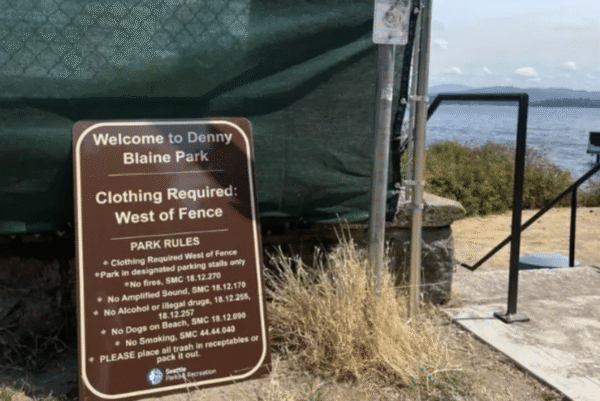
(Photo courtesy Friends of Denny Blaine)
Judge says toplessness allowed at Denny Blaine Park — even in “clothing required” areas
A King County judge has ruled that Seattle cannot broadly enforce restrictions on toplessness at Denny Blaine Park, narrowing the city’s ability to regulate behavior at the longtime clothing-optional beach. The ruling clarified that topless sunbathing remains allowed at Denny Blaine, including in areas marked “clothing required” under the city’s abatement plan.
The decision comes as part of an ongoing legal dispute over how the city manages the park, where some residents have raised concerns about lewd public behavior and safety, while advocates say enforcement has disproportionately targeted lawful toplessness. Denny Blaine has been a gathering place for the LGBTQ+ community for decades.
The ruling does little to resolve the broader dispute between neighbors and LGBTQ+ park users. Nearby residents continue to press concerns about safety and alleged illegal behavior, while park advocates argue that enforcement has unfairly targeted lawful toplessness, especially topless women or those perceived to be women. The case now moves forward, forcing Seattle to deal with larger questions about how to balance public access, community concerns, and the future of one of its most contested public spaces.
TAKE ACTION: Have an opinion about Denny Blaine Park? Share your opinion with Seattle Parks and Recreation by calling (206) 684-4075 or emailing [email protected].
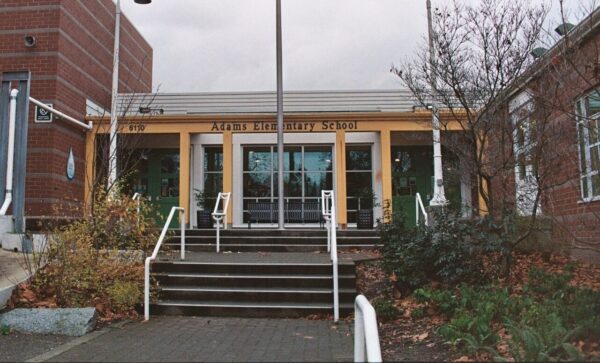
Adams Elementary (Image: Chance)
Adams Elementary principal controversy is a test of SPS superintendent’s promises | OP-Ed
When Seattle Public Schools Superintendent Ben Shuldiner took the district’s top position, he promised honesty and transparency—two qualities he said were critical to helping parents and teachers regain trust in district leadership. He also promised to reform a district central office he described as a “Wild West” of cronyism. This week, an editorial in The Seattle Times makes the case that Shuldiner’s appointment of Anitra Jones as principal of Adams Elementary has been an early test of those promises. Jones previously led Rainier View Elementary, where families and educators raised serious complaints about that school’s learning environment under Jones’ leadership. Jones was removed from Rainier View in 2024 after intense community pressure.
The Times editorial board argues that if Shuldiner is right about the need for hard, structural reform, it has to show up in decisions like this one. Placing a controversial former principal at Adams without meaningful community input, the editorial writers say, has deepened distrust among parents and staff and raised questions about whether SPS will prioritize students and school communities over internal employment politics. Read the full opinion in The Seattle Times.
TAKE ACTION: How do you feel about SPS leadership’s principal appointment process at Adams Elementary? Share your opinion with SPS Superintendent Ben Shuldiner at 206-252-0167 or [email protected]

(Photo courtesy Seattle Parks and Recreation)
OSPI plan preserves some level of Transition to Kindergarten program in every district currently offering it
Following budget cuts to Washington’s Transition to Kindergarten (TK) program, the Office of Superintendent of Public Instruction (OSPI) is moving to preserve access for children in higher-need areas. Funding cuts would reduce the free, public-school-based prekindergarten program’s current 7,000 to roughly 5,000. In response, OSPI has released a plan that ensures about half of the 157 participating districts will not lose any slots, and no district will see its program eliminated entirely. Some more affluent districts, however, will see significant losses in seats, including Issaquah School District. Catch up on the latest in Superintendent Chris Reykdal’s effort to preserve the program in The Seattle Times.
TAKE ACTION: Should the state restore full funding to Washington’s Transition to Kindergarten program? Share your opinion with your state lawmakers.

(Image: Jeremy Dwyer-Lindgren / Woodland Park Zoo)
Help Woodland Park Zoo shape the next 20 years
Woodland Park Zoo (WPZ) is seeking input from parents and other members of the Seattle community as officials there plan the next 20 years of animal habitats and visitor experiences. Although public input helped shape several improvement concepts, zoo officials hope that even more people will take a survey to learn about and share their thoughts on those early concepts
The 10-minute survey will randomly show one of three campus concepts, then ask questions about how the respondent and their family might want to interact with or experience the concept.
The concepts: include an “All-Season Loop,” a winter and fall-friendly route with indoor spaces and cold-hardy animals; a “Public Greenway” connecting the zoo’s greenbelt with community amenities outside the zoo’s front door; and “Savanna Days and Nights,” an expanded savanna, including summer evening access.
The current planning process began in June 2025 in partnership with the City of Seattle and Seattle Parks and Recreation and should be completed this year, providing the zoo with a framework for change.
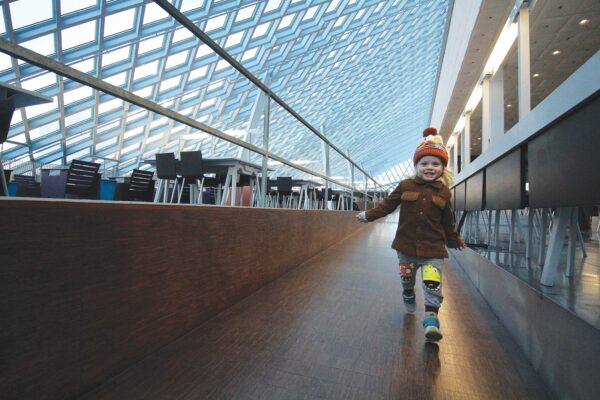
Seattle Central Library. (Photo by Kathryn Mueller)
Lots and lots kids and parents use Seattle Public Libraries, according to a new impact report
Seattleites are turning to the public library in large numbers, according to Seattle Public Library’s recently released 2025 Impact Report. According to the report, the library logged 3.4 million visits and 12.7 million checkouts in 2025—a level of use that underscores the library’s role as a daily resource, especially for children and teens.
More than 1,300 story times and early-literacy programs drew 43,000 attendees, while 6,000 students took part in after-school homework help, including teen tutoring sessions. Overall, the library hosted 5,800 programs with 130,000 participants, offering everything from literacy support to tutoring and digital skills.
Access to technology and materials remains central to that impact. Patrons used public computers for 400,000 hours, printed 2.1 million pages, and scanned 487,000 pages. Overall engagement remained high, with 330,000 people using a library card in 2025. In a city survey, 98% of residents said the library improves quality of life, with many describing it as a free, welcoming space where families can gather, learn, and stay connected without cost.
But there is a cost: Seattle voters will see a proposed $480 million Seattle library levy renewal on their August 4, 2026, primary ballot. The levy covers library services, maintenance, technology, security, and staffing, with a significant portion supporting services for homeless populations and enhancing safety. It is double the amount sought from taxpayers when the levy was last renewed in 2019.
TAKE ACTION: Mark your calendar for the August 4 primary election and try to get your ballot in earlier to protect your vote on the library levy.
New book explains why children crave screens — and what parents can do to help them dial back
 If you’ve been scratching your head, trying to understand why your 5-year-old, 10-year-old, tween, or teen seems downright mad when you call an end to screen time for the day, award-winning science journalist Michaeleen Doucleff has answers for you. In a recent NPR interview, Doucleff discussed her newly published parenting book on what she describes as “dopamine-seeking” behavior in children.
“Dopamine Kids: A Science-Based Plan to Rewire Your Child’s Brain and Take Back Your Family in the Age of Screens and Ultraprocessed Foods” was released in March. In it, Doucleff draws on neuroscience and global parenting practices to explain why kids raised in highly stimulating environments—dominated by screens, constant snacks, and rapid rewards — often struggle to disengage and regulate their attention.
Rather than framing the issue as defiance, Doucleff positions it as a predictable brain response. Her approach urges parents to dial back high-intensity inputs and reintroduce slower, more self-directed activities, allowing children to rebuild tolerance for boredom, improve focus, and develop steadier emotional control. Check out the interview on NPR.org.

A rock slide on State Route 20 in March left part of the road blocked. (Photo courtesy of Washington State Department of Transportation)
Preparing for a road trip to eastern WA along Highway 20? Expect a far longer drive.
Planning a family trip to Twisp or Porcupine Creek in the near future? Plan for a longer drive than expected. A key stretch of the North Cascades Highway remains closed with no reopening date in sight after severe winter damage and a March rockslide tore through the corridor. About 26 miles of State Route 20—between Diablo Lake and Porcupine Creek—are still impassable as crews prepare for extensive repairs that go far beyond clearing debris, including totally rebuilding sections of roadway.
According to an article this week in the Washington State Standard, the closure has stretched well past the highway’s typical spring reopening, raising concerns for communities on the east side of the Cascades that rely on summer tourism. State transportation officials say the work could take weeks once underway, but that permitting, contractor selection, and the scale of damage—spanning unstable slopes and washed-out roadbed—mean there’s still no clear timeline for when the route will fully reopen.

Kids locking their phones. (Photo from overyondr.com)
Do cellphone bans in schools work? New study says not as much as schools hope
A new study highlighted this week in The New York Times finds that school cellphone bans that use locked pouches to store students’ phones are effective at one thing: getting devices out of students’ hands. But the authors of the study published by the National Bureau of Economic Research concluded that bans do not necessarily improve academic performance or behavior.
According to the study “The Effects of School Phone Bans: National Evidence from Lockable Pouches,” student phone use dropped significantly across schools that adopted strict, “bell-to-bell” restrictions. But early results show no consistent gains in test scores, and in some cases, discipline issues initially rose as schools enforced bans. Then things improved.
“We find that pouch adoption substantially reduces phone use as measured by GPS pings and teacher reports,” study authors write. “In the first year after adoption, disciplinary incidents increase, and student subjective well-being falls, consistent with short-term disruption. However, effects on well-being become positive in later years, and disciplinary effects fade.
“For academic achievement, average effects on test scores are consistently close to zero,” according to the authors. “High schools see modest positive effects, particularly in math, while middle schools see small negative effects. We find little evidence of effects on school attendance, self-reported classroom attention, or perceived online bullying.”
The findings land as more Washington schools move to ban or limit cellphone use by students despite no statewide mandate. State leaders have largely left decisions to districts, and most have adopted some form of restriction. In Seattle that shift became formal last week, when Seattle Public Schools rolled out its first districtwide policy: a full-day ban for K–8 students, with more limited use allowed for high schoolers outside class time.

Image from “The Quaker Meeting and Me,” a book by Rebecca Price.
An article worth a replay: Quaker parents were on to something
A style of parenting rooted in a nearly 375-year-old religious tradition actually closely aligns with what modern research identifies as the most effective approach to raising children. Practices long emphasized by Quakers, including giving children meaningful autonomy, asking guiding questions rather than issuing commands, and focusing on strengths rather than weaknesses, mirror what psychologists call “authoritative parenting”—a style linked to stronger emotional health, self-regulation, and academic success. An article published a year ago in “The Atlantic” warrants a frequent replay as each new generation of parents faces the question, “How do we raise resilient kids?”
The Quaker approach is not permissive, it pairs independence with clear, calm limits and emphasizes modeling behavior—treating children with respect, reinforcing their inherent worth, and prioritizing empathy and community responsibility. Research cited in the article shows that children raised with this balance of structure and autonomy tend to develop resilience, internal motivation, and a stronger sense of purpose. At its core, the philosophy rejects rigid parenting “fads” in favor of a steady framework: guide rather than control, set boundaries without harshness, and trust that, given support, children are capable of thoughtful decision-making. Read the “Quaker Parents Were Ahead of Their Time.”
National survey shows ‘hard’ parenting leads to healthier parent-child relationships and child outcomes
A new national survey of roughly 24,000 U.S. parents conducted by the Institute of Family Studies finds that what often feels like the hardest parts of parenting—setting rules and enforcing them—may be tied to stronger parent-child relationships over time. Parents who consistently enforced household expectations also reported closer relationships with their children, a pattern echoed in teens’ own responses. At the same time, those parents were more likely to describe parenting as difficult, underscoring a core tension: the practices linked to better outcomes are often the most demanding day to day.
The study also highlights how much context matters. Parenting feels easier when adults feel supported—by partners and by their communities—and harder when finances are strained or support is lacking. Age plays a role as well: fathers report the early years as most difficult, while mothers tend to find the elementary-school years most challenging. The broader takeaway is not that parenting should be harsher, but that clear structure paired with support systems appears to strengthen both relationships and long-term family stability.