Fridays in my childhood were reserved for trips to Blockbuster, the long-gone video store chain romanticized by generations raised to be kind and rewind. Movies were portals – some to familiar places, others to new frontiers – through which us offline, suburban kittens frequently jumped.
Last week, for my own family’s Friday movie night, I put on something, as my kids say, “for work.” Given my job as a film writer, my two daughters have seen almost every age-appropriate flick released in the last five years.
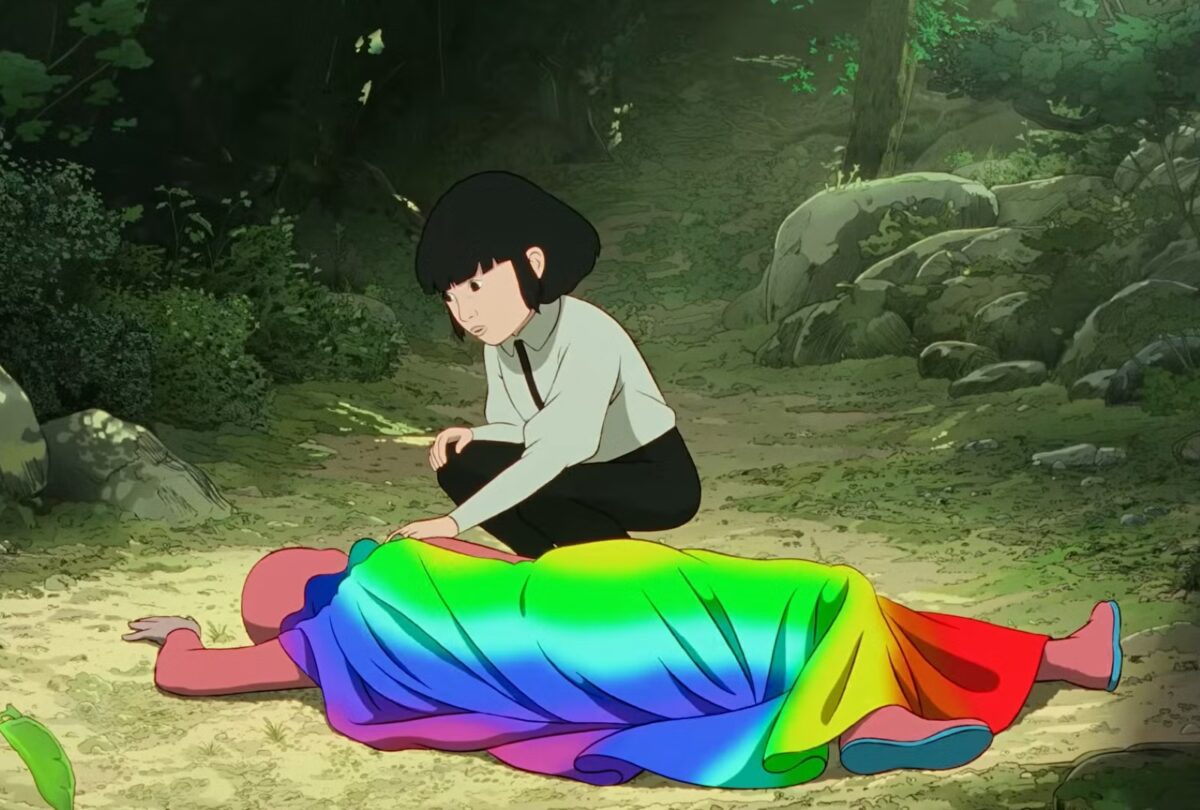
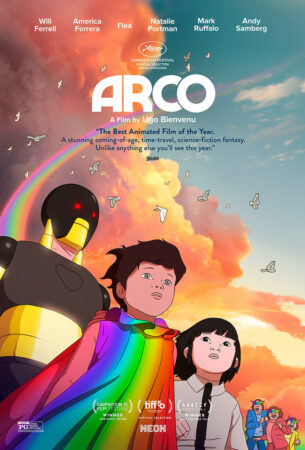
“Arco,” coming to theaters this week, is a time- and space-traveling odyssey with a tender vision of the impending environmental crisis and humanity’s machine-reliant future. It’s also undeniably higher brow than the last work movie they saw with me, “The SpongeBob Movie: Search for SquarePants.” All three of us went into “Arco” blind, and I was reassured of the choice by its PG rating and recent Oscar nomination for Best Animated Feature.
(Image courtesy of Neon)
On- and Off-Screen Heartache
“Arco” follows a young boy living in a distant future. He inadvertently travels hundreds of years in the past, where Earth is struggling with climate change and a society disassociating under the growing weight of advanced technology. Written and directed by French filmmaker Ugo Bienvenu, the film emulates 80s Japanese anime, taking inspiration from Miyazaki and spinning a story that feels far more urgent than Studio Ghibli’s pastoral perspective.
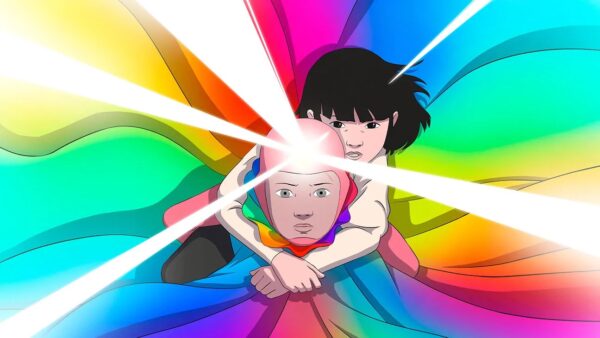
At the film’s climax, a young girl named Iris has an emotional, tear-filled goodbye with Mikki, her robot nanny. An artificial stand-in for her parents who live and work outside of the family home, Mikki offers the only form of physical love that Iris experiences in her daily life, and its “death” is a tearjerker.
(Image courtesy of Neon)
“I’m sad,” my six-year-old said at no one in particular, tears welling to her throat and then her eyes. She nuzzled into me harder.
This admission, coupled with the waterworks, were not enough to force me to my feet. Hardly a day goes by that someone in our house doesn’t cry. This is the age of big feelings and high emotions, the usual culprits being hunger, fatigue, minor injury, or the savage tit-for-tat of sibling rivalry.
But her swell of sorrow wasn’t due to any of those reasons. This was a moment of empathy for fictional characters, a phenomenon that she’s experienced before, though perhaps not as frequently as I might assume. Sure, she’s seen a fair number of movies in her six years of life, but she has also been shielded from the incessant emotional whiplash that older generations endured.
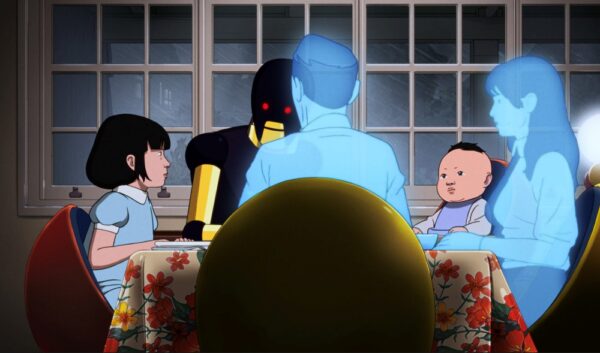
(Image courtesy of Neon)
The Sad Movies We Grew Up With
For much of its existence, Disney has made unavoidably sad movies. The studio’s Golden Age (1937 to 1942) released films geared as much to adults as to children, a function of economic necessity and public demand. Films like “Snow White and the Seven Dwarfs,” “Dumbo,” “Pinocchio,” and “Bambi” featured scenes of death, or near-death, and unending human suffering or animal anguish.
In the late 20th century, the Disney Renaissance (1989 to 1999) and the advent of VHS home theater revitalized the market for children’s animated features. Films like “The Lion King” and “The Hunchback of Notre Dame” pushed the envelope of what young viewers could expect from a “kid’s movie.”
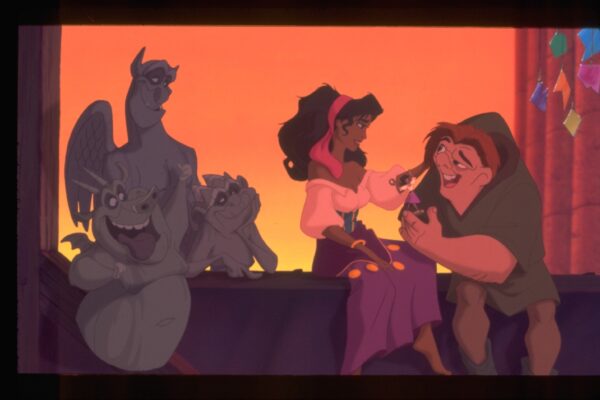
“The Hunchback of Notre Dame” pushed the envelope of what to expect for a kids movie. (Image courtesy Walt Disney Pictures & Walt Disney Animation Studios)
Scanning the Blockbuster aisles in my mind’s eye, I revisit the movies that once brought me the same feelings of sadness my daughter was experiencing, snuggled up next to me on the couch. I see Shadow stuck in the pit at the end of “Homeward Bound: The Incredible Journey,” Littlefoot’s mother sacrificing herself in “The Land Before Time,” and Charlie saying goodbye to Anne-Marie in “All Dogs Go to Heaven.”
As an adult, I don’t particularly seek out movies likely to make me cry, but the gut-punch never stopped me in my youth. Oftentimes, it was the opposite: feeling something by film’s end was more gratifying than not. Feeling something was far better than feeling nothing.
A recent study in Media Psychology found that children can be moved by “moral beauty” in film, and the ensuing emotion they experience opens their heart and mind to greater empathy in real life. The study, which placed the 2015 Pixar film “Inside Out” at the center of its investigation, concludes that movies can fuel a child’s social intelligence, offering them a new awareness of their own feelings, as well as the emotions of those around them.
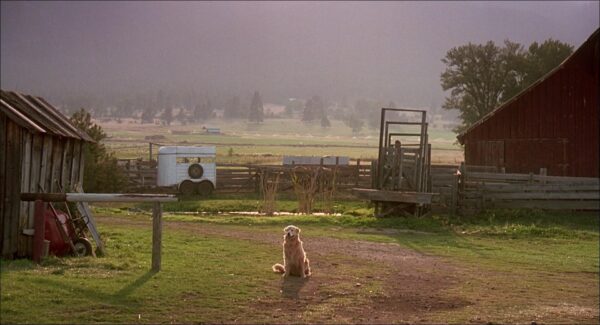
Who doesn’t remember this moment from “Homeward Bound: The Incredible Journey” (Image courtesy Walt Disney Pictures & Touchwood Pacific Partners 1)
What Movies Teach Kids About Empathy
As my daughter sniffled and pursed her lips, my initial reaction was to “make it better,” to reassure her or to distract her from the sentiments bubbling over at the sight of the dying robot. As an adult viewer with a critical eye and a college degree in film studies, I didn’t find Mikki a particularly endearing character (“The Wild Robot” and “WALL-E” are just two android-centric films that make for a more captivating watch).
But my daughter was not crying about the red-eyed bot. She was not connecting or commiserating with Mikki. She was empathizing with Iris, whose sorrowful goodbye was big, loud, and wholly human. She had put herself in Iris’ place, reacting the way she might if her own pet robot decombusted before her eyes.
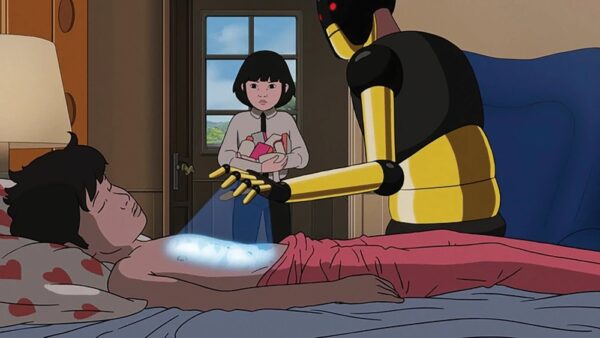
(Image courtesy of Neon)
Like “Inside Out,” “Arco” employs a traditional blueprint known as the “Hero’s Journey,” a classical narrative that follows a hero who goes on an adventure, encounters challenges and overcomes them, returning changed by the journey. The act of following their journey, parsing through the story’s themes and messages, is an early test of cognition that helps kids make sense of complex ideas and situations that they will likely encounter in their own lives. That same study found that films can provide young viewers with insights about life. Stories can introduce topics like death, loss, separation, and any number of traumatic life events in a
controlled setting, allowing the young viewer time and distance from the event to process it.
I don’t enjoy seeing my children upset, but I was touched by my youngest daughter’s expression of compassion and by her ability to connect, at just six, with a fictional character and a situation that has no resemblance to her own life. Films are meant to broaden our perspective, and “Arco” did just that.
Despite the brief tears, my daughter said she liked the movie. My other daughter asked to watch it again; she was smitten with the hand-drawn aesthetic and the plot that did not dumb itself down for them, even the ending’s twist that had me in a chokehold. They had questions about some of the nuances of the plot, and I answered them as best I could. Our family movie night has never felt as meaningful as it did that night. We all need a good cry once in a while.
“Arco” is in theaters now.