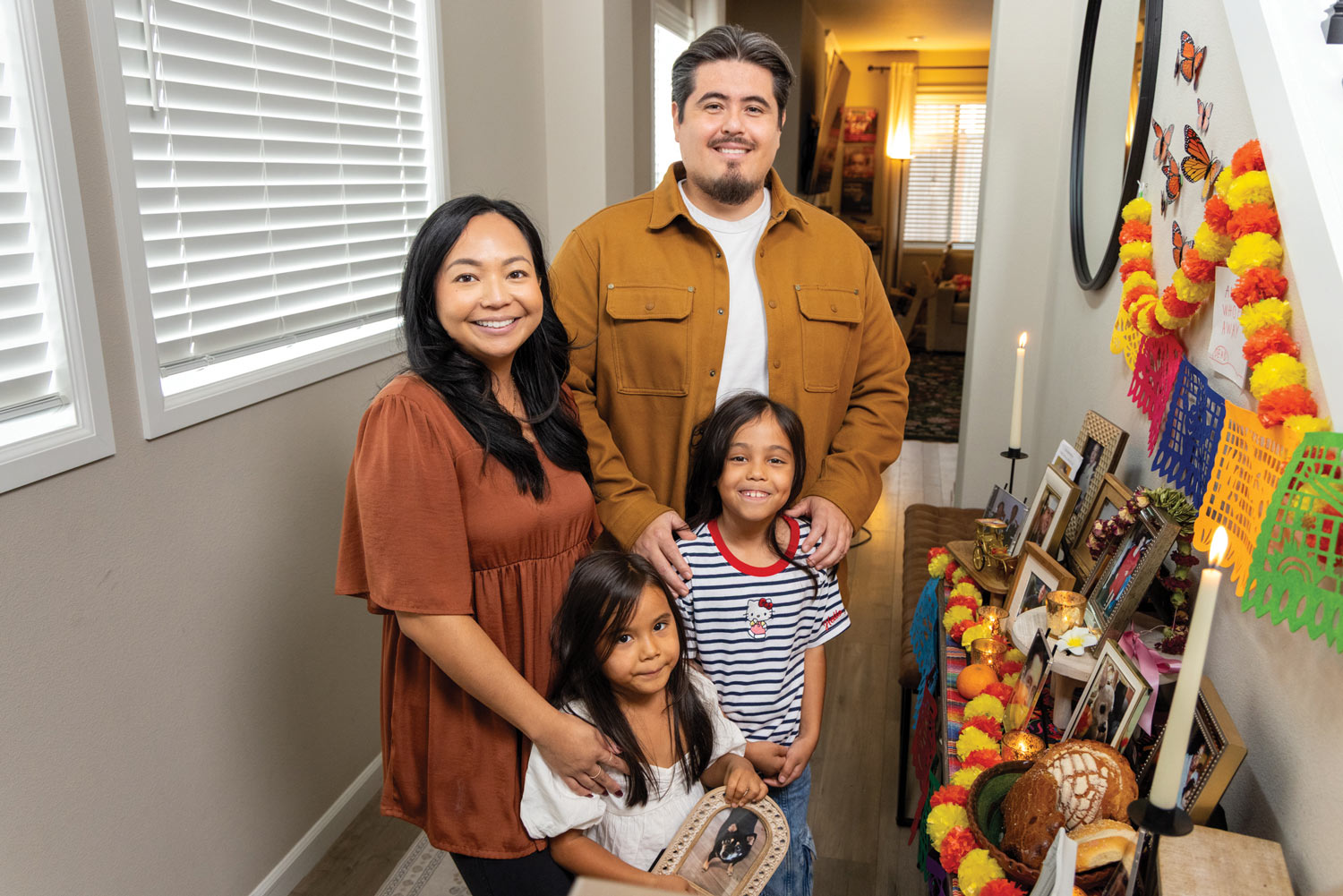
Día de los Muertos is recognized every November, but for the Bravo household, remembering loved ones who have passed on is a year-round celebration. In the Covington family’s entryway, an ofrenda (altar) displays framed photos of relatives, friends, and pets. Tucked among the pictures is a quote by poet Linda Hogan that reads, “Suddenly, all my ancestors are behind me. Be still, they say. You are the result of the love of thousands.”
“[The ofrenda] is a reminder that our ancestors are always with us, and that the lives we’re living would not be possible without the people who came before us,” said Linet Madeja-Bravo. “I want our kids to grow up seeing that remembrance and honor as a normal and meaningful part of our everyday lives.”
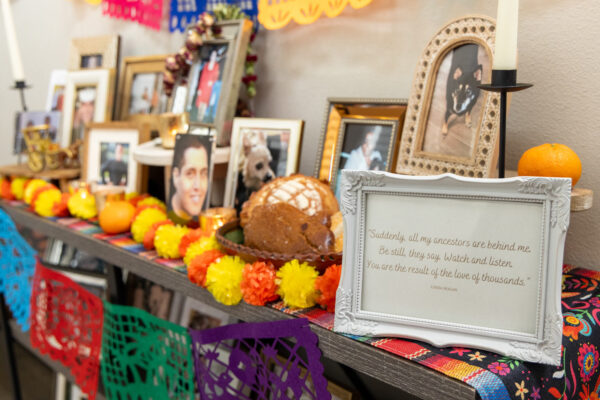
The Bravo family ofrenda (Photo by Joshua Huston)
Madeja-Bravo, a daughter of Filipino immigrants, and her husband, Christian Bravo, who is Mexican American, are raising their two young daughters to celebrate Día de los Muertos and Undas, a Filipino holiday that combines All Saints’ Day and All Souls’ Day. Día de los Muertos is a holiday rooted in indigenous Mexican culture, dedicated to remembering loved ones and recognizing that life and death are a continuous cycle. Celebrations for Día de los Muertos and Undas, which both fall on November 1 and 2, involve cleaning and decorating gravesites, lighting candles, and spending time with family.
Every November, the Bravo family adds traditional decorations — marigolds, papel picado (colorful cut paper), and candles — to the ofrenda. They also read picture books about the holidays.
“I love [the holidays] because we all get to hang out with each other and your family and relatives are with you,” said 8-year-old Bella. “It celebrates where we came from, and it’s also our cat Zorro’s first Día de los Muertos and Undas.”
Neither parent grew up celebrating these holidays, but decided to start once they had kids, reflecting the fluidity of culture over generations. For Madeja-Bravo, celebrating with her children feels like a form of resistance in a country that can erase or ignore the histories and contributions of some people groups.
“Being a mom of Mexican and Filipino kids, while also trying to learn and reconnect with what it means to be a Filipina in the diaspora, isn’t always easy,” Madeja-Bravo said. “So in a lot of ways, these traditions are something we’re discovering together. I’m not trying to create some perfect version of what it means to be Mexican or Filipino, but [I’m] hoping our kids will grow up knowing that these parts of who they are are absolutely worth knowing, celebrating, and carrying forward.”