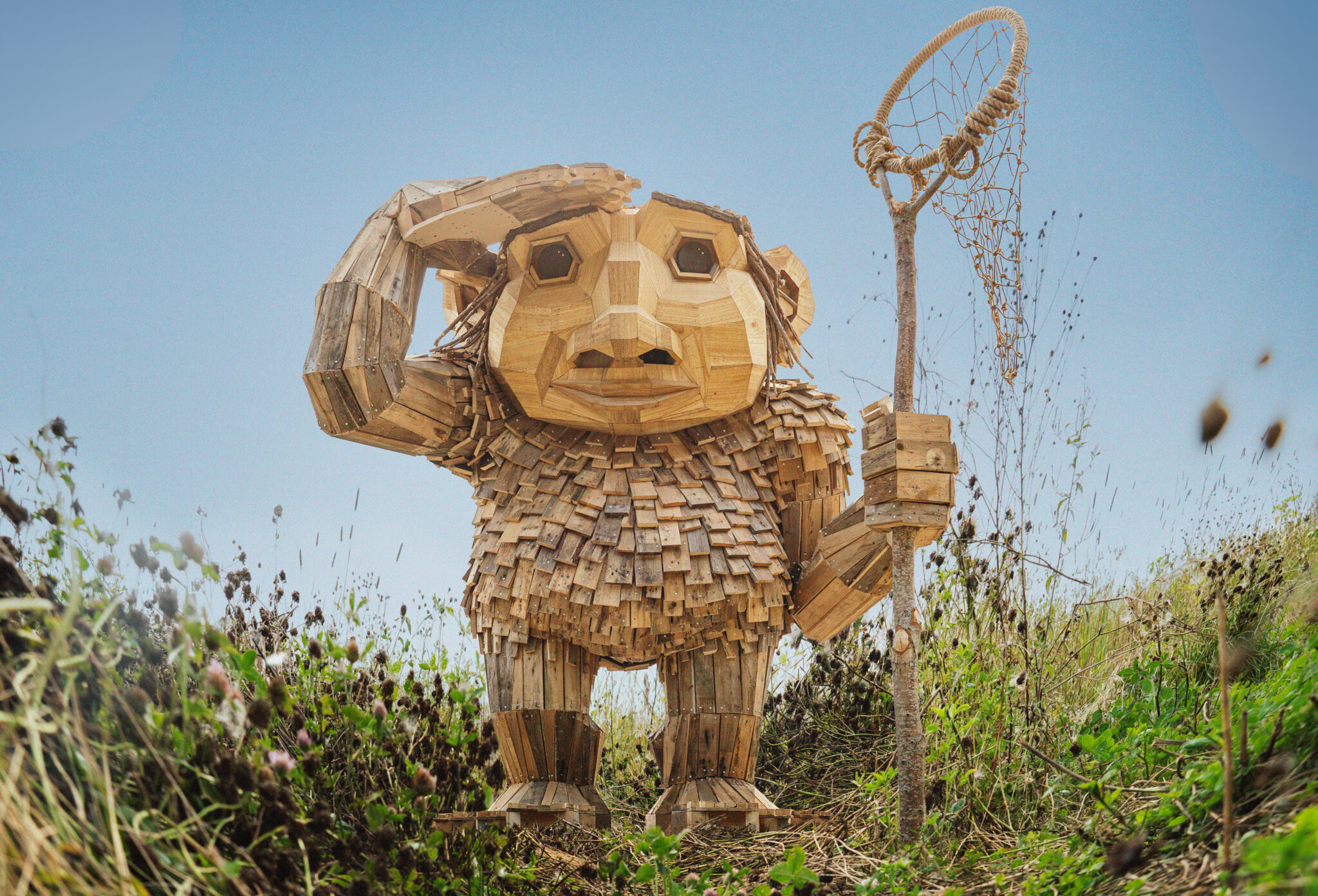
The Thomas Dambo trolls that currently populate the greater Seattle area are popular attraction to local families and visitors to our region. And, from October 15 to January 24, 2026, the troll count grow from five to 17 giants. Below is everything you need to know to hunt down all those folkloric creatures—and to understand what motivates them and the artist who made them.
A troll hunting map
How do you find all those trolls? With a map, of course. As colored leaves and cooler-but-not-yet-cold temperatures settle in, fall is a terrific time to troll hunt. The map below shows all the spots in Puget Sound where trolls are lurking, sitting, lying down and otherwise waiting for your family to find them:
We should mention, there’s another troll here in the Pacific Northwest, but it’s a bit of a drive: In Portland, you’ll find Ole-Bolle — Dambo’s first troll in the region — living in the garden behind Nordia House where he appears to lift the roof off a little red cabin to get a look at what’s inside. Read more about the Portland troll.
But those are just the local trolls to look for. They are part of a much bigger art installation as Thomas Dambo trolls can be found in countries all around the world. Check out Dambo’s Global Troll Map.
A girl who loves trolls
“What do you think of him?”
“I wish he lived at my house. He could sleep in my swimming pool.”
I’m listening to Lenon, age 5, as we stand in front of Bruun Idun, the sweet-faced, flute-playing wooden troll who lives under a shady copse at the north end of the beach walk in Seattle’s Lincoln Park.
The swimming pool, Lenon’s dad, Roger, tells me, is a kiddie pool, not big enough for even one of Bruun Idun’s feet, but he’s not going to kill the dream: “Maybe,” he tells Lenon, “but look, she’s got the whole ocean right here.” Lenon and Roger, by the way, are middle names at the request of a cautious White Center dad, who loves finding trolls but isn’t so keen on them finding his family.
“We’ve seen each one several times,” Roger tells me of the five wooden trolls installed by Danish artist Thomas Dambo in and around Seattle in the summer of 2023. “She wants them each one to live with us.”
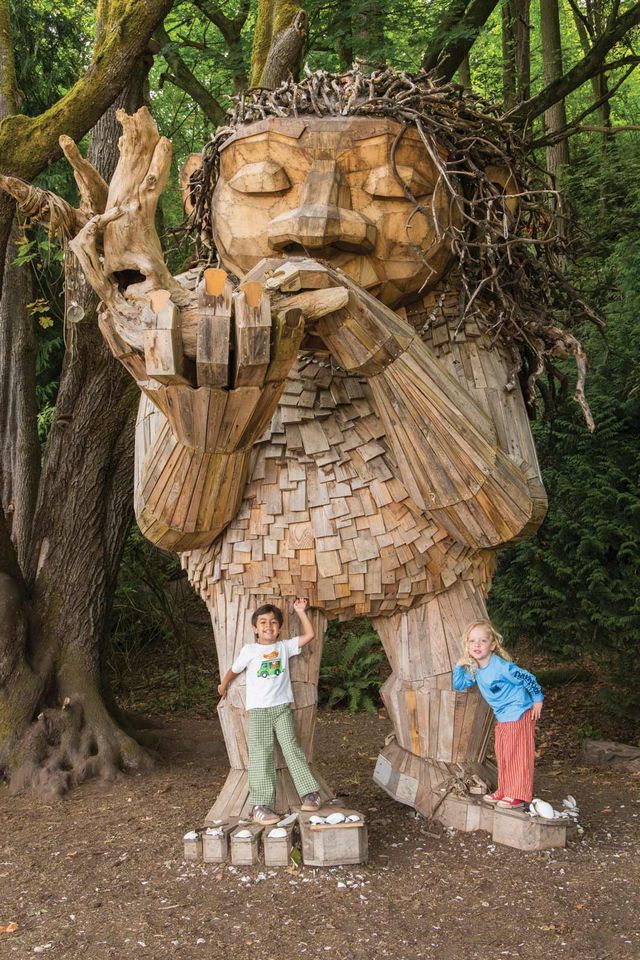
Bruun Idun (Photo by Josh Huston)
That’s because each Dambo troll feels like a friend (as opposed to scary). Every troll has a story. They change a bit as the seasons pass, so they feel both familiar and new each time you visit.
I tell Lenon that Bruun Idun, eyes closed as if caught up in a secret musical moment, is playing her flute to the orcas in the water. According to Dambo troll lore, she is asking them “why they have all left the Puget Sound.”
I let her dad tackle that question with Lenon, and watch as about 80 people, big and small, sidle up to Bruun Idun over the course of a Saturday afternoon.
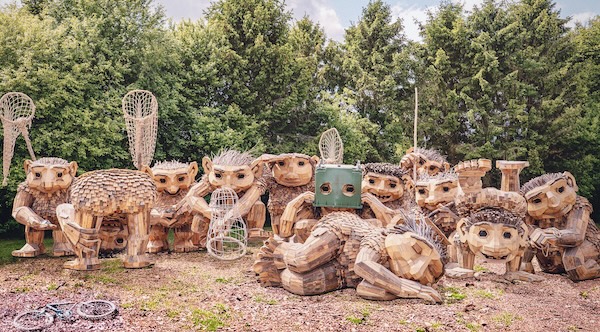
From Trolls: A Field Study (Photo courtesy Imagine / Thomas Dambo)
New temporary trolls at NW Trek and Point Defiance Zoo
Beginning Oct. 15, Lenon and her family will get to hunt down 12 more of Dambo’s whimsical giants — four hidden among greenage at Point Defiance Zoo & Aquarium (PDZA) and eight along the winding trails and native wildlife habitats of Northwest Trek Wildlife Park in Eatonville. The trolls will be peeking at people and gathering intel on humans at the two sister parks until Jan. 24, 2027.
The installation of the traveling “TROLLS: A Field Study” has been months in the planning with PDZA and NW Trek and reflects a mission they share with Dambo: to promote sustainability and environmental awareness.
“Honestly, the idea just fit us,” said Mick Szydlowski, spokesperson for PDZA and Northwest Trek. “When we first learned about Thomas Dambo’s trolls, it felt like discovering a new species we didn’t know we needed.
“The zoo is already a place where people come face‑to‑face with awe. The trolls tap into that instinct: they’re huge, mysterious, and just a little bit mischievous,” Szydlowski said. “Bringing them to the zoo — splitting them between here and Northwest Trek, our sister wildlife park — felt like a natural extension of what we already do, which is creating moments of surprise that connect people to the outdoors.”
How do you get a troll to come to your city?
In general, a visit by Dambo trolls starts with a group willing to host and cover installation costs. The 2023 “Northwest Trolls” exhibition that brought Bruun Idun and four other trolls to greater Seattle was primarily funded by the Scan Design Foundation and the Paul G. Allen Family Foundation. Those trolls are being cared for by volunteers and members of the non-profit organizations or municipalities that oversee each site. Each has remained standing beyond their contracted three-year lifespan. Barring any major damage or other concerns, officials at Scan Design said they hope each sculpture will remain in place for as long as 15 years.
The request for a visit from the temporary “TROLLS: A Field Study” was approved by the Board of Park Commissioners for Parks Tacoma, which oversees Northwest Trek and PDZA.
To install these new and sizable creatures, the wildlife parks are working with Imagine, an international immersive storytelling and experiential design company. If your little troll hunter asks how the trolls get built and who does the building, the short answer is: “No, Thomas Dambo does not build each troll on his own.”
“This project takes plenty of collaboration,” said Ashley Friel, who coordinates exhibit communication for imagine.
Dambo and his team of artists work out of his studio in the Danish countryside. Key parts (such as the face) are prefabricated in Denmark and shipped to the installation site. The giant is then built using roughly five tons of materials. Some trolls will include nearly 200 recycled wooden pallets. If volunteers are needed for an installation, the hosting organizations will put out a call.
“The Trolls are crafted from recycled or reclaimed materials, including fallen branches, scrap wood, twigs, and pallets,” said Friel. “For this exhibition, each Troll’s hair has been crafted from a special type of wood, such as birch, walnut, or chestnut, to give them a unique flair.”
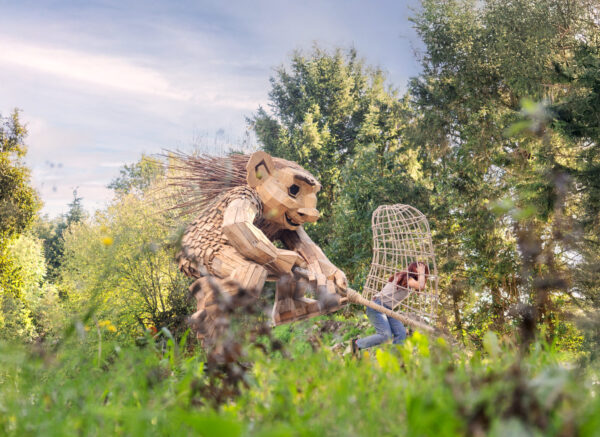
From Trolls: A Field Study (Photo courtesy Imagine / Thomas Dambo)
Who keep the trolls standing (or sitting)?
They’re made of wood and wood breaks down. So who who keeps the region’s semi-permanent trolls healthy and standing for families to find and love? An ad hoc “Troll Team” of trained volunteers and host-site partners keeps watch over the sculptures and handles minor repairs using a reference guide from Dambo and his crew. Dambo may step in if damage is extensive.
So far, repairs have been minor: Lincoln Park staff removed graffiti the troll who plays a flute amid the trees with light pressure washing, while volunteers replaced wind-damaged boards on Jakob Two Trees with recycled pallets donated by park operations and coordinated through the City of Issaquah’s Arts program. Organizers hope each troll will remain in place for at least three years — and potentially as long as 15. Read more on the work of protecting and fixing the trolls.
Why is that trolls capture our hearts?
Western Washington doesn’t have the greatest number of commissioned semi-permanent Dambo trolls in the country. That honor goes to North Carolina with seven. But during the three months “TROLLS: A Field Study” exhibit is up in the Pierce County animal parks, the Puget Sound troll map will include 17 big, magical, wooden faces.
Just what is it about those faces that so capture our family’s hearts and interest? I asked Friel, Szydlowski and local parents to tell me, in a word, what the trolls inspire in kids (big and little).
For Friel, the word was “curiosity.”
“These trolls can teach us a lot about the importance of taking care of our planet and seeking out adventure,” Friel said.
Parents in the region came up with a whole list of single words to describe their and their kids’ attraction to Dambo’s structures: “mysterious,” “funny,” “mystical,” “soulful,” “sweet,” “spellbinding.” “Whoa.”
Dambo’s trolls are “like a manifestation of a dream… a friendly monster, the best kind,” Susan, a Seattle grandmother, said.
And then there was new mom Paloma’s word: “Grounding.” Indeed, these trolls feel rooted in the earth.
“Kids love anything that makes the world feel bigger and stranger in a good way,” said Szydlowski. “A troll isn’t just a sculpture; it feels like a character you’ve stumbled upon mid‑adventure. A giant troll makes you feel small in the best possible way.”
Trolls in folklore
Folklore is a valued part of Dambo’s Scandinavian culture, and his trolls are steeped in it.
“I’ve always been a storyteller and creator,” Dambo told Mia Le Journal in a 2025 interview. “Growing up in Denmark, I was surrounded by fairy tales and learned early on that nothing should go to waste. Trolls, deeply rooted in Scandinavian folklore, became the perfect subject. They’re both protectors and tricksters, much like nature itself, and building them from recycled materials highlights the idea that “trash” can be transformed into treasure.”
While most of his creatures give off a gentle vibe, he points out that traditional troll stories carry a hint (or sometimes a bang) of warning: be on your best behavior if you don’t want to be captured by a troll. The affable crew that makes up “TROLLS: A Field Study” gets at the story of sustainability in a new way — by making human behaviors a point of troll research.
“These 12 Trolls are on a journey to study humankind,” said Friel. “They explore how humans and Trolls are alike, as well as the many ways we differ. The Trolls’ individual stories are inspired by their curiosity about things we humans see as normal, like cell phone usage and grocery store food packaging.”
To get deeper into the story, Dambo has created the “TROLLS: A Field Study” book to go along with the installation. It acts like an official field guide of the type anthropologists might use, and offers great and often funny questions and activities for kids and parents to explore together:
“Why do humans wrap their food like gifts?”
“Do they poop?”
“Why do they give snacks to the bin (garbage)?”
Trolls: A lesson reuse and sustainability
Dambo’s trolls have been built in more than 17 countries and have captivated millions around the world. All of that work is about getting people to rethink their relationship with what they throw away. Although Dambo was on leave and not available to provide new insights, he stresses in every interview he gives that much of what we call trash can be reimagined as treasure:
“Trash is not disgusting,” Dambo recently told The New York Times. “It’s disgusting to throw it out.”
“Thomas Dambo doesn’t just build art; he builds stories about reuse, resourcefulness, and imagination,” said Szydlowski. “It’s one thing to talk about sustainability, and it’s another to let people walk inside it, touch it, and feel its scale.”
“The trolls are basically giant conversation starters: why reclaimed materials matter, how creativity and conservation overlap, why large outdoor art invites people deeper into the natural world,” he added. “Staff and volunteers can’t help but share the ‘field study’ idea: the trolls are out observing humans while we’re observing animals, and somewhere in the middle you get a pretty fun discussion about stewardship.”
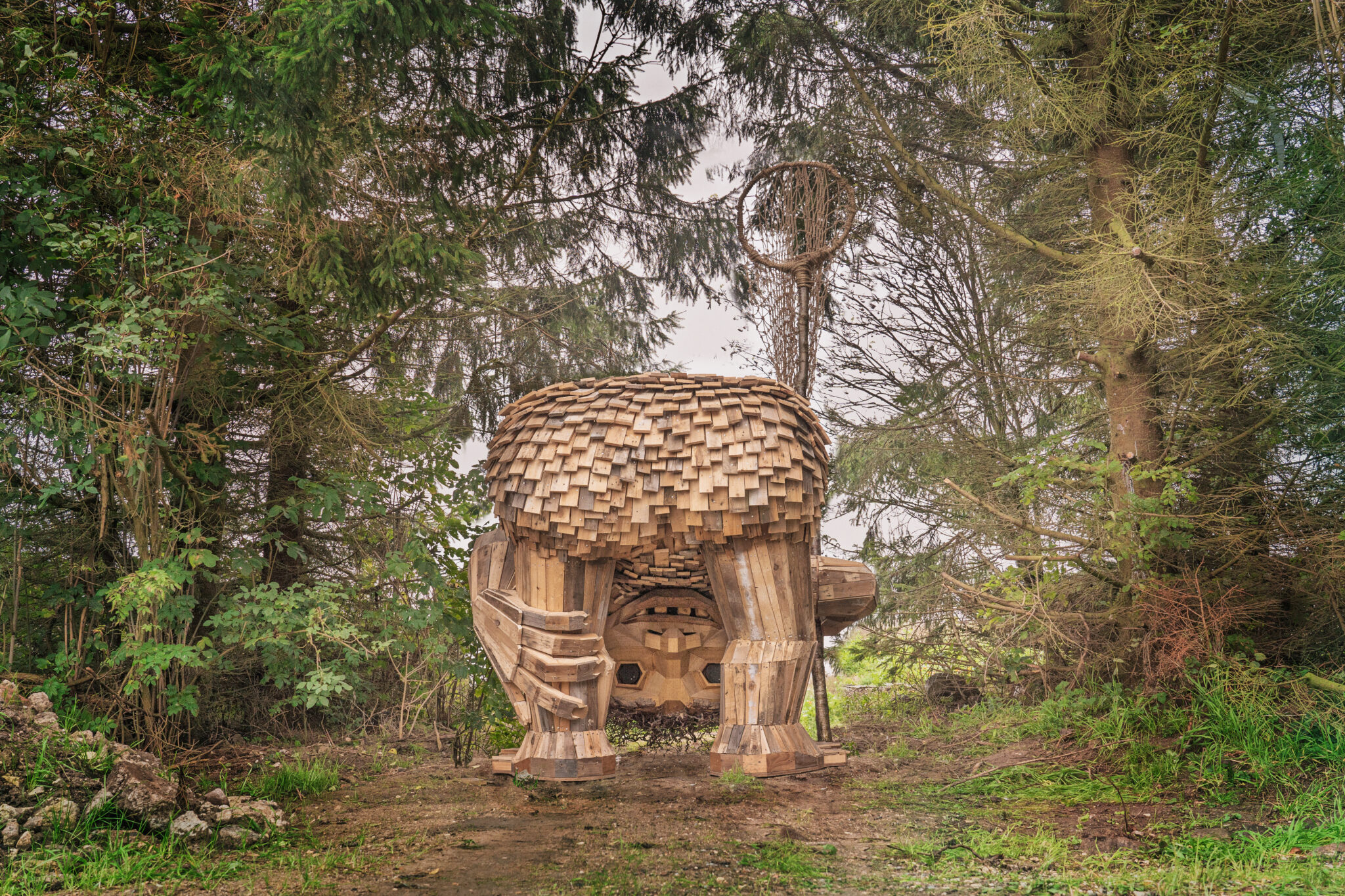
From Trolls: A Field Study (Photo courtesy Imagine / Thomas Dambo)
All about the trolls visiting NW Trek
- Taks “organized the field study after noticing increasing signs of human waste and environmental damage. Taks believes trolls must understand humans before deciding how to help them change.”
- Wilde “protects untouched areas of the forest, tracking how wildlife behaves when humans are present versus when the forest is quiet.”
- Anja “closely observes human behavior, focusing on moments of kindness.”
- Bignut “thinks about the future of forests, studying how small actions today affect ecosystems many years from now.”
- Lilnut “protects seeds and new plant growth. She studies how forests regenerate after storms, fires, or human activity.”
- Hasse “experiments with building structures from reclaimed materials so forests aren’t further harmed.”
- Kirse “is always in motion, symbolizing curiosity or human physicality.”
- Valle “reminds us to rest but not to sleep through the beauty around us.”
All about the trolls visiting PDZA
- Poppi “gathers small objects left behind by humans. She wants to understand why humans create so many things meant to be used only once.”
- Birch is interested in how trees communicate through roots and soil. “Birch may symbolize human connection or even disconnection from nature.”
- Boge “believes trolls and humans should learn from one another.”
- Larke “observes weather, birds, and seasonal change, reminding her fellow trolls that nature moves in cycles that cannot be rushed.”
All about our 5 semi-permanent Northwest Trolls
- Pia the Peacekeeper (Bainbridge Island) was the first of the Northwest trolls. Find her at Sakai Park where she sits cross-legged, gently holding small human puppets.
- Bruun Idun (West Seattle) is tucked in Lincoln Park where she plays her flute to the orcas, asking why they have all left the Puget Sound. Reach more about this troll who lives near the sea.
- Jakob Two Trees (Issaquah) is nestled in the woods of Cougar Mountain, enjoying a peaceful moment and reminding humans to do the same. Read more about this troll with a Coast Salish connection.
- Frankie Feetsplinter (Ballard) is located at the National Nordic Museum. Frankie is the youngest and “most irresponsible of all the Trolls.” Read more about the completion of Frankie.
- Oscar the Bird King (Vashon Island): Oscar traveled far and settled for a rest. Because he speaks crow, he’s been dubbed the bird king. Read more about Oscar and his tale.
The last words
Lenon and Roger have had many a troll conversation since the arrival of the first five Northwest Trolls in Puget Sound. “She asks a lot of questions about trolls,” Roger said. “Like do they take baths?”
As the two moved along the path at Lincoln Park, waving good-bye to Bruun Idon, I noticed the troll stayed put. She probably knows there are no orcas in Lenon’s kiddie pool.
Roger’s words — he couldn’t get it down to just one — for what this and other Dambo trolls inspire in the young and young at heart hung in the air, perfect and right:
“Enchanting,” he said. “Marvelous. Magical.”