Why does it feel so hard to find a clean, open public restroom in Seattle?
It’s a question parents of young children ask most urgently, often while frantically facing an urban potty emergency. The scarcity of public toilets is usually blamed on upkeep costs, the threat of vandalism and drug use, and a lack of political will, with other budget priorities gobbling up the funds needed for clean, reliable places to pee and poo.
Stacy, a Seattle mom, said that when her child that when potty training, “I carried his folding potty with me because there was nowhere to take him.
“We eventually got a Seattle Aquarium membership so we would have a clean, safe place to use the restroom when we spend the day in Seattle,” Stacy added. “We love everything the Aquarium has to offer, but that is our major reason we keep it!”
25 per 100,000
It’s estimated that Seattle, with a population of 823,400, has 25 restrooms per 100,000 residents—or about 200 public restrooms, about 129 of which are maintained by Seattle Parks & Recreation across 97 parks.
But how many public restrooms does a city Seattle’s size actually need?
There is no universally accepted per-capita standard. New York City, which has struggled with its own restroom shortage, adopted a law in 2025 setting a goal of at least 2,120 public bathrooms by 2035—roughly 25 per 100,000 residents, which is Seattle’s current level. But an earlier proposal for New York was shot down: Introduced by New York City Councilmember Sandy Nurse in 2023, the legislation called for one public restroom per 2,000 residents, a goal developed with input from advocates for unhoused people, older adults, families, people with disabilities, and mobile workers. Nurse cited research comparing restroom access in major cities, including work by the Urban Design Forum.
Applied to Seattle, Nurse’s proposal for NYC would translate to approximately 412 public restrooms, more than double what’s currently available.
A mama mayor acts
This under-commoded status quo has lasted for decades. That is, until we elected a mayor with a toddler.
“As a mother of a 3-year-old, I have very personal experience of how much your quality of life is improved by having access to public restrooms and how much that determines where you’re able to go and how you’re able to experience the city,” says Mayor Katie Wilson.
The city’s 2027-28 budget passed last week, and it includes spending for Wilson’s pet priority. The budget includes $1.8 million to add a restroom to Mount Baker’s Cheryl Chow Park and another to-be-determined park in Northeast Seattle, $971,000 for park restroom renovations, and $1.4 million for up to 10 new portable restrooms in busy areas across the city.
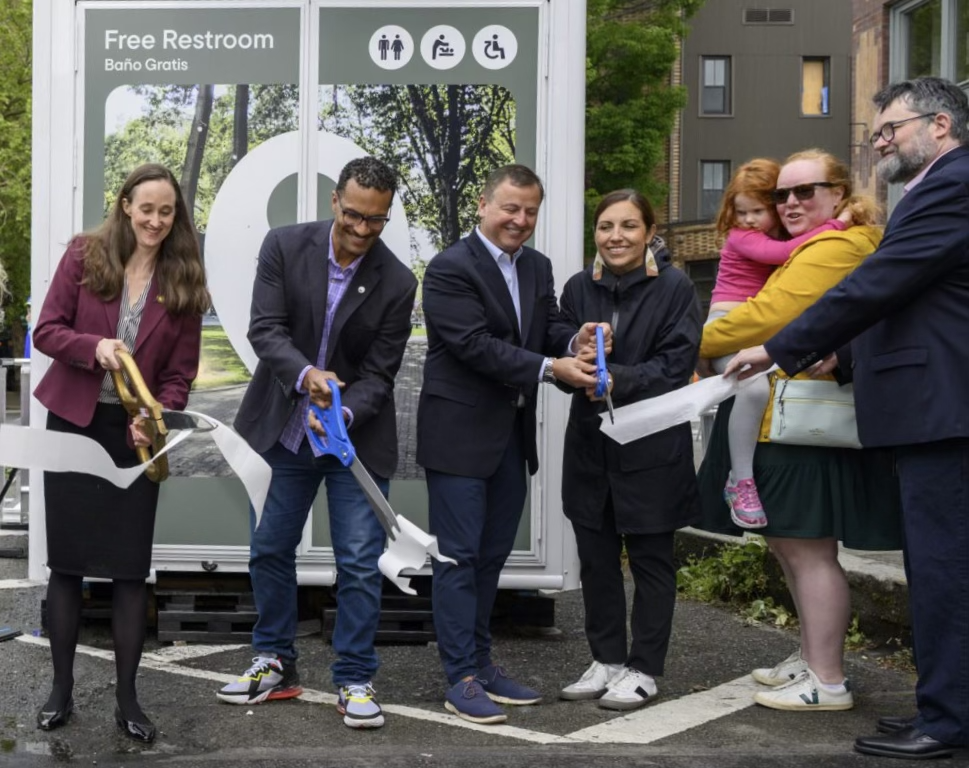
Wilson kicked off her bathroom buildup last May with a pilot program of four portable Throne restrooms in Pioneer Square in time for the World Cup. These modular units are accessed with an app or QR code and feature remote monitoring and automated sensor-based cleaning. Only 1.6% of uses resulted in complaints, and the pilot program is widely considered a success.
“The World Cup was a shining example of what our city can feel like when people are enthusiastically using our public space,” Wilson says. “The fact that we were able to provide more public restroom access in Pioneer Square during that time was definitely an important part of making people feel welcome and comfortable in our city.”
Those renovations and rebuilds are sorely needed
Those renovations are important. A 2025 audit of those 129 bathrooms run by the Parks Department found:
- The department was not meeting its target of cleaning every restroom 2-3 times a day or maintaining a consistent level of cleanliness throughout the city.
- The department did not have reliable data to evaluate restroom maintenance performance.
- Auditors found park restrooms are locked inconsistently and stated restroom hours are not always accurate.
- The audit found the Parks Department was struggling to keep up with preventive maintenance due to vandalism and staffing constraints.
Another problem is that it takes a long time for Seattle’s public restrooms to be replaced or rebuilt if they are damaged beyond use.
Seattle parent Jack Frank says the Seattle public restroom drought is real. And portables are hard to use. Taking his kids to Wedgewood’s Dahl Field is uncomfortable since the restrooms were damaged by a fire in October 2024.
“The two porta potties there are difficult to use,” Frank said. “When my kid gets a bit of pee on their pants, and I need to change them into fresh pants, I don’t have the space to do so. Same for any other kind of messy toilet training accident. Wintertime this becomes a big issue.” He finds it hard to believe the situation has not been rectified.
“I get that public infrastructure needs funds allocated in that budget cycle, and that the city needs to go through a design and bidding phase, but [it’s] years later and we are still waiting,” Frank said.
Restrooms and …
Wilson is headed to the US Conference of Mayors in January, where she’ll chair the Childcare Task Force and share policies, best practices, and ideas for making childcare more available and affordable. It’s part of her vision, along with more accessible restrooms, to make Seattle a more welcoming place to raise a family,
“We deserve nice things,” says Wilson. “We should be using our resources to make the city a great place to live.”
Stacy, the mom who takes her kid to Seattle Aquarium when nature calls, agrees. Of the new portable restrooms the Wilson has secured for Seattle, she says: “Having a clean place to go potty while out walking around the city would be nice. I’ve not seen one of these yet in our adventures. If we can keep them clean and safe, I love the idea.”
** Seattle’s Child staff writers contributed to this report