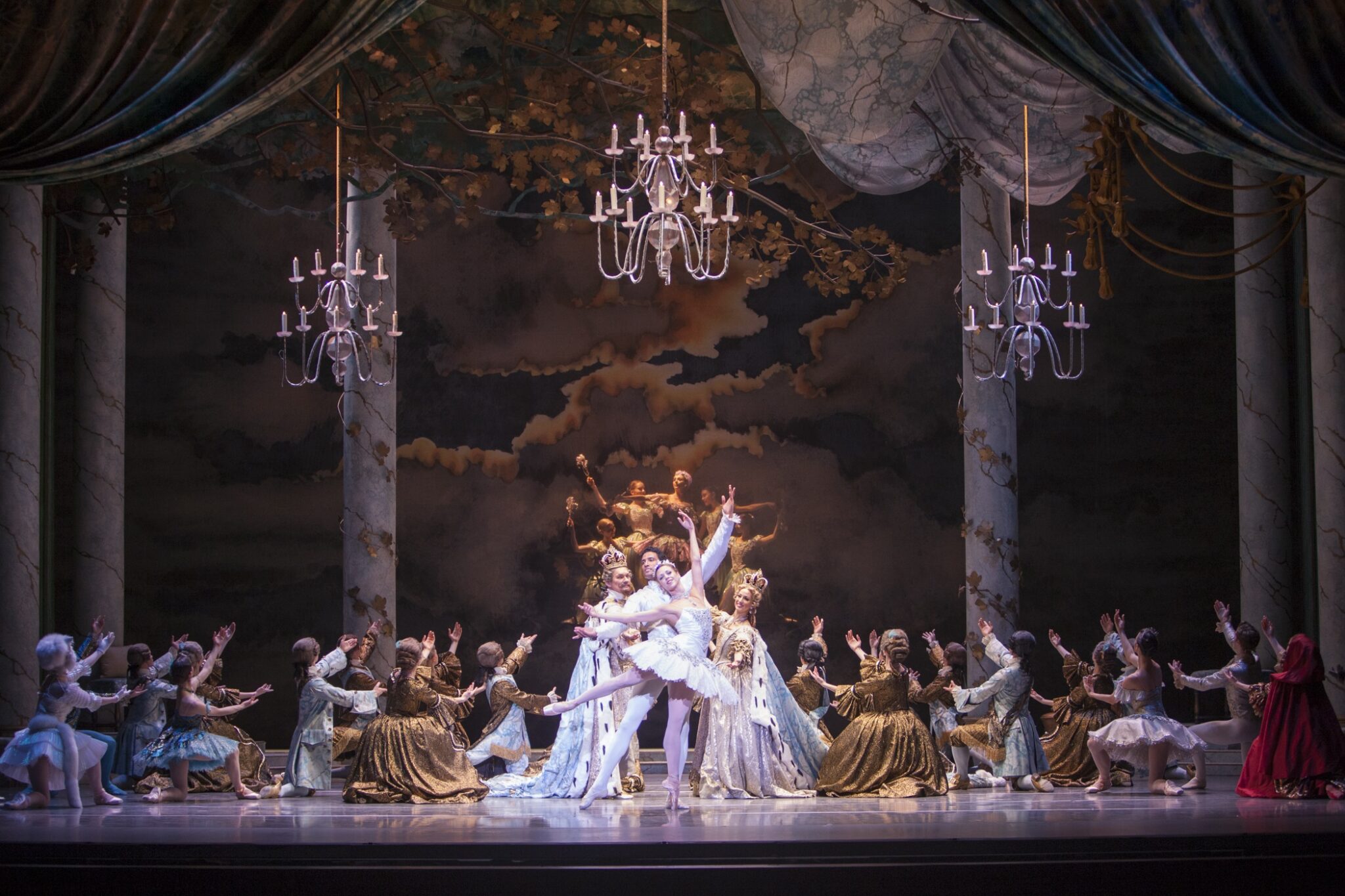
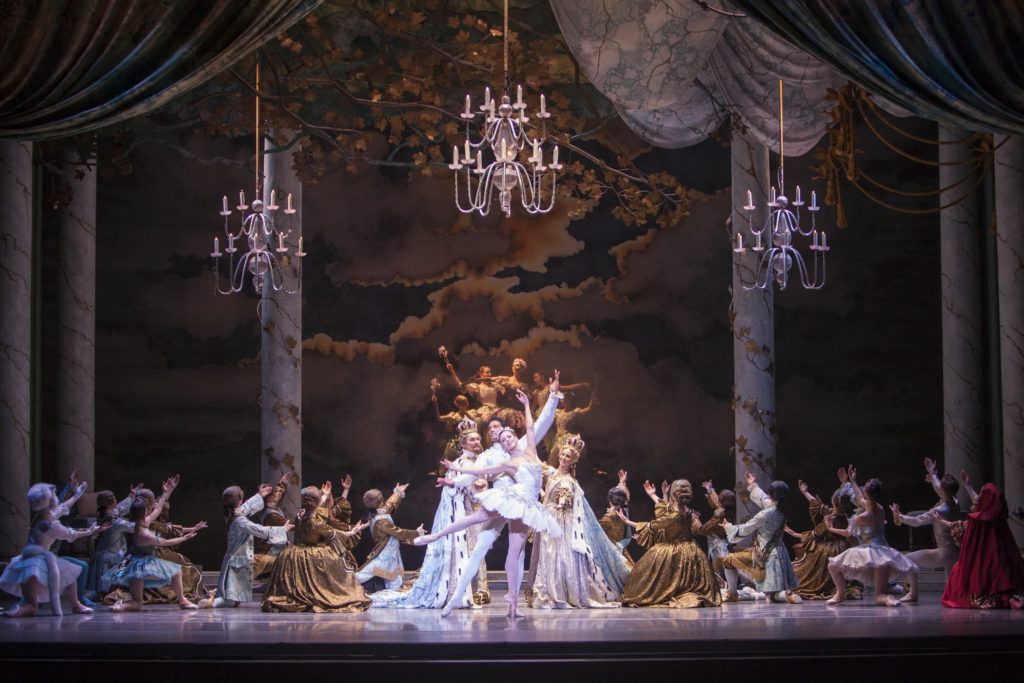
The music swells as the red curtain rises, revealing a gauzy fabric screen printed with intricate leaves. It sweeps to the sides and shows us the pillars and marble floors of a palace, filled in a moment with slowly circling courtiers in opulent robes.
“Where’s the king? Where’s the queen?” my 7-year-old companion, Taylor, asks. They glide in wearing purple and cerulean blue trimmed with ermine, holding the baby princess doll.
Thus begins Pacific Northwest Ballet’s The Sleeping Beauty, a great introduction to ballet for children with its familiar plot line, sumptuous costumes and – until the third act – action to keep them engaged. The Prologue and the first two acts are each followed by a 15-minute intermission, breaking up the three-hour ballet into manageable pieces for children to enjoy.
I strongly recommend that you review the fairy tale before you go so that the dances and music without words will make sense. (It’s adapted from the 1692 story by Charles Perrault, if you have an older compilation, or look it up on www.pnb.org or read the summary on page 12 of the program.)
Even so, it took us a minute to realize that the dancers in various colored tutus in the Prologue were the “good fairies” presenting little Princess Aurora with gifts of beauty, wisdom and happiness. The evil fairy, Carabosse, steals the scene, flying in from overhead in a rage of darkness and sparks and cursing the baby.
Taylor found her “creepy,” but not scary – a few children 5 and younger might be frightened. The Lilac Fairy then modifies the curse so that the princess will only go to sleep when she pricks her finger on a spindle, and can be awakened when a prince gives her a kiss of true love.

The First Act (The Curse) opens with Princess Aurora’s 16th birthday party and her famous dance with four young dukes, who are her suitors. It’s called the Rose Adagio, one of the most difficult sequences in ballet, involving the dancer balancing on one toe for an inordinate amount of time. (Many of the little girls in the audience did, indeed, try to see how long they could stand on tippy-toes during the intermission.)
Aurora is presented with a spindle by Carabosse, who is disguised as a hag. She pricks herself as she is playing with the unfamiliar object and goes into a deep sleep. The bad fairy fights with the dukes and shoots a red light at one of them, killing him. Children will be fascinated by the way the Lilac Fairy put the rest of the court to sleep and the way thorns climb up the pillars and descend from the sky as the palace darkens.

Taylor was faster catching on to the beginning of the Second Act (The Vision and Awakening) than I was. She realized that the Lilac Fairy and her ethereal nymphs had conjured up a vision of the princess to enchant the prince in the forest – and the dances were in his imagination. She was thrilled by the mists that rolled onto the stage and the boat that carried the Lilac Fairy into the woods and ferried her and the prince back to the palace.
The prince finds Princess Aurora, gives her a quiet kiss and awakens her as the Lilac Fairy touches the rest of the court. At this point Taylor noticed the skeleton in the foreground. It was the duke who had been killed!
The Third Act (The Wedding) contains the most breathtaking dance sequences, but for Taylor it was a bit too much with several dances in the “Gold and Silver” Pas de Trois, the “Bluebird Pas de Deux” and the “Grand Pas de Deux” with Aurora and the prince. In the original ballet, a dozen of Perrault’s other fairy tale characters danced for the prince and princess; in this version, only Puss in Boots and the White Cat and Red Riding Hood and the Wolf appear. They’re crowd pleasers for children; the cat, with her little batting paws, drawing the most laughs. Still, before the end, Taylor was saying “not another dance” and “can we go now.”

If you have a child who is getting restless after the end of the Second Act, you might want to skip the less-active Third Act or watch it on the screen in the lobby.
But for most of the children – especially the dozens of little girls in fancy dress – the ballet was a piece of magic in a hum-drum world. Taylor later told her mother she loved it, and has been ballet dancing around the house with her little sister ever since.
Photo credits: Pacific Northwest Ballet company dancers; Jonathan Porretta as the wicked fairy Carabosse and Laura Tisserand as the Lilac Fairy; Princess Aurora (Lesley Rausch) with Maria Chapman and Otto Neubert; Sarah Ricard Orza and Kiyon Gaines as the White Cat and Puss in Boots. Photos © Angela Sterling.