Time travel is possible when you visit “POMPEII: The Exhibition” at Pacific Science Center. Your visit begins as a guide brings your attention to the Roman resort city of Pompeii. A magnificent door slowly swings open and reveals a stunning marble statue of a Roman god.
The exhibition is designed so that you feel as if you are a participant in the daily life of a Roman city inhabited by 25,000 people. Your life is pretty sweet, if you are a member of the wealthy upper class. Screens with computerized graphics show recreations of Roman baths, gardens and atriums to give you insight into first century AD life. Make sure you read all signs carefully or you may find yourself and your children in a dimly lit, red-curtained Roman brothel, or a medical area; not for the squeamish.
|
Photo: Tonya Cunningham |
Artifacts first discovered in 1740 – frescos, gold jewelry, glass bowls and intricate oil lamps – impressed me, but not so much my 11-year-old son. He gamely observed the carved marble benches and bronze statues, but kept asking to get to the exciting part – the volcano.
The exhibit doesn’t disappoint in this aspect. After leaving the peaceful life by the sea, ominous red curtains line your way as you climb the dark ramps to what can be described as a reenactment of the horror of meeting your demise: Death by volcano. You are given the option to pass on this experience. I wimped out, but my son was game. He reported that a short film gave a play-by-play of the events of that fateful day, while strobe lights and heavy smoke poured in through vents on the floor. I heard many people coughing, so I knew I made the right decision for myself.
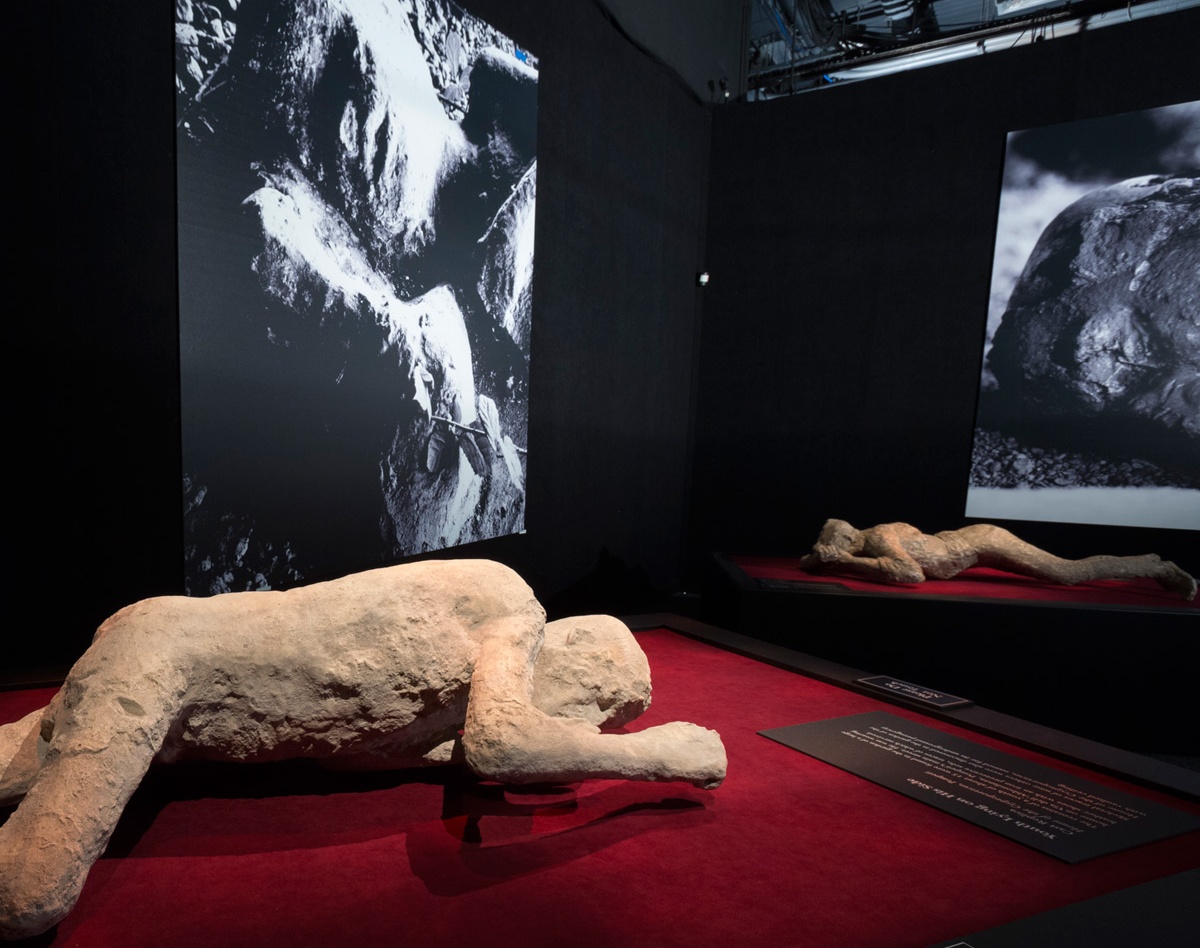
After experiencing the drama of a volcanic eruption, a panel opens and you are faced with the grim reality of what volcanic ash and heat can do to a human. Archaeologist Giuseppe Fiorelli figured out that air pockets made by decomposing bodies long buried in ash could be filled with plaster to create casts. As the exhibit states, “What nature destroyed it also preserved.” These body casts are placed in glass, coffin-like display cases. There is a child, a pregnant woman and many others who were caught in their last moments of life, lying down, trying to breathe or escape.
We overheard a child asking his mom, “Why can’t the man get up?” Unless your child is fascinated with history, or natural disasters, this is not an exhibit for very young kids. Sensitive children may be scared, and energetic children may wish they were on the playground.
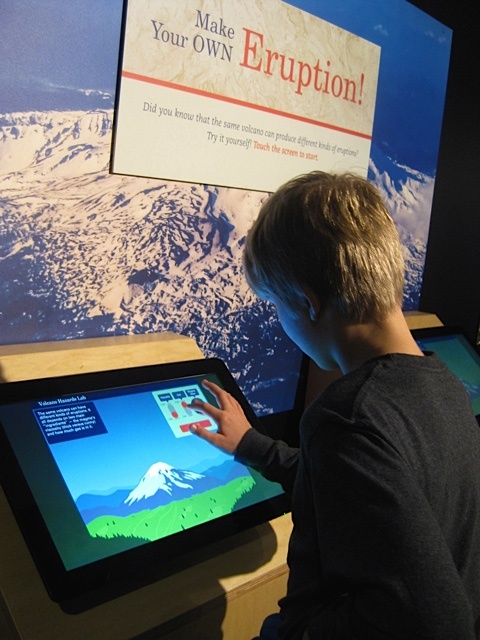
After this somber walk through dark rooms, you immediately find yourself in a brightly-lit gift shop with souvenirs. Your tour ends in the next room, where you are faced with the fact that you, too, live in the shadow of an active volcano. Interactive displays cover what to do in the event of an emergency, what we need to worry about and the science behind predicting an eruption. Discussions about our own safety in the event of a natural disaster are valuable and much needed. It’s a good reminder of how powerful the natural forces that we love here in the Northwest are, and how dangerous they can become.
Even with a timed entry, I recommend visiting “POMPEII” on a weekday if you can. It isn’t as crowded and you will have better access to the important facts and information. An audio tour is available for purchase, which can be good depending on your child; mine likes to explore and discover on his own. Strollers will be cumbersome as you navigate some of the narrow halls housing the ancient paintings, statues and artifacts on display.
Be sure to visit the rest of the exhibits at Pacific Science Center (included with admission) for more science fun. The Science Center's on-site café provides easy, but pricey, food. Families can also opt to pack a lunch or eat in the Armory located at Seattle Center.
As we left the exhibit, we wanted to learn more about ancient archaeological discoveries. Thankfully, we also had tickets to see the accompanying IMAX movie, Greece: Secrets of the Past. Inside the theater, we soared over the glorious Aegean Sea to see the excavated islands of Santorini and Athens. We saw a recreation of the Parthenon, and the 40-foot ivory and gold statue of Athena brought back to life through stunning cinematography. This tour of sunny Greece was the perfect anecdote to a rainy and gray Seattle day.
IF YOU GO
Where: Pacific Science Center, 200 2nd Ave. N, Seattle.
When: Now through May 25. Pacific Science Center is the exhibition’s last stop on its U.S. tour.
Cost: On weekends, the exhibit costs $36 for adults, $34 for seniors, $27 for youth ages 6-15, $24 for children ages 3-5, and free for kids younger than 3. On weekdays, the exhibit costs $33 for adults, $31 for seniors, $24 for youth ages 6-15, $21 for children ages 3-5, and free for kids younger than 3. Tack on an extra $6 for the audio tour and $4 for the IMAX show.
Contact: 206-443-2001; pacificsciencecenter.org.
Tonya Cunningham is a freelance writer, poet and antique dealer. Her children, ages 11, 9 and 7, share her love of history, beachcombing for treasures and hiking in the Seattle rain.