Whether you read the novel or watch the story come to life on stage, Don Quixote is a tour de force. In Pacific Northwest Ballet’s sumptuously fast-paced production, which debuted in Seattle in 2012 and now returns for only nine performances through Feb. 8, audiences are treated to a color-drenched spectacle of stamina, vision and perseverance.
For my 8-year-old daughter, Emma, last Saturday’s three-hour with two intermissions evening performance proved a test in stamina, too. Although she is a two-time veteran of PNB’s Nutcracker, it was clear from the moment we took our seats that Don Quixote would be a different experience, one that disregards a child’s usual bedtime (except for matinees, which I’d recommend for the younger set). Noting only a few other school-aged children in the audience – all older than Emma, not needing the extra cushion seat – I wondered how she would do.
I needn’t have worried. Don Quixote is a transporting experience, one that whisked us from the cold, gray chill of a winter night in Seattle to the squares, verandas and “sun-kissed” landscapes of Barcelona, Spain. The story follows Spain’s legendary hero, Don Quixote, and his lovable thief-turned-squire, Sancho Panza, as they set out on a quest to find Don’s elusive dream lover, Dulcinea. On the way, they literally stumble into the unfolding drama of a delightfully resilient romance between the vivacious Kitri (whose father is adamant that she marry Gamache, a rich fool) and the poor yet dashing Basilio. The audience is treated to one stomping or toe-twirling dance after the other amid the sights and shakes of castanets and tambourines, seductive fans and tautly twirling matadors.
Animated by the technical skill of sought-after choreographer Alexei Ratmansky (who retained choreography by Marius Petipa and Alexander Gorsky when the ballet was first produced in Russia over a century ago), the bright and bustling scenes ensured that all eyes, sleepy or not, remained fixed on the story. For Emma, this also meant joining in unexpected laughter, such as when the donkey and horse – pedaled forward by hidden help – ambled into sight, or when certain characters performed rakishcapers with sidelong winks or knowing smiles.
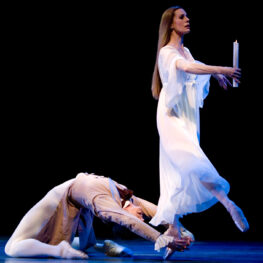
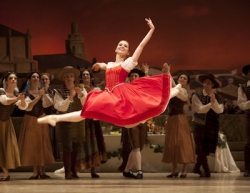
Even more impressive were the athletic feats put on display by principal dancers (find the rotating cast information here). The flitting antics of a handful of youth – 24 children from PNB School were incorporated into the production – threatened to steal the show at times, too, when mimicking their elders with impish charm and well-practiced skill. The aging, messy-haired Don Q (played most evenings by award-winning film and television actor Tom Skerritt) and his sidekick Sancho Panza (played by local theater actor Allen Galli) were also fun to watch, if not for their dancing skills. Instead, they served as narrative contrast to the dancers’ gravity-defying one-armed lifts, endless fouettés (whip-like ballerina turns) and dazzling pointe work set to the music of Ludwig Minkus’ stirring score.
Though not schooled in ballet theory and technique, Emma could appreciate (amid increasing yawns as the evening progressed) scenes that would delight any child: an illuminated “woman in the moon” whose expression eventually succumbs to clouds, dancing cacti and monsters, and the famous windmill scene that precedes a glittering green-lit forest scene with a wing-tipped ballerina. Perhaps this preponderance of action and scenery could prove too stimulating or distracting for some children; in Emma’s case, the ballet’s pace and packed-for-effect quality kept her engaged even when the dances seemed to go on and on and on.
A plot aspect to note: There is a love-triangle dynamic, which reminded me of Romeo and Juliet at times. For this reason, Don Quixote could be more appropriate for the teenage crowd, though much of the courting, as well as a staged suicide (parents be warned!), felt innocent enough.
Originally created for the Dutch National Ballet in 2010, the ballet originally cost $3 million to build; eight shipping containers were needed to transport the sets and costumes from Amsterdam to Seattle (in comparison, the Stowell/Sendak Nutcracker filled only two). Another interesting fact, which doesn’t surprise if you’ve seen the ballet, is that the masks for the monsters were made by a company that worked on the Lord of the Rings movies.
See these masks, as well as the rest of the glorious sets and costumes, in Pacific Northwest Ballet’s Don Quixote, now through Sunday.
IF YOU GO
Where: Marion Oliver McCaw Hall, 321 Mercer St., Seattle.
When: Now through Feb. 8: Thursday through Saturday at 7:30 p.m., Sunday at 7 p.m., with matiness on Saturday and Sunday at 1 p.m.
Cost: Tickets range from $30-$184.
Contact: 206-441-2424, pnb.org.