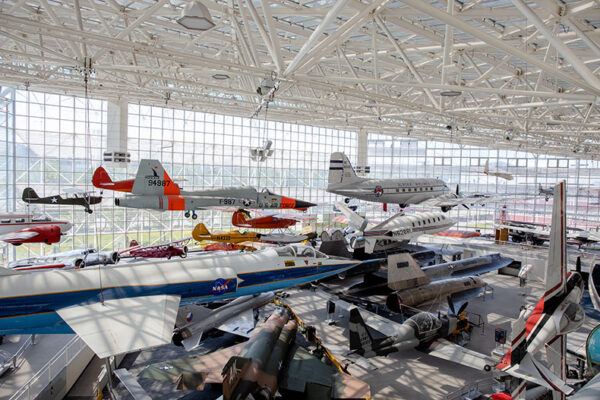
The Museum of Flight is a great place to take airplane-loving kids or out-of-town guests. You can wander world-class historical exhibits, a Space Shuttle Trainer, and a former Air Force One – and get up close and personal with the Blue Angels each summer. But did you know it’s also a place where kids can pursue an existing passion, find a new one, or launch themselves toward a fulfilling career? The Museum of Flight in Seattle offers an array of aviation programs just for kids.
Aviation programs for kids at The Museum of Flight
We don’t just mean by joining the Museum’s Aerospace Camp Experience (ACE) in the summer (although, how cool is that?). Programs at the Museum are much deeper and more varied, potentially earning kids high school and/or college credit, scholarships, or putting them well on the path to flying as a private pilot – or maybe an astronaut.
Aerospace is all around Puget Sound, but much of it is unfamiliar. How can we, then, introduce our kids to this world of opportunity? The Museum of Flight is here to help.
What does aerospace really mean?
Let’s back up briefly to clarify: When we say “aerospace,” that encompasses both the airplanes we’re familiar with and the emerging world of commercial space flight and exploration.
And, as Julie Williams, director of marketing communications and creative for The Museum of Flight, explains: “Both space and aviation exist in ample ways in our region.”
You could drive by Blue Origin, located in Kent, but have no idea what goes on inside (Hint: research and development related to spaceflight). And what about those planes parked at the Boeing plants in Renton and Everett? Thousands of people do hundreds of different jobs designing, building, and flying them.
How aerospace touches lives and communities
Many of these jobs are things we might not have thought of. For instance, for every person whose job is to pilot a commercial plane, 60 other people had a hand, in some aspect, of getting (or keeping) that plane in the air. Additionally, the focus on sustainability has become important in aviation, driving advances in reusable spacecraft, more efficient airplanes, and cleaner fuels.
“There are a lot of really cool things going on,” says Dana Riley Black, Ph.D., the Museum’s vice president of education.
“There’s so much going on that many people living here haven’t thought about, yet it touches their lives,” says Riley Black. She and her team aim to demystify the field and make it accessible to the next generation of mechanics, engineers, designers, pilots, astronauts, and more. They want the next generation to reflect the population of the Puget Sound area, which includes groups typically underrepresented in aerospace.
“We want to introduce learners to the opportunities right in our community,” she said. “To create that aspiration. … That is, to cause someone to think: I could see myself as this. I could imagine myself on this path.”
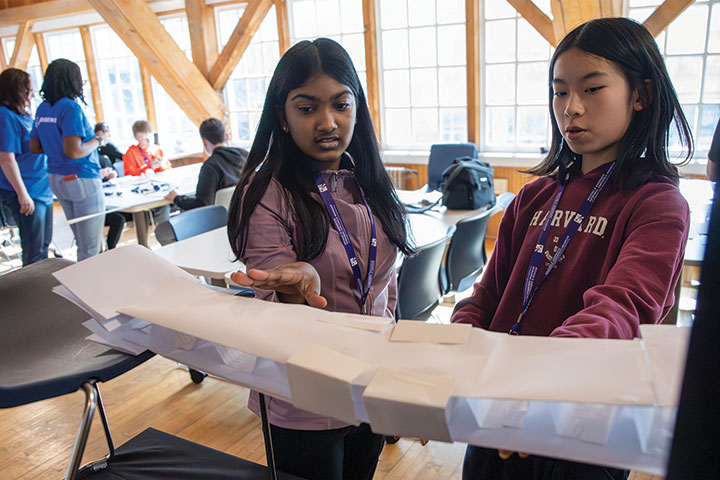
Two Michael P. Anderson Memorial Aerospace Program students discuss their wing design during an activity facilitated by engineers from The Boeing Company. Photo courtesy The Museum of Flight.
Sparking the interest of students interested in aviation
The Museum often takes its show on the road, so to speak, bringing a portable planetarium or rocketry program to schools. In addition, it hosts groups such as Girl Scouts to meet an astronaut or use a flight simulator, to name just a few examples. But there’s more than that: Amelia’s Aero Club brings middle-school learners together to explore STEM topics while making friends, chatting, and laughing a lot.
High school juniors in the Washington Aerospace Scholars program participate in an online course developed in partnership with the University of Washington, with resources from NASA. Then they attend a summer residency at the Museum and design a mission to Mars, and “they’re very, very serious,” said Riley Black. These scholars can earn five college credits.
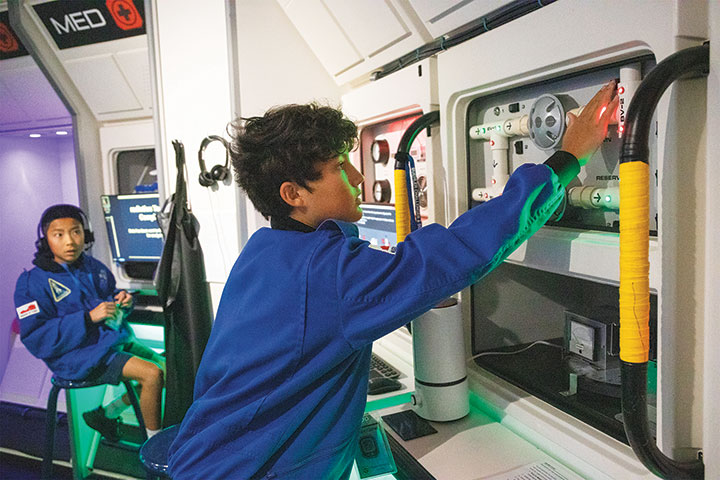
A young learner troubleshoots an alarm sounding during a simulated space mission in the Museum’s Challenger Learning Center. Photo courtesy of The Museum of Flight.
STEM and aviation programs for kids
In addition, the Museum’s Aviation Learning Center and Challenger Learning Center go beyond the gallery exhibits that most of us see: These are active, immersive, high-energy places.
“We want to give kids a vision of what the possibilities are, and we’ve got a unique community space where we can do it,” Riley Black said. Some educational programs include a complimentary Museum membership that a student can continue to use with an adult family member until age 19.
The Museum has something to engage everyone interested in aviation programs, from kindergartners to high school seniors. In addition to presentations and hands-on learning, its programs feature fantastic speakers, industry mentors, field trips, and more. People who have actually flown planes and traveled to space make appearances at the Museum all the time.
Have we piqued your interest? Have you wondered what to do with that kid who is always talking about planes and space exploration? The possibilities are many and varied. A good place to start is a trip to the Museum or a visit to this website: museumofflight.org/Education