Gospel music is magical and infectious. It makes a body — any body, young or old — want to sway, clap, and join in the singing. And, it can make a body want to do those things, whether or not you believe in the Christian story behind it.
A joy for all, not just certain belief systems
That is all to say, if you take your family to see Intiman Theatre’s “Black Nativity” this holiday season, expect to sway, clap, and sing. The presentation directed by Valerie Curtis-Newton with music direction by Sam L. Townsend, Jr., and choreography by Vania C. Bynum offers a pause from the dreary challenges of the year to step into a moment of joy.
You might also want to take a moment to prepare kids for what they will be seeing, advises the show’s Associate Director Faith Bennet Russell: “Talk to them about what they may see and experience. Talk to them about what they may know about the Christmas story, and then let them know what they’ll see may be a little different. There’ll be music, which might be loud at times. There’ll be a stage, there’ll be dancing and singing, and there’ll be a lot of joy and fun.”
If your crew is non-Christian, non-religious, or simply unfamiliar with the traditional Christmas tale, here it is in a nutshell: As foretold by prophets, a baby (Jesus) is miraculously born of a virgin mother in a barn in the town of Bethlehem. His birth is announced to faraway kings and shepherds by angels. The kings and shepherds follow a guiding star to the barn where they find the baby lying in a manger. A review of those basics, whether you present it as truth or story, will definitely help younger audience members understand what they are seeing and hearing.
Ann Bergman did just that with her granddaughters, Fiona, 10, and Clara, 7.
“We went over the meaning of nativity at dinner before the show,” Bergman said. Both girls agreed the primer helped them follow what was happening.
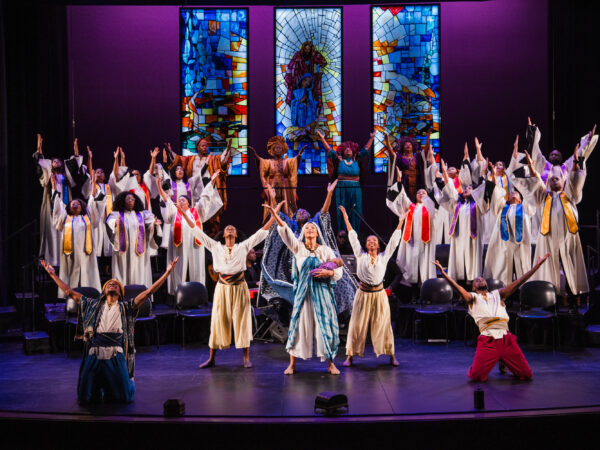
‘Black Nativity’ (Image: Joe Moore
A ‘re-imagined’ production that’s also all tradition
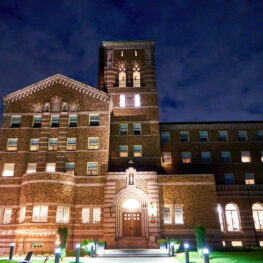
That said, expect to hear, see, and sing the words Jesus, savior, lord, king, and Christ many times in this two-hour production now onstage at Capitol Hill’s Broadway Performance Hall.
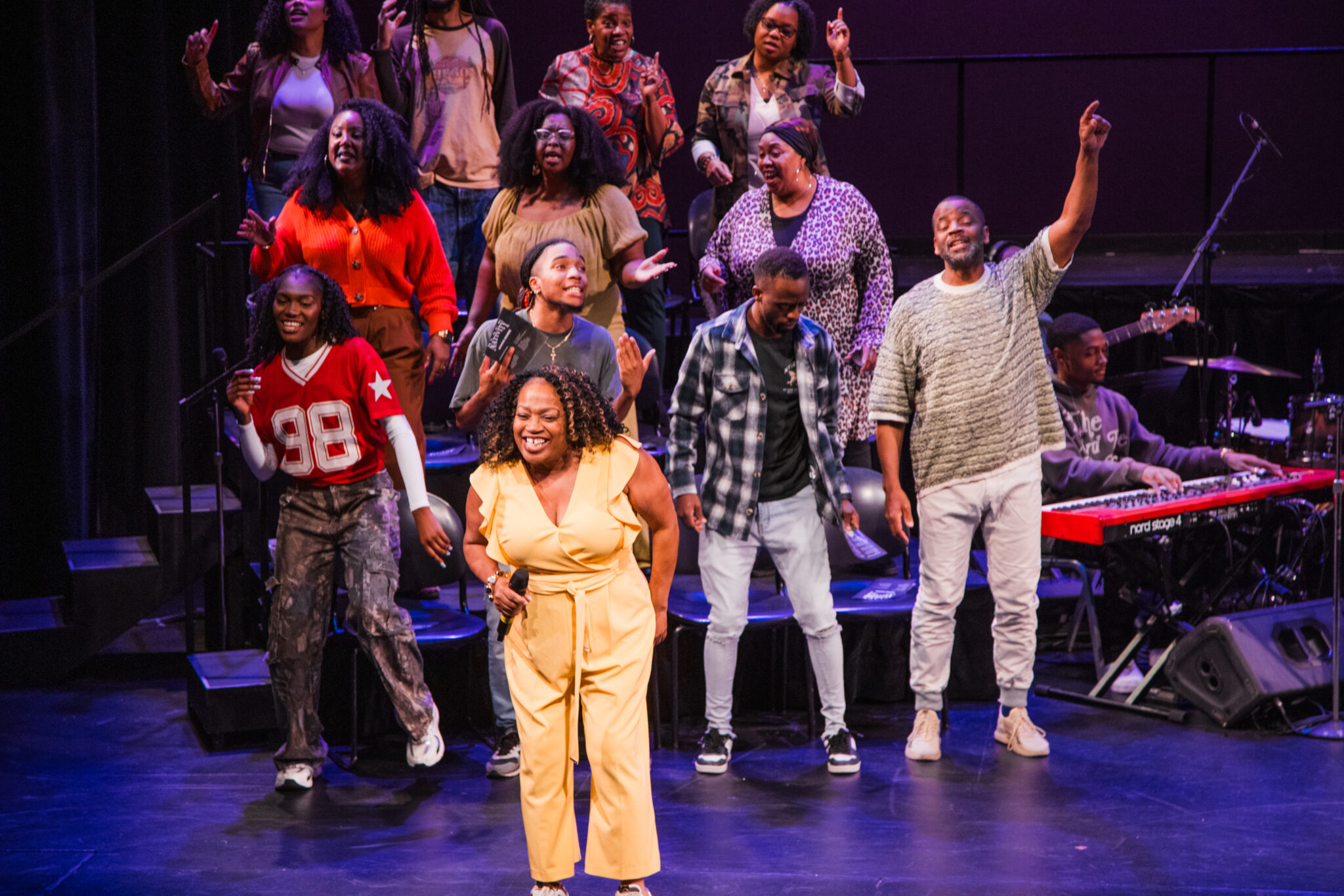
“Black Nativity” retells the Christian foundational story through the lens of Black gospel music and choreography. It is presented here as a theatrical celebration and a community‑centered musical experience. The production features 30 performers, a live band, and a citywide gospel choir, and invites the audience to sing along in parts.
“I really liked it,” Fiona told me, “especially because they told the story with singing, acting, and dancing.” In fact, both Fiona and Clara said they enjoyed the colorfully costumed, storytelling first half of the production the most.
The second half turns into a plainclothes sing-along that includes both familiar Christmas carols, like “Silent Night” and “Hark! The Herald Angels Sing,” and traditional gospel songs. It’s enjoyable as the music conductor invites the audience to really belt out the tunes. Still, some may find it overly preachy, what with all the hand-raising, praising, and “Yes, Lord” ing in the audience and on stage.
Cultural connection
“Black Nativity is an invitation to experience an important aspect of Black culture — faith. The show holds all the moving energy and evangelism of a Black gospel church service, right down to the passing of the basket mid-show (in this case, to help fund Intiman Theatre’s free seats program and a local food bank rather than tithe a specific religion). And yet, even with its decided focus on Jesus, it is also a rich theater experience and comes with no expectation of conversion.
As a parent who found value in exposing my kids to myriad cultural traditions, I appreciated that the second half of ‘Black Nativity’ started with a explanation of Kwanzaa, the annual seven-day celebration African-American and Pan-African heritage observed from December 26 to January 1, and with the naming Kwanzaa’s seven principles: Umoja (Unity), Kujichagulia (Self-Determination), Ujima (Collective Work and Responsibility), Ujamaa (Cooperative Economics), Nia (Purpose), Kuumba (Creativity)and Imani (Faith).
I should mention here too that “Black Nativity” has become part of Seattle’s broader holiday culture. Intiman first staged the show in 1998 to rave reviews, and it became an annual tradition until 2012, when it went silent before being revived in 2023.
I first saw “Black Nativity” with my kids in 2004, when they were 6 and 9 years old. We returned several years in a row at their request. And although this year’s production offers some new elements, I noticed the same riveted interest and attention in the young people in the audience on opening night as I saw in my own kids.
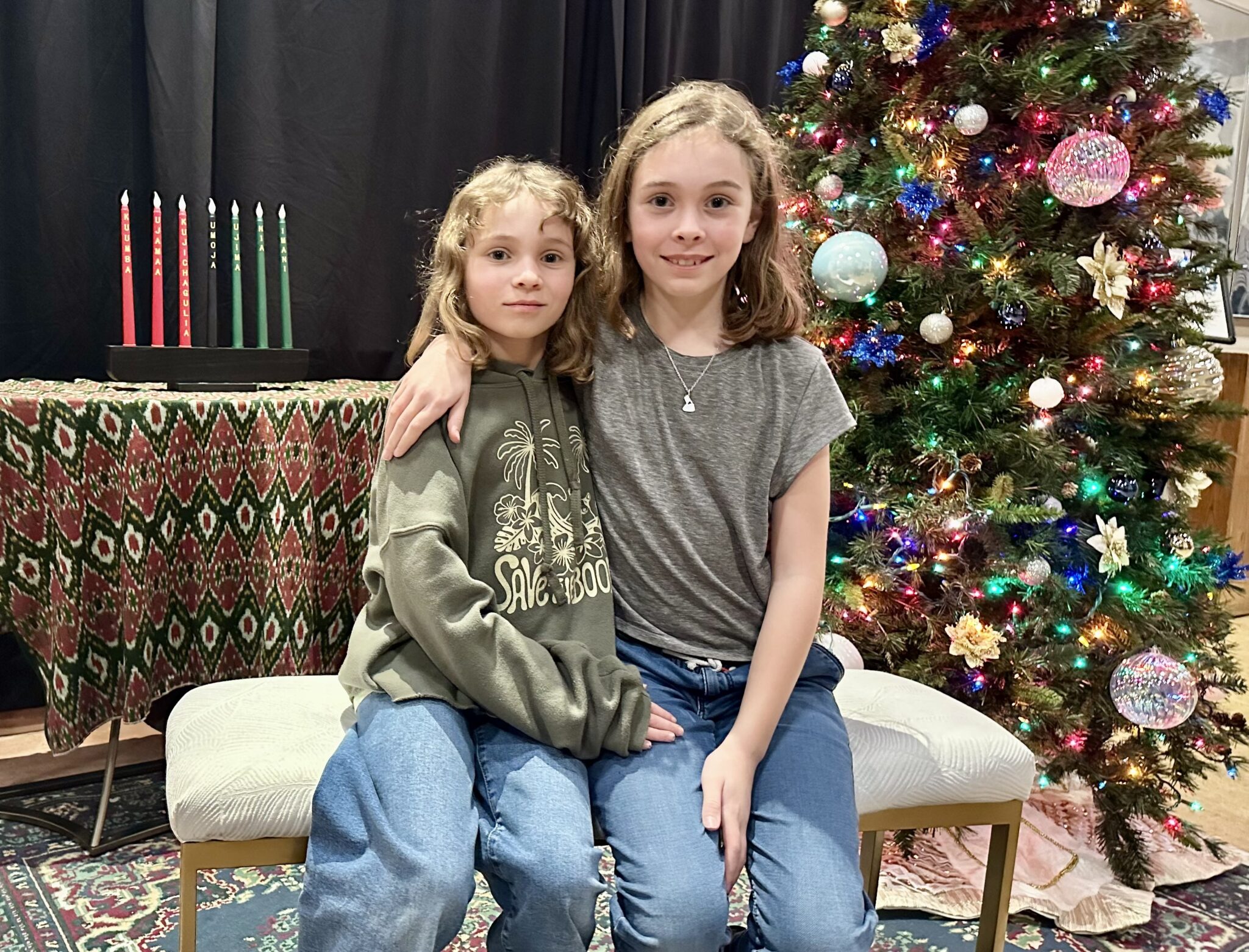
A post-show smiles in front of the Kwanzaa candles and Christmas tree. (Image: Cheryl Murfin)
Key to kid enjoyment? Participate!
Along with a story primer, Russell says that engagement is key to kids’ enjoyment of the show.
“One of the ways younger audience members can get the most out of [it] is by being participants as well as spectators,” Russel said. “The show is interactive and is designed for the audience to partake in the celebration. Where with typical plays or musicals, younger audiences may have a harder time with being quiet and still, with ‘Black Nativity’ they can clap, laugh, dance, use their voice, and be involved with the story as it unfolds.”
You may want to simply tell your kids, Russell adds. “It’s another way to celebrate the holiday season.”
The show definitely proves that, a glittery, rousing birthday celebration for the Christ child, followed by a joyous choral party. In that regard, the show saves the best for last. Soloist Josephine Howell’s rendition of”Have Yourself a Merry Little Christmas” (often called “A Merry Little Christmas”) is a heart-stopper and the most secular standout moment.
Family-friendly but best for kids aged 7 or 8 and up
By the end of the 7:30 p.m. show, Clara and Fiona were having a hard time staying awake, but seemed happy to have attended. I also ran into another mom who brought her kids, ages 6 and 4. The 6-year-old “is loving it,” she told me, but she felt it was a bit much for her younger child. They decided to head out at the intermission.
This brings me to a suggestion: If you have kids under the age of 10, consider attending a 2 p.m. show on a Saturday or Sunday, or even a 6:30 p.m. show. You’re likely to see a lot more kids at those, which may be more fun for all.
If you go
- Where: Broadway Performance Hall, 1625 Broadway, Seattle.
- When: Through Dec. 28.; Tuesday, Wednesday, Thursday, Friday, Saturday and Sunday options with 2 p.m., 6:30 p.m. and 7:30 p.m. shows depending on the date.
- Cost: Adults $41.50–$111.50; Discount options are availa for students, military, and anyone with need. Select your seat, then change the price using the dropdown menu.
- Tickets: Go to initman.org.