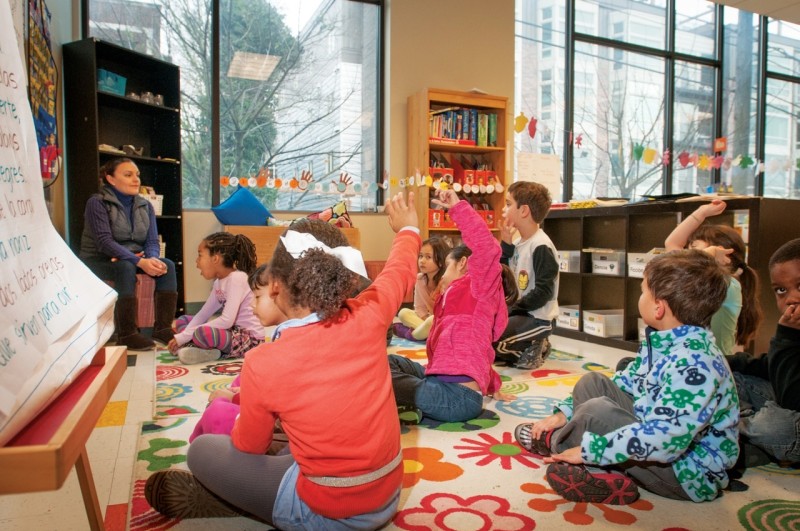
A New York Times editorial from 2012 argues that being bilingual does more than equip us to thrive in a globalized society: Research shows that speaking more than one language bolsters our cognitive abilities and produces brighter minds. Based in the Central District, Seattle Amistad School offers a dual Spanish and English immersion program that develops language skills while building values for community and equality.
Amistad enrolls equal numbers of native English and Spanish speakers, as well as children who are already bilingual. With a 1:10 student/teacher ratio for all grade levels, the independent preK through fifth grade school's roster currently includes more than 40 students.
Founder and Head of Seattle Amistad School Farin Houk brings many years of experience as a public school teacher, literacy specialist and two-way immersion instructor to her work at Amistad. Here, Houk talks about why Seattle trails other cities in foreign language education, explains her school's unique teaching model, and looks ahead.
Are the foreign language educational opportunities available for kids in Seattle lagging behind other cities?
Seattle is far behind most other major metro areas, including Portland, in foreign language education and bilingual education. There's such a disconnect here. Seattle is a highly educated, professional city, and we know we want our kids to be bilingual, but it's like we're afraid to take the leap and do it the right way.
As opposed to the 50/50 Spanish/English model taught at some other immersion schools, Amistad applies a 90/10 curriculum. Can you talk about the 90/10 model?
A 90/10 program like Amistad's is not my great idea; it's been demonstrated by decades of research to be the most effective way for kids to learn a second language, for native speakers to realize academic success, on and on. But it is a bit of a leap for all families, because it's a long-term process. Becoming fully proficient even in one language takes many years, and to be bilingual is even more of a commitment. A 90/10 program manifests that trust in kids, and similarly, that faith in children's potential informs all other aspects of our program design as well.
Tuition for the 2013-2014 school year ranges from $8,000 to $13,900. About 60 percent of students receive some form of financial aid. Do you work with families who can't afford tuition or who solely rely on financial aid or subsidies?
We have yet to turn away a family for financial reasons. If Amistad feels like the right place for your family, we will make it work. What you end up with is a group of families who are fierce in their commitment to what we are building here, in their commitment to provide something different for their children. It's inspiring. This business model does require some shifts in perspective: We're not fancy. We recycle folders to give them to families who come for tours. I've had parents say to me that they recognize that they pay more because they can, so that other people who can't pay as much can be here.
Talk about a typical day at Amistad School.
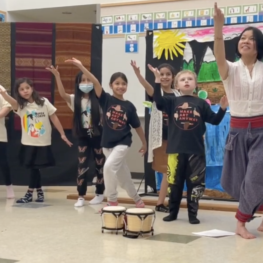
During the day kids learn! They read a lot, they write a lot, they sing and use poetry a LOT, they work with artists in residence to create self-portraits, they play capoeira, they go for PE, they sing the continents song over and over and over as they do Play Doh, they visit with elders who visit us from Horizon House, they prepare for a trip to the art museum, they teach other kids about what you might eat when you go to tia's house in Peru, they reflect on the legacy of Nelson Mandela, they discuss recess conflicts, they walk to Miller Park and get the wiggles out. Kids are busy, and we send them home tired. Happy, and tired.
What is your dream for the school moving forward?
My hope is certainly that the school can be meaningful for students and families, and can give them choices and opportunities in their lives that may not have been accessible before. But I think that one of the most important contributions that Amistad could make is to change the public discourse about kids, and especially the conversation around kids of color and kids who come with a language other than English.
If we can create the circumstances here at Amistad where all kids can realize greatness, whatever it looks like, then it's no longer a question of potential, it's a question of the will of educators. It begs the question: Why can't public schools do the same thing for greater numbers of kids? It's not rocket science; there are very intuitive and yes, even elegant solutions. But real solutions start with believing in kids' potential. And as a very wise friend says, "Even if it were rocket science, we've done that. We've made it to the moon." We can do this, too.