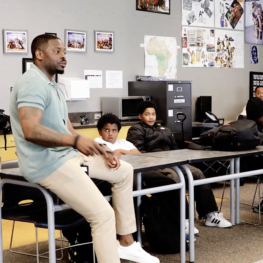
During a recent lunch period at Robert Eagle Staff Middle School in Seattle, Principal Zachary Stowell said his walkie talkie was quiet. No fights. No incidents.
It wasn’t like this when he started.
“I couldn’t do my job. We were perpetually drowning in conflict,” Stowell said. “We needed a reset.”
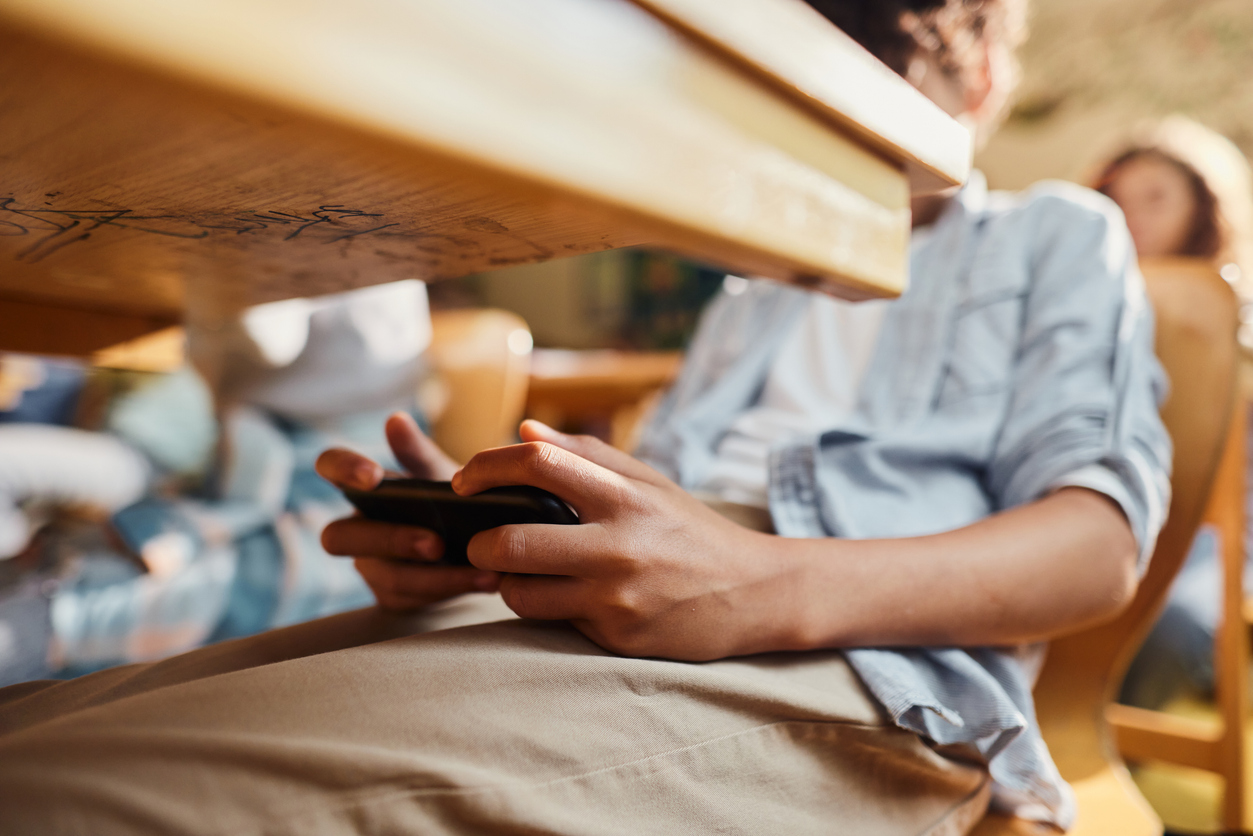
In 2024, Stowell’s school adopted an “away-for-the-day” cell phone policy. Students have to lock their phones in magnetic pouches when they arrive at school, and they can’t be unlocked until the end of the day. There are exceptions for kids with medical needs, family responsibilities or other legitimate reasons, and teachers can also unlock the pouches if there is a serious emergency.
Since the policy went into effect, Stowell said there has been much less fighting; kids are socializing and more engaged in lessons. He said they are also smiling more.
Advocates for phone-free schools say all-day restrictions are a best practice that carries huge benefits for students’ social, emotional and academic wellbeing. In recent years, they have pushed for Washington to adopt a similar statewide policy.
Last week, Washington Gov. Bob Ferguson signed a new law instructing the state superintendent to study limiting cell phones in schools. But some parent advocates think that falls short of what is needed and worry that as other states adopt more comprehensive restrictions, Washington youth are getting left behind.
“The evidence is clear that these kids are facing a mental health crisis,” said Danica Noble, a mother of three who advocated for a statewide restriction this year.
About 75% of school districts in Washington have some sort of policy limiting phones, according to a state study. But of those, only 30% require phones to be put away for the entire day.
Instead of implementing a statewide policy, the bill passed by lawmakers this year instructs the Washington Office of Superintendent of Public Instruction to study the issue and deliver a report with recommendations by the end of 2027. Lawmakers hope the report will enable school districts to adopt all-day phone policies by 2030, according to the legislation.
Noble thinks Washington is moving too slowly. At least two dozen other states have adopted comprehensive statewide policies.
“We don’t have that kind of time. Our kids don’t have that kind of time,” Noble said.
The issue recently motivated Noble to quit her job and run for a House seat in Washington’s 32nd district. She has heard stories from her son about classmates using their phones for online gambling, cheating on tests and looking at explicit material.
“Even if my kid doesn’t have a phone, he’s still going to get exposed,” Noble said.
The bill was sponsored by Sen. Marko Liias, a Democrat from Edmonds. He would have liked to see a statewide phone ban as well. But the votes weren’t there.
“I’m in the awkward position of, like, defending a compromise,” Liias said. “I wanted to see action, I wanted to see movement.”
Still, Liias thinks the data and recommendations produced by the superintendent’s report will create urgency and spur most districts to “do the right thing” and implement away-for-the-day policies. “And then we’ll be left with some folks that are behind the curve, and we can focus on more accountability for them,” he added.
Overall, Liias described his bill as a “minimum step.”
Ferguson, a parent himself, seems to agree. During the bill signing, he said he felt strongly about phones in schools and looked forward to revisiting the issue during the next legislative session.
“Other states are doing it, and Washington should not be the last state to get on board,” he said.
District choice
The idea of a statewide phone restriction has been floated for years, but it has faced pushback from key lawmakers.
Rep. Sharon Tomiko Santos, a Democrat from South Seattle, has been chair of the House Education Committee for more than a decade. She argued that the data on the effectiveness of blanket phone restrictions is more nuanced — and that phone policies are best left to individual districts.
“I think it’s an overly-broad response to really the wrong target,” Santos said, adding that classroom distraction and students’ emotional and social well-being are distinct problems that need more targeted interventions.
“It really depends on: What is the problem that you’ve identified that you’re trying to solve?” Santos said.
Santos also argued that phone restrictions will not work without buy-in from students, citing a recent Pew study which found that only four in 10 students support classroom cellphone bans, and fewer want all-day limits.
Noble, the parent advocate, said she understands the importance of including student perspectives. But phones are addictive by design, she said, so it makes sense that some students object to restrictions.
‘Cigarettes on airplanes’
Connor Hui, a senior at Lake Washington High School, had mixed feelings when he testified about the bill earlier this year. Hui told KNKX he has seen how excessive social media use can hinder his peers’ social skills and ability to concentrate in class.
“I think there is a valid concern for mobile device addiction, especially in young teens and young adults,” Hui said.
Hui’s school restricts phones during instructional time, but not during passing periods or lunch — a policy that he said is a good middle ground and has helped him focus in class. But he has concerns about a blanket policy restricting phones for the entire day in schools across the state.
“I feel like the line of communication between students and parents is also very important during school hours as well, because plans could change,” Hui said. “I really hope that lawmakers take into account the people and the parents and students that will be impacted by a statewide ban.”
A decade from now, Stowell, the principal at Robert Eagle Staff Middle School in Seattle, thinks people will view allowing phones in schools as a serious mistake — like “cigarettes on airplanes.”
“The data is there,” Stowell said. “It’s a no-brainer.”
Stowell cautioned that removing phones isn’t a silver-bullet solution. But he still thinks it’s made a massive difference.
“Having phones removed allowed us to reach our potential here,” Stowell said.
This article has been reposted with permission from the Murrow Local News under a Creative Commons license, which allows stories produced by Murrow Local News fellows can be republished. Read this article and others online at Washington State Standard, which provides freely distributed, independent local journalism Click here to support nonprofit,