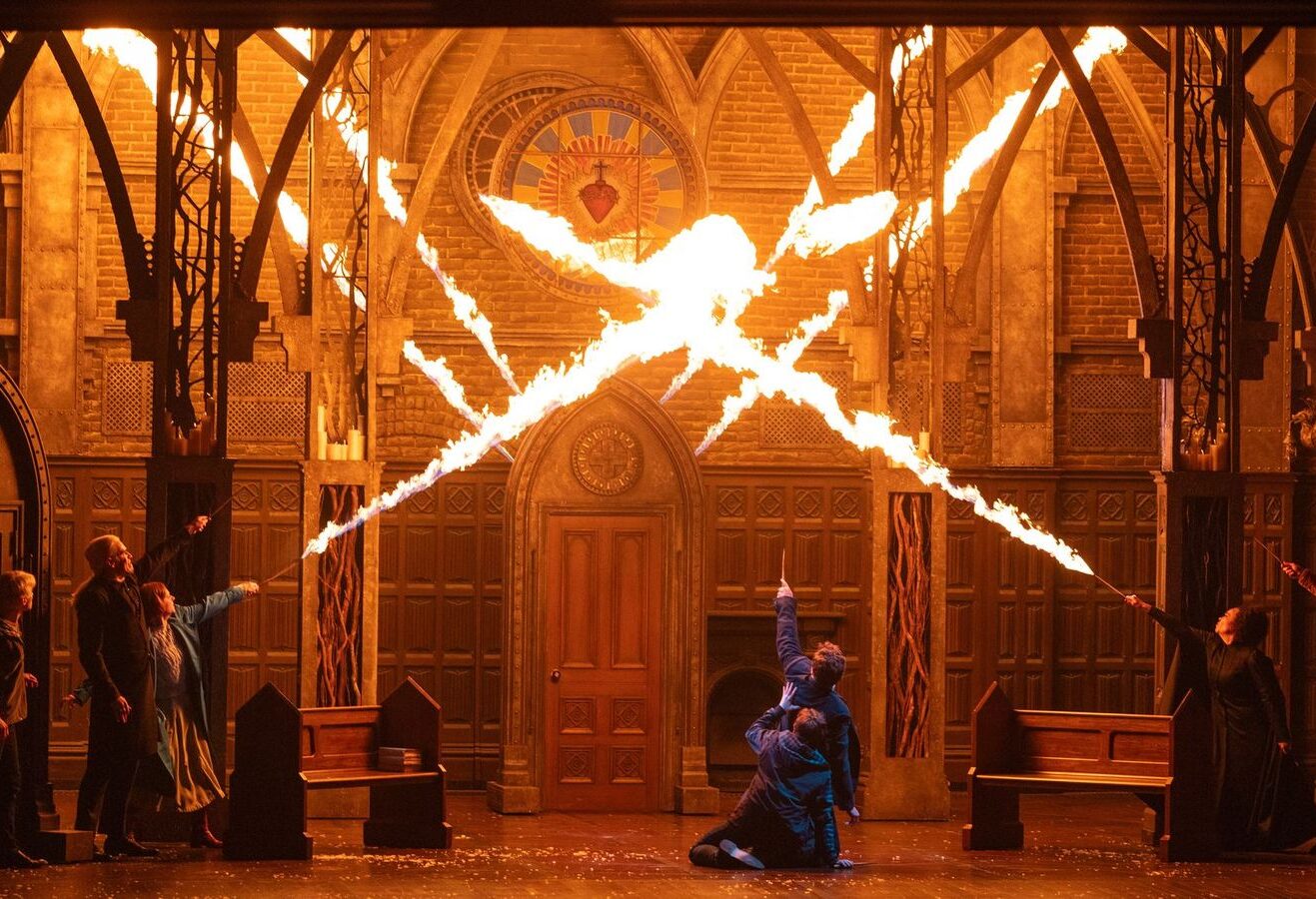
The bottom line: Potterheads, assemble! The theatrical addendum to the seven-novel series is whirling its magic wand at The Paramount Theatre in Seattle, just in time for one last enthralling theater outing before the kids head back to Hogwarts. “Harry Potter and the Cursed Child” offers a spellbinding saga, filled with incredible stage flair, otherworldly practical effects and, at times, unsettling pyrotechnics that will transport audience members into the wizarding world for a few hours.
For some, this may be as jolting as traveling by Floo powder, but those eager to return will be greeted “as an old friend” by the production’s emphasis on acceptance, friendship and love.
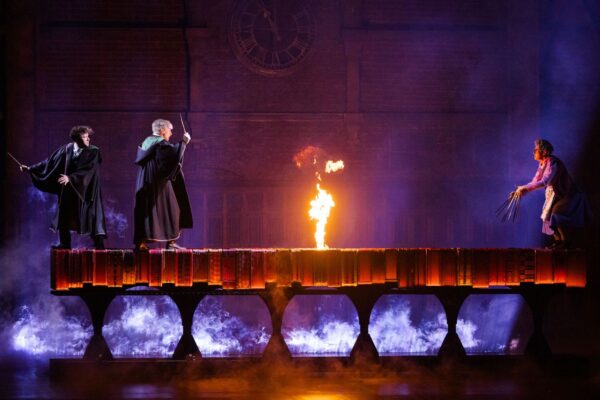
‘Harry Potter and the Cursed Child’ national tour now at The Paramount Theatre (Photo by
A very Potter exploit
Written by Jack Thorne from an original story by Thorne, J.K. Rowling, and John Tiffany, “Harry Potter and the Cursed Child” has been condensed from its original two full-length productions into one, cutting over an hour and a half of content while offering a more accessible experience for all. The story is set 19 years after the Battle of Hogwarts and opens where the book ended with the epilogue: on Platform 9 ¾ where Harry (Nick Dillenburg), Ginny (Abbi Hawk), Ron (Matt Harrington), Hermione (Rachel Leslie) and Draco (Ryan Hallahan) are seeing their offspring off onto the Hogwarts Express.
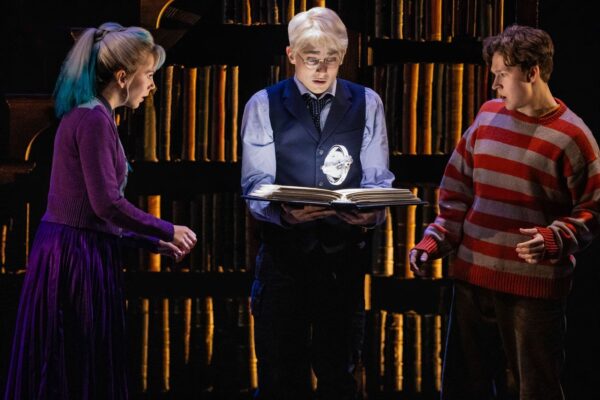
From there, the story veers into bewitching nostalgia and terrifyingly uncharted territory. Harry and Ginny’s son Albus (Adam Grant Morrison) becomes best friends with Draco’s son Scorpius (David Fine), the bumbling, good-natured antithesis of his father. Two goofy, self-ascribed “losers”, Albus and Scorpius are brought ever closer by their dangerously harebrained, albeit well-intentioned plan. To erase the suffering of Amos Diggory and his mysterious niece Delphi, the boys use a confiscated time-turner, travel to the past, and save Cedric “The Spare” Diggory from his tragic fate.
However, small changes ripple into devastating consequences in the present. As they try to fix things, they only succeed in making them worse until the unimaginable arrives in their new reality: Voldemort had defeated Harry Potter at the Battle of Hogwarts. Harry is dead. Evil reigns supreme. With the help of Dumbledore’s Army, Albus and Scorpius must right their wrongs and contend with a malignant force pulling the strings that has the potential to change the world forever.
(Photo by Evan Zimmerman)
The magic of theater, the curse of prerequisites
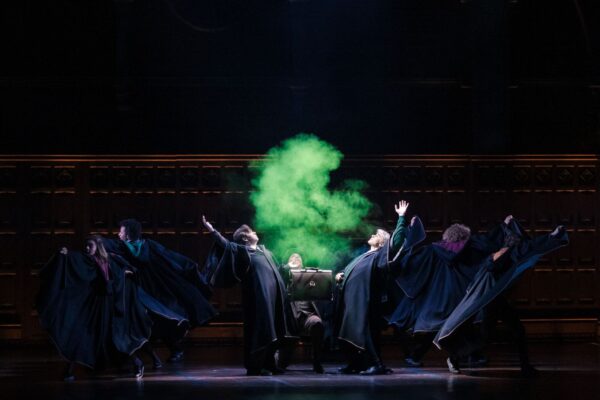
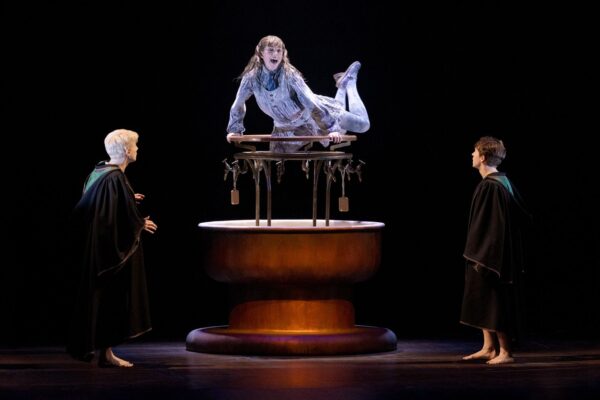
“Harry Potter and the Cursed Child” is a wonder of a production. It bottles up the unfiltered, hypnotic charm of a world built around magic and delivers in spades. Props and humans alike fly through the air. Characters change bodies in the middle of the stage. Wands seemingly are magic sticks, shooting fire at the whim of their holder. Invisibility cloaks actually make characters disappear. There is no shortage of enchantment to this production, thanks in large part to the special effects team, led by Jamie Harrison, who is, as listed on the playbill, in charge of “Illusions & Magic”. (I think, from now on, an illusionist should be on staff for every staged production.)
The large, gliding, caped dementors may force smaller viewers to cover their eyes – they are intimidating renderings that effortlessly whoosh from the ceiling – but their appearance is relatively brief, and the Kiss they administer is artistic rather than graphic. Voldemort’s pseudo appearance at the very end of the production is not as threatening or scary as one might anticipate. The rest of the magic that happens on stage should instill a sense of captivation, not fear.
The perfectly timed choreography by Movement Director Steven Hoggett offers smooth transitions and added whimsy that I could have watched on repeat for hours longer. The actors travel across the stage, over moving staircases, out of fireplaces and even, incredibly, through bookshelves. There is no opportunity to miss a beat, and they don’t. If bewilderment is what you’re after, “Cursed Child” will leave you gobsmacked.
In terms of following the story, however, there is a benefit for viewers to have read at least up to the fourth book, “Harry Potter and the Goblet of Fire”. As much fun as the stage hocus-pocus moments are, and despite a nearly 3-hour runtime, the play speeds through the plot and characters, frequently jumping forward and backward in time. There is little opportunity to fully explain why, when, where, or how the plot is unfolding. Having a solid understanding of Harry’s journey through the end of the Tri-Wizard Tournament is invaluable for fully appreciating “Cursed Child”.
(Photo by PhotoByEvanZimmerman)
Acceptance, friendship, bravery and queer love
The “Harry Potter” series has always been known for themes that generally revolve around love in all its many shapes. What makes “Cursed Child” such a fun, ever-evolving piece of media is that the condensed version of the play, as well as the actors who are giving their own spin to the written lines, have fully leaned into the gay romance that many fans have been begging for online.
The play was accused by some of “queerbaiting” when the 2-part play first premiered in 2016. This updated production lessens its focus on the female love interests of Albus and Scorpius, opening the door for their own spark and the undeniable implications of their burgeoning relationship. Morrison and Fine, who portray Albus and Scorpius, respectively, offer real chemistry and heart to the roles in this production. Their magnetism radiated off the stage.
But this production is hardly just about romance. It goes much deeper than that. It’s about recognizing you in someone else and opening your heart enough to trust them with that part of you. It’s about the many forms that bravery can take and the sacrifices we make for those we love, from facing your death at the hands (or kiss) of a dementor to standing up to your very famous father, confessing your feelings for someone he would otherwise despise.
It is human to misunderstand one another, and “Cursed Child” makes it clear that, in some ways, we are all cursed children, moving through life, attempting to make sense of our place in it, often through the lens of our parents and the trauma we’ve inherited from them. Life is learning to carry less of that, and, if anything, “Cursed Child” can hopefully offer a safe place for impressionable viewers to feel seen.
(Photo by Evan Zimmerman)
Talk about it: Points to discuss before and after the show
- Before: For kids who have not finished the original series, the play’s website offers handy resources to review beforehand to mitigate questions during production. Most pressing to understand are who belongs to mwhom (Albus, Scorpius,, and Rose) and exactly when the story takes place (19 years after the Battle of Hogwarts).
- Before: What are the most prominent themes that course through all seven books? How do the books define “good” and “bad” or “right” and “wrong”?
- After: How does the new generation of young wizards uphold the legacy built by their parents? What new lessons or issues do they bring to light?
After: How does “The Cursed Child” attempt to break some of the rules or cliches that the books established? Does Albus’ sorting into Slytherin prove or upend those points?
The details
Dates: The show runs through September 12, with a variety of showtimes spanning the morning and evening. The ASL Interpreted Performances are Saturday, August 30 at 1:00 p.m. and September 5 at 7:30 p.m. The Audio-Described Performance is Sunday, August 30 at 1:00 p.m.
Runtime: Approximately 2 hours and 55 minutes, including one intermission.
Age recommendation: 8+.
Location: The Paramount Theatre is located at 911 Pine St, Seattle.
Get tickets.
Click here to learn how to participate in The Paramount Theatre’s ticket lottery to attend the show for $40.