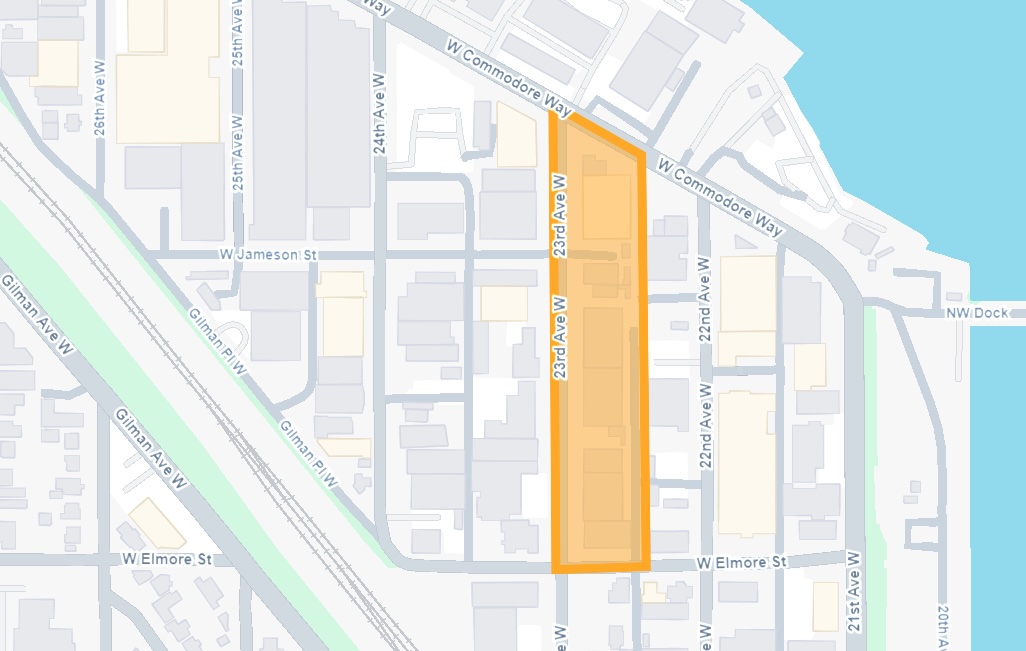
Elevated levels of lead have been found in the public right-of-way along the 4200 block of 23rd Avenue W in Seattle’s Interbay neighborhood, prompting cleanup of known contamination, additional environmental testing and precautionary public health guidance.
A specialized contractor hired by the City of Seattle cleaned known areas of contamination in the roadway and a stormwater catch basin on August 27. Additional testing is underway to determine whether contamination extends to other public areas and whether further cleanup is needed.
While that work continues, Public Health – Seattle & King County recommends that pedestrians use alternate routes around the 4200 block of 23rd Avenue W, between W Commodore Way and W Elmore Street, when possible. People should also avoid the alley between 22nd Avenue W and 23rd Avenue W unless access is necessary.
Lead-contaminated dust can be carried on shoes and on stroller and wheelchair wheels and tracked into homes, vehicles and workplaces. Pedestrians who have recently been in the affected area can take simple precautions, including removing shoes before entering their home and wiping stroller or wheelchair wheels with a damp cloth.
Initial Findings
Seattle Public Utilities (SPU) collected samples from the roadway, and a stormwater catch basin along 23rd Avenue W in late July, followed by confirmatory testing in August.
Testing found 55.3 parts per million (ppm) of leachable lead in a roadway sample and 451 ppm in a catch basin sample. Both levels are above Washington State’s hazardous waste threshold of 5 ppm.
Additionally, Public Health collected water and dust samples at a nearby private daycare in mid-August. Samples collected in areas where children spend time did not show concerning levels of lead. Three of 11 samples showed levels above the Environmental Protection Agency’s (EPA) action levels – these three samples were collected in areas where children do not spend time. The daycare is working with Public Health to eliminate lead dust at the facility.
SPU hired a specialized contractor to clean the known areas of contamination in the public right-of-way and stormwater catch basin. That work was conducted on August 27. Additional sampling will help determine whether further cleanup or remediation of public areas is necessary.
The extent and source of the contamination have not yet been determined. City, county, state and federal agencies are conducting additional environmental testing and assessment to determine whether contamination is present in other locations, evaluate potential public exposure and identify any additional response or cleanup that may be necessary.
Investigation Background
The environmental investigation followed concerns about occupational lead exposure at Dyno Battery, located in the area.
In March 2026, Washington State Department of Labor & Industries (L&I) fined Dyno Battery related to workplace conditions at the facility involving lead exposure. Battery production involves lead. In April, the Washington State Department of Health and L&I alerted Public Health – Seattle & King County (Public Health) about concerns of lead exposures at Dyno Battery and potential for workers to track lead home and expose their families. As part of the response, Public Health also became concerned about possible environmental contamination. Public Health contacted Seattle Public Utilities (SPU) in July, who conducted testing of soil and dust samples near the facility. Results confirming the high levels of lead came back in August.
Frequently asked questions
What if my child played there? The only way to know if your child was shingtonexposed to lead is to get their blood lead levels tested. Talk to your child’s healthcare provider to schedule a blood lead test. For more information on the health impacts of lead and ways to reduce exposure, see Family Quick Guide – Lead and Your Child. Translated resources and more information available from the Washington State Department of Health.
If I walked on the affected block and tracked dirt into my home, should I be worried? If you pass through the area regularly, be sure to damp dust, damp mop and vacuum your space with a HEPA vacuum. Remove shoes at the door and wash your hands to avoid tracking lead into your home, particularly if you have children or pets that play on the floor. The greatest risk is tracking it home and then exposing young children and pets. Avoid this route for the near future.
Yes, but best to avoid this block and take an alternate route for the near future.
Should I or my child get a lead test? Until we know more about the extent of contamination, we can’t say for sure whether a specific person should get a blood lead test. However, if you’re concerned about lead, you should talk to your health care provider about getting a test.
We always recommend children get a blood lead test, at least once between 12 and 24 months. If any of the below is true for you or your child, we recommend getting a blood lead test:
- Live in or regularly visit a home built before 1978
- Live within a kilometer of an airport, lead-emitting industry, or on former orchard land.
- Are covered by Apple Health/ Medicaid
- Use traditional remedies or cosmetics
- Come from a country outside the US
- Have a friend or sibling with a blood lead level above the blood lead reference value
- Live in foster care
- Have a parent, grandparent or caregiver who works with lead at their job or for a hobby
Next Steps
City, county, state, and federal officials are conducting more soil and water sampling to determine the extent and source of the pollution, the risk to the public and other businesses in the area, and any additional necessary remediation.
Public Health is in the process of working with employees at Dyno Battery to advise them on the risks of lead and how to obtain and understand blood lead tests. Public Health is also working with the daycare to reduce lead levels and inform parents about lead testing and steps to protect children from lead. Public Health will continue to work with businesses in the area to raise awareness of lead risks and ways to protect their health.
More information about lead and lead testing
If you have questions about lead and your health, you can call the Washington Poison Center: (800) 222-1222. Language interpretation available.
For information online about lead, lead exposure, and how to reduce your risk: kingcounty.gov/lead
Washington State Department of Health has resources in multiple languages for families about lead:
Does Your Child Need a Lead Test? Also in Amharic, Arabic, Burmese, Chinese, Dari, French, Karen, Korean, Oromo, Pashto, Russian, Somali, Spanish, Tigrinya, Ukrainian, Vietnamese
Family Quick Guide – Lead and Your Child , also in Arabic, Dari, Pashto, Russian, Somali, Spanish, Ukrainian, Vietnamese
Originally published on August, 27, 2026 in Public Health Insider, the official blog of Public Health – Seattle & King County. This article is posted with permission from PHSKC.