Editor’s Note: A service to our parent community, Seattle’s Child publishes timely alerts and informational posts from Public Health-Seattle and King County. Facts in public health contributions are vetted by the department.
If you’ve never seen a measles rash before, there’s a good reason. Most of us have grown up in a world where measles is something we prevent, not something we experience. But now we’re hearing that the U.S. has lost its measles elimination status. (You’re not wrong, it’s a mouthful.) What does it mean and why do we care?
Measles used to spread regularly, then vaccines massively slowed the spread. Now it’s spreading regularly again. Why? Because fewer people are getting vaccinated. In practice, this means more measles outbreaks, more serious illnesses, and more hospitalizations. Check now to make sure you and your family have protection. If not, get vaccinated.
How did we eliminate measles?
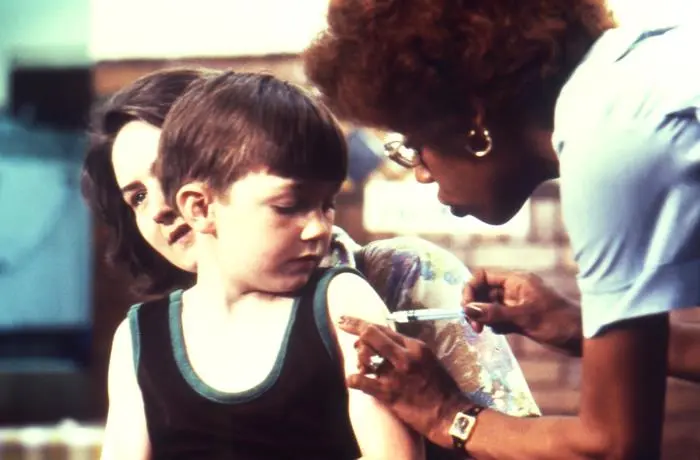
Before the MMR (measles, mumps, and rubella) vaccine, measles was so common that almost every child caught it. Many recovered but far too many suffered serious complications, long-term disability, or even death.
Thanks to widespread adoption of MMR vaccination, in 2000, measles was declared eliminated in the U.S. That didn’t mean measles had disappeared entirely – in fact, it remained common in many parts of the world. But it meant that measles hadn’t spread continuously in the U.S. for a full year.
For the next couple of decades, we rarely saw measles spread in this country. Outbreaks occasionally began when an unvaccinated person traveled abroad and brought measles home. Public health departments would then work quickly to identify and isolate cases. Because most people were vaccinated, measles usually ran out of people to infect before it could get very far. Think of it like a spark on a wet field: the chance of a fire is low.
But in recent years, vaccination rates have dropped in many communities, leaving more people vulnerable to infection. Measles cases have increased dramatically across the country, and outbreaks have become larger and harder to contain. People who haven’t traveled out of the country are catching measles in everyday places – schools, workplaces, churches, sporting events, and restaurants. Now that measles has spread uninterrupted for 12 months, we no longer meet the definition of elimination.
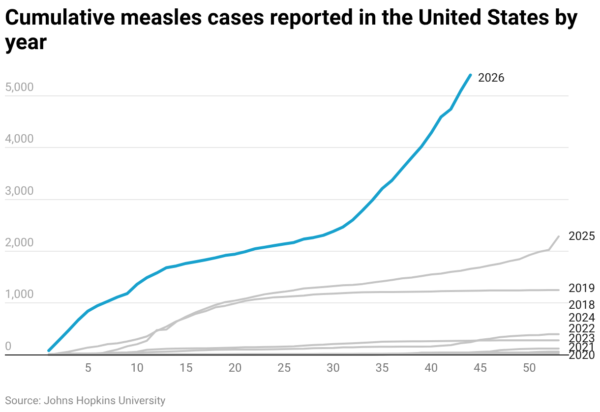 Now, in communities where vaccination rates are low, a measles case is like a spark on a dry field. Instead of burning out, it can ignite a fire quickly.
Why are people worried about the return of measles?
We might not be so concerned if measles was just a rash. But measles can lead to serious complications, like pneumonia, blindness, brain damage, and even death. It can also weaken your immune system’s memory, making it forget how to fight off infections you’ve already had or been vaccinated against.
We already know the solution
We’ve got a strong track record of preventing measles outbreaks, and we know how to keep our communities safe. When at least 95% of people in a community are vaccinated against measles, it’s very difficult for measles to spread. When you’re vaccinated, you also protect people who can’t be vaccinated or may not be fully protected by vaccination, like young infants, some pregnant people, and people who are immunocompromised. By getting vaccination rates back up to 95% or higher, we can achieve measles elimination again.
Time-tested
In the decades of time since its introduction, the measles, mumps, rubella (MMR) vaccine has been safely given to hundreds of millions of people. One dose of the MMR vaccine is 93% effective at preventing measles, and two doses are 97% effective. Like all medications, the MMR vaccine can have side effects, but these are usually mild and go away on their own. The small fraction of people who catch measles after vaccination generally have milder symptoms, recover faster, and are less likely to spread the virus to others.
Should I lose sleep over measles?
No! If you and the people you care about have evidence of immunity, you can breathe easy. You’re likely very well protected. Take this opportunity to locate your own and your family’s vaccination records and bring them to your doctor or local pharmacy.
And if you’re not yet vaccinated, the fix is simple: vaccination. Make an appointment with your doctor, visit a pharmacy (if you’re insured), or find a range of other options: Where to get vaccinated in King County.
More information
- How does measles spread and what are the symptoms?
- Who needs a measles vaccine?
- How can I access my vaccination records?
- Where can I find local information about measles cases and more?
Leer en español. Want more insights from Public Health – Seattle & King County? Subscribe to the Public Health Insider blog. Originally posted on November 17, 2026. Reposted with permission.