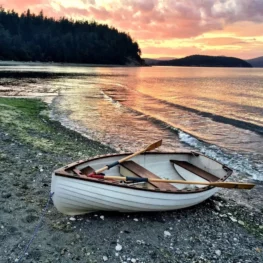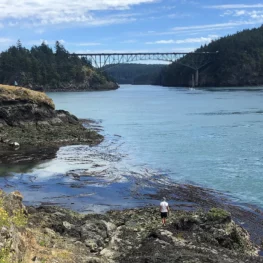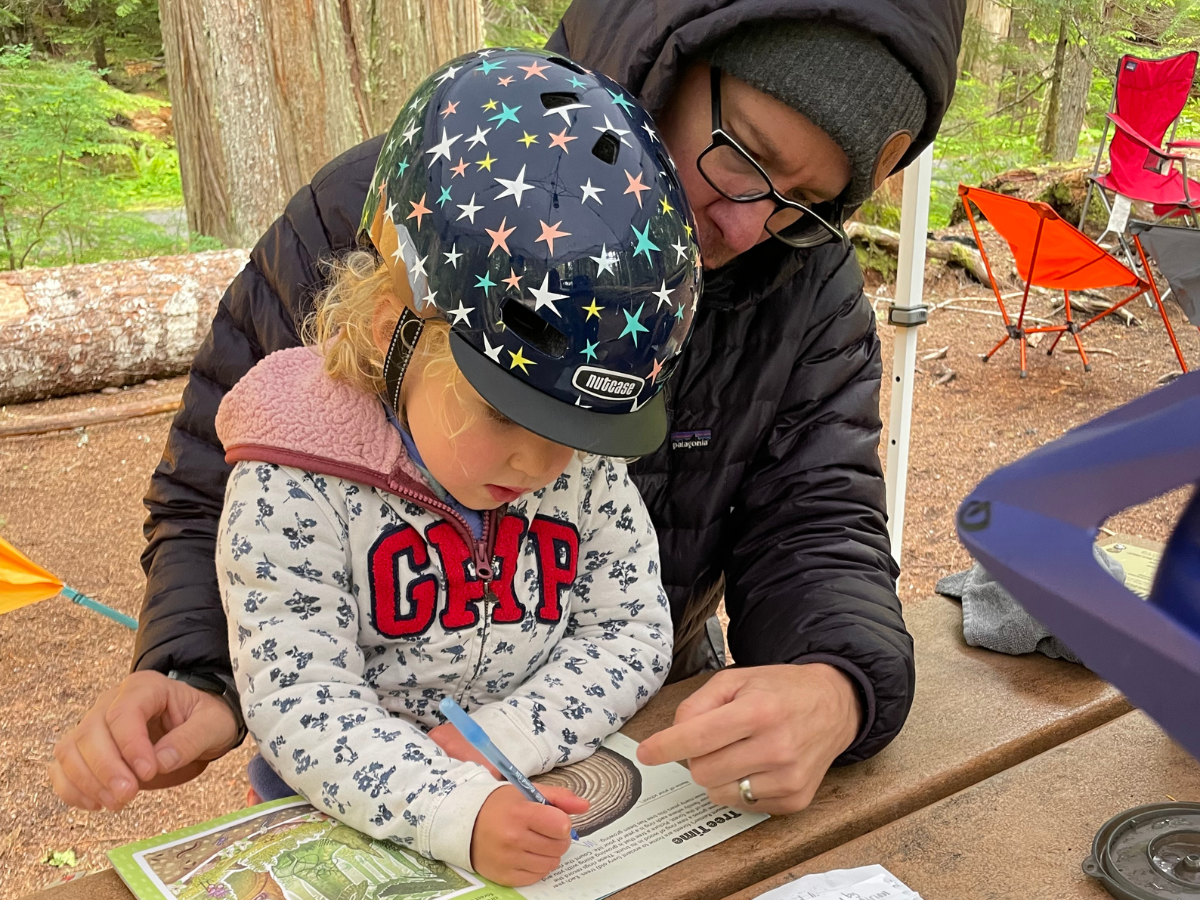
Camping is a favorite pastime of our family, and includes activities like scheduling trips and competitively booking campsites months in advance, planning meals and filling our cooler with ice packs and groceries, strategically packing our car, and finally, when our long-awaited summer comes, enjoying time exploring, hiking, learning, and putzing around our campsite.
Over the past few years, our family has added another activity to camping at or visiting a National Park Service (NPS) site: the Junior Ranger program.
When I learned about the NPS Junior Ranger program a few years ago, I fell in love — a program with activities for kids to learn about the outdoors, earn a badge, and become a Junior Ranger at different NPS sites? Sign us up!
To date, my two seven-year-olds have completed five Junior Ranger programs.
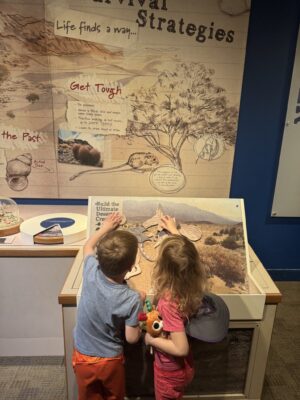
(Image: Ellie White / Seattle’s Child)
According to Caitlin Campbell, NPS Junior Ranger Program National Manager, the Junior Ranger program “seeks to ignite children’s curiosity and help them and their family build a personal connection to National Park Service sites, stories, and resources.” The program is a way for kids (and families!) to more deeply engage with NPS sites.
Kids who want to participate can pick up a Junior Ranger booklet at a visitor center or print it online (make sure to check with each NPS site before you visit to see if that site has a Junior Ranger program and where you can get the booklet). Campbell notes that there are 433 NPS sites around the country, and most have a Junior Ranger program.
Once they have their booklet, kids can complete activities at their own pace. In Junior Ranger programs we’ve participated in, the booklets include activities such as word searches, bingo, scavenger hunts, coloring, matching, singing, and more.
(Image: Ellie White / Seattle’s Child)
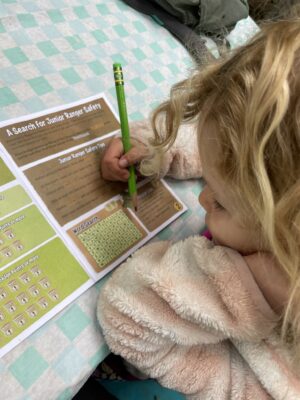
For example — in the Redwoods National and State Park booklet, our kids (then six years old) did a variety of activities, like fill-in-the-blank safety tips, identifying and recording different wildlife or signs of wildlife they saw around the park, matching animals to their habitat, determining how old a tree was by counting rings, coloring in their own basket design, and identifying parts of a California Condor’s body. We did most of the booklet at our campsite, though we also took the booklets along on hikes and outings in case we wanted to stop and work on them while we were out.
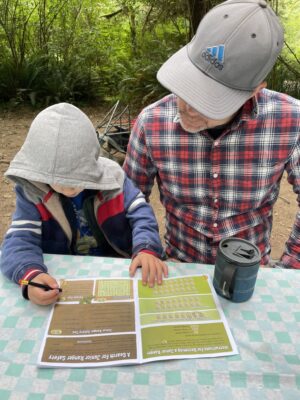
In our experience, our kids need a lot of guidance as they work through the activities in the various Junior Ranger programs we’ve completed, either because they couldn’t yet read, they didn’t understand certain concepts yet, or they needed reminders of what they needed to complete if they wanted to receive the badge. Campbell says the programs “are meant to help a family experience a national park together. Parents and guardians should be ready to participate alongside their child […] They’re meant to guide the whole family to explore a national park together.” The programs, Campbell explains, are generally designed for 6-13-year-olds, though anyone can participate in the program.
Campbell notes that “families should plan to devote at least one hour to complete a Junior Ranger activity booklet.” We found that most of the booklets took a few hours to complete, and we worked on them at different times throughout our camping trip (or back at home, as was the case for the Klondike Gold Rush Historical Park booklet). I imagine that as my kids get older, the faster and more independently they’ll complete tasks and activities in the booklets.
(Image: Ellie White / Seattle’s Child)
Different programs have different requirements for how much of the booklet must be completed to become a Junior Ranger. Campbell says that “participants do not have to complete the entire booklet but are encouraged to do as much as they can as best as they can,” and that if families need accessibility accommodations to participate in the program, they should contact the park before their visit.
Not a multi-day NPS site visitor? You can still participate in the Junior Ranger program on day trips, or at NPS sites that have the program but do not have campgrounds, such as the Klondike Gold Rush Museum in Seattle.
In Washington, we have over ten Junior Ranger programs at NPS sites, like Olympic National Park, North Cascades National Park, Mount Rainier National Park, Ebey’s Landing National Historical Reserve, Fort Vancouver National Historic Site, Klondike Gold Rush Historical Park, Lake Roosevelt National Recreation Area, and the Whitman Mission National Historic Site.
I think that I’m a bigger fan of the Junior Ranger program than my kids, as I have to remind them to work on the activities during our visits to NPS sites (though when I told my son this, he told me that he’s a bigger fan than me!) It’s such a great family experience, a nice break, and a quiet activity, especially during multi-day camping trips.
(Image: Ellie White / Seattle’s Child)
We’ve planned trips to Olympic and North Cascades National Parks for this summer, partly because we love visiting them, and partly because I want my kids to try the Junior Ranger programs at these sites. We may also check out Ebey’s Landing National Historical Reserve on a camping trip out to Whidbey Island. As a Washingtonian, I want to try to complete as many Junior Ranger programs as possible, as we enjoy and explore our beautiful and wonderful state!
More Ways to Plan Your Next Family Camping Trip
If the Junior Ranger program has you inspired to get outside more, we’ve got plenty of ideas to help you plan your next adventure:
- Guide to family-friendly hikes in the North Cascades | Explore one of Washington’s most stunning (and underrated) national parks with kid-approved trails.
- Guide to kid-friendly hikes at Mount Rainier National Park | From wildflower meadows to paved paths, these hikes make Rainier accessible for all ages.
- No reservation? No problem. Where to find a last-minute campsite | Because sometimes the best trips are the spontaneous ones.
- Camping across Washington: A family guide to the most scenic spots | From coastal campsites to mountain views, find your next favorite place to pitch a tent.